
Table of Contents
- Introduction: Just Think How Easy Our Lives Are Today
- The Chaos of Barter: 3 Major Problems of Ancient Trade
- Gold as the Saviour: How Its Properties Created Real Money
- The First Gold Coin Revolution: The Story of the Lydian Lion
- Conclusion: The Timeless Lessons from the History of Money
Introduction: Just Think How Easy Our Lives Are Today
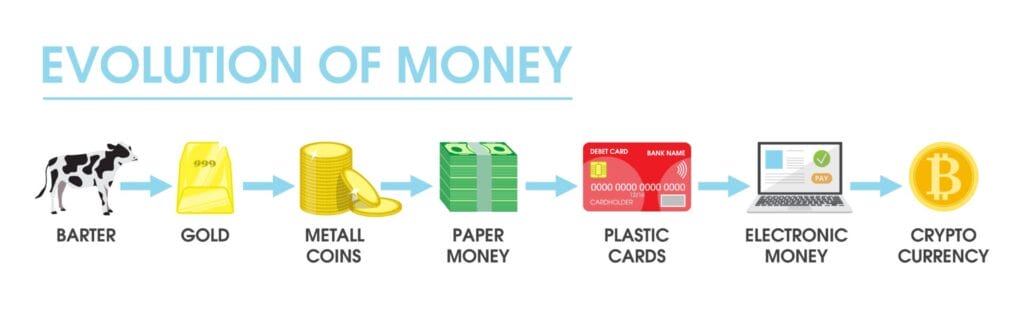
Have you ever stopped for a moment to consider just how remarkably easy it is to buy a cup of coffee in the morning? We simply tap a card, scan a QR code, or hand over a few colourful polymer notes. The entire transaction is over in seconds. But have you ever imagined what it was like for our ancestors thousands of years ago, in an age before the very concept of ‘money’ existed? Back then, trade was an incredibly complicated, frustrating, and often inefficient process. Without money, human civilisation depended entirely on the barter system—or, to put it simply, the direct exchange of goods.
While the idea of “I’ll give you a chicken for your shoes” might seem straightforward on the surface, the reality was fraught with problems that held back progress. This was the starting point for the history of money, an epic story of humanity’s relentless search for a better way to trade. From seashells to salt, various commodities were tried, but the most perfect answer was eventually found in a glittering, captivating yellow metal: gold. This article will take you on a journey back in time to understand the chaos of the old system and to appreciate how gold emerged as the saviour of the ancient world’s economy.
The Chaos of Barter: 3 Major Problems of Ancient Trade

Before we can truly appreciate the genius of gold as money, we must first understand how inefficient and troublesome the barter system really was. Imagine a world with no coins or banknotes. Your wealth is whatever you produce with your own hands. This system, while being the most basic form of trade, had several critical flaws that not only made daily life difficult but actively hindered economic growth, innovation, and the formation of more complex societies. Understanding these weaknesses is the key to appreciating the evolution in the history of money. Here are the three main problems our ancestors faced every single day.
1. The Problem of Matching Wants (You Have a Chicken, He Wants Shoes)
This was the single biggest and most frustrating problem in the barter system. It’s known in economics as the ‘double coincidence of wants’. For a trade to occur, you have to find someone who not only wants what you are offering, but who also has exactly what you want in return. Imagine you are a chicken farmer in desperate need of a new pair of shoes because your old ones are worn out. You take a healthy chicken to the local market. Your mission: find the shoemaker.
You might get lucky and find the shoemaker, but unfortunately, he just had chicken for dinner last night and has no interest in your offer. Instead, he tells you he needs a sack of wheat for his family. So, the deal fails. Now you have to embark on a second, unplanned mission: to find a wheat farmer in the market who happens to want a chicken. After a long search, you find one and successfully trade your chicken for a sack of wheat. You then have to go back to the shoemaker and hope he hasn’t already traded the shoes you wanted to someone else. This incredibly time-consuming and energy-draining process made the economy extremely inefficient and limited.
2. Goods Were Not Durable (Wealth Could Rot Away)
The second critical problem in the barter system was the storage of value. In a world without money, your wealth was measured in the physical goods you owned or produced. If you were a fisherman, your wealth was the fish you caught. If you were a farmer, your wealth was the vegetables or fruits you harvested. The problem? These items are not durable. Fish will go off in a few days, and vegetables will wilt. This meant that you could not store your wealth for the long term. You were forced to trade the fruits of your labour quickly before they spoiled and lost all their value.
This situation led to several profound negative effects on society. Firstly, it made it incredibly difficult to plan for the future. You couldn’t accumulate wealth for emergencies or for your old age. Every day was a struggle to ensure your work wasn’t wasted. Secondly, it discouraged specialisation. A farmer might not dare to grow perishable fruits on a large scale because the risk of loss was too high. The history of money is, in essence, the search for something that could store value effectively—something that wouldn’t rot or fade away, allowing people to preserve the results of their hard work with confidence.
3. Difficulty in Dividing into Smaller Units (A Cow for a Loaf of Bread?)
Imagine this scenario: you are a successful cattle rancher and own several healthy cows. Your wealth is clear. But one evening, you only need a single loaf of bread for dinner. You go to the local baker. How do you conduct an exchange using the barter system? Would you offer an entire cow for one loaf of bread? That would be absurd. Would you cut off a small part of the cow’s leg? Of course not, as this would kill the animal and drastically reduce its value. This is the ‘problem of indivisibility’.
This problem made small transactions involving large goods almost impossible to conduct fairly. It forced trade to be limited to items of roughly equal value. For example, a cow might be exchangeable for several goats, or a large quantity of wheat. But for small, everyday needs like buying salt, spices, or a pair of sandals, it became highly impractical. This was yet another major hurdle in the history of money that needed to be overcome. People needed something that could be easily divided into smaller units without losing its value, enabling transactions of all sizes, from the largest to the smallest.
Gold as the Saviour: How Its Properties Created Real Money
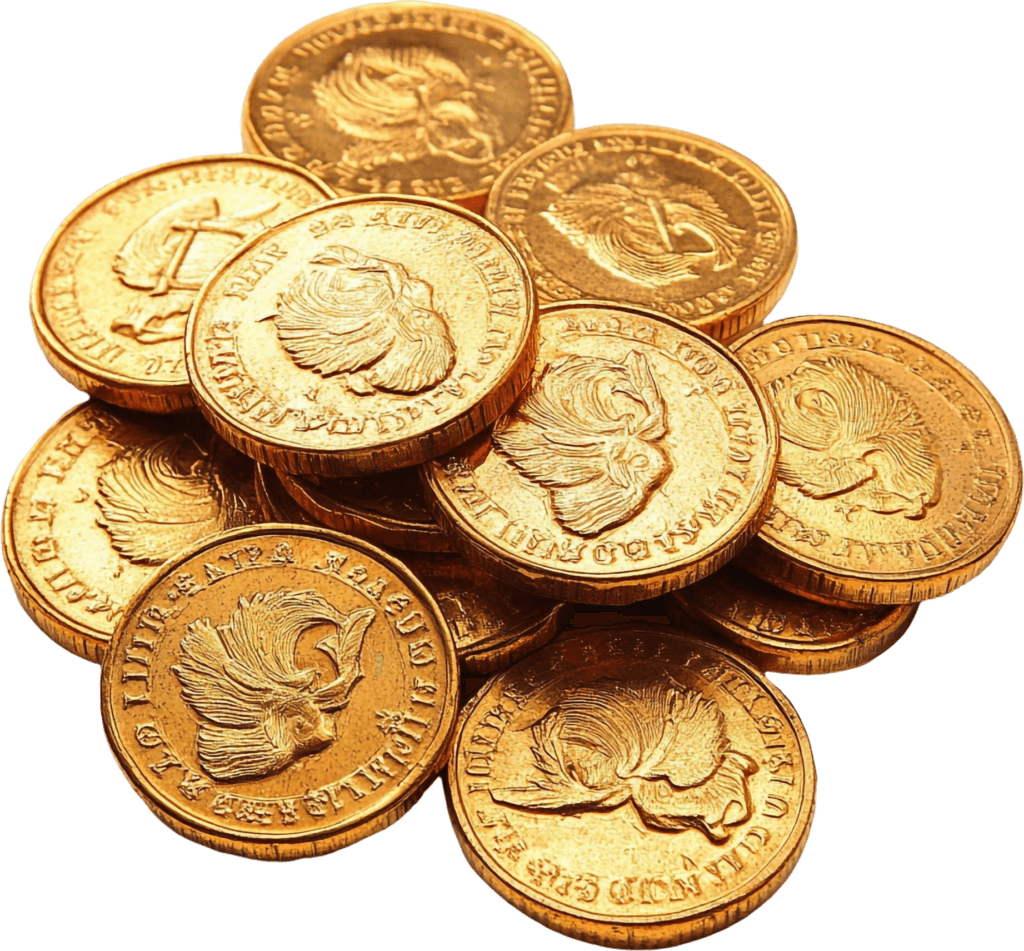
In the midst of the chaos and inefficiency of the barter system, people began to search for better alternatives. Various commodities were used as ‘intermediate money’ at different times, such as salt (from which the word ‘salary’ originates), seashells in some island communities, and even cocoa beans by the Aztec civilisation. However, all of them had their own weaknesses. Salt could dissolve, seashells could break, and cocoa beans could be eaten.
And then, an almost perfect solution emerged, one that was adopted by nearly every civilisation across the globe without being forced. That solution was gold. The unique properties of this precious metal naturally answered every problem that existed in the old system, giving birth to the concept of real money. This was the moment the history of money began to change course.
1. It Was Universally Accepted, Making Trade Easy
Unlike other commodities, almost everyone in every ancient civilisation intuitively recognised the value of gold. Its beautiful lustre, its untarnishing colour, and its rarity made it highly desirable. The benefit of this was that it quickly began to function as a universally accepted “medium of exchange,” overcoming the biggest problem of the barter system.
Let’s go back to the story of the chicken farmer. Now, he no longer needs to find a shoemaker who wants a chicken. He can sell his chicken to anyone—perhaps a passing soldier—for a small piece or some dust of gold. He can then use that piece of gold to buy bread, shoes, or whatever else he needs. The problem of matching wants was solved. Trade became fluid and fast.
2. It Is Eternal, Allowing Wealth to Be Stored and Inherited
One of the most magical properties of the yellow metal is its incredible durability. It does not rust, it does not rot, and it is impossible to destroy with natural elements like fire or water. The benefit of this is that it became the perfect “store of value,” a feature sorely lacking in the barter system.
The wealth stored in the form of gold today will still hold its physical integrity in 10, 100, or even 1,000 years. The fisherman could now sell his perishable catch for gold and save it without fear. It allowed people, for the first time in history, to confidently save the fruits of their labour, plan for the future, and pass wealth down to the next generation. This was a revolution in the history of money.
3. It is Easily Divisible and Portable, Making Transactions Practical
This precious metal is also incredibly practical in its physical form. It can be melted at a relatively low temperature and shaped into anything—coins, bars, or even fine dust. The benefit of this is that it can be divided into very small units to match the value of any item, from the cheapest to the most expensive. The ‘cow for a loaf of bread’ problem was now completely solved.
You could use a tiny pinch of gold dust to buy that bread fairly. Furthermore, its value density is extremely high. A large amount of wealth in the form of gold can be stored in a small pouch and carried easily, unlike lugging a cow or several sacks of grain to the market. These characteristics completed its function as perfect money.
The First Gold Coin Revolution: The Story of the Lydian Lion
The use of gold in the form of nuggets and dust had already solved many of the problems of the barter system. However, there was still one more evolutionary step needed to create a truly modern and efficient monetary system. Every time a transaction took place, merchants still had to carry a small set of scales to weigh the pieces of gold. More cumbersomely, they also had to test its purity to ensure it wasn’t mixed with cheaper metals. This process was still time-consuming and required expertise. The climax in the history of money occurred when this concept was standardised. It began in an ancient kingdom located in modern-day Turkey, known as Lydia.
1. Creating Standards and Trust in Trade
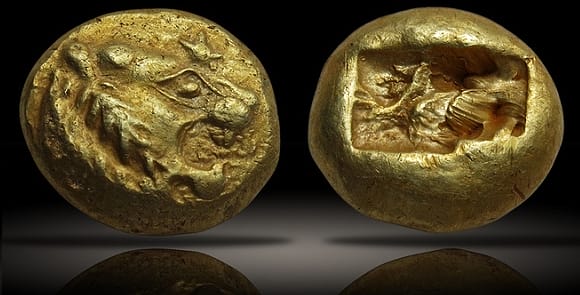
Around 2,600 years ago, King Alyattes of Lydia created an innovation that would change the world: the first coin. These coins, now known to historians as ‘Lydian Lions’, were made from electrum (a naturally occurring alloy of gold and silver) and were produced to a standard weight and purity. Most importantly, each coin was stamped with the image of a roaring lion’s head, which was the official royal symbol.
The benefit was immense and immediate. That stamp acted as a guarantee from the king that the coin contained the stated amount of precious metal. Merchants no longer needed to carry scales or touchstones. They simply had to count the coins. This built a vital new element into commerce: trust in the system. The process of buying and selling became dramatically faster and more efficient.
2. Accelerating Economic Growth and International Trade
With a standardised, trusted, and easy-to-use currency, trade in Lydia and the surrounding Mediterranean regions exploded. Merchants could conduct business with greater confidence and speed, across much larger distances. Markets grew larger and more integrated. The benefit was that this spurred economic growth, encouraged specialisation (as everyone could focus on their craft), and laid the foundation for the international trade systems we see today. The invention of the gold coin was not just a financial innovation; it was a catalyst for civilisation. The effects of this pivotal moment in the history of money are still felt today, as the concept of standardised currency we use is directly descended from this Lydian revolution.
Conclusion: The Timeless Lessons from the History of Money
The history of money is not just a dry story about paper notes or digital numbers on a screen. It is the story of human evolution in the search for the fairest, most efficient, and most reliable tool for trading with one another. The journey from the clumsy and frustrating barter system to the elegant and efficient system of gold coins is one of the greatest achievements in human history. It is a testament to the wisdom of our ancestors in identifying the unique properties of this precious metal and harnessing them to build better, more prosperous economies.
Understanding this journey gives us a profound appreciation for the true value of gold. It is not just another investment commodity; it is real money, tested by time. This history teaches us that honest and stable money should have intrinsic value, be difficult to produce, and be universally accepted. For thousands of years, gold has met all these criteria perfectly, making it the most honest form of money in the history of civilisation. And that lesson remains deeply relevant today, in a world where we are increasingly disconnected from the concept of real, tangible value.
✨ WANT TO START SAVING IN GOLD?
With just RM100, you can begin your gold savings journey with Public Gold.
This is the perfect opportunity to build a stronger and more secure financial future.