

Table of Contents
- Introduction: Why Gold is More Than Just an Asset for Muslims
- Recognised in the Qur’an as a Valuable Asset in This Life & the Hereafter
- The Currency of the Sunnah and the Foundation of a Just Economic System
- A Commodity That Comes with Responsibility: The Concept of Zakat
- A Symbol of Trust and Social Responsibility in Islam
- Conclusion: Understanding Gold as a Trust and a Protector of Wealth
Introduction: Why Gold is More Than Just an Asset for Muslims
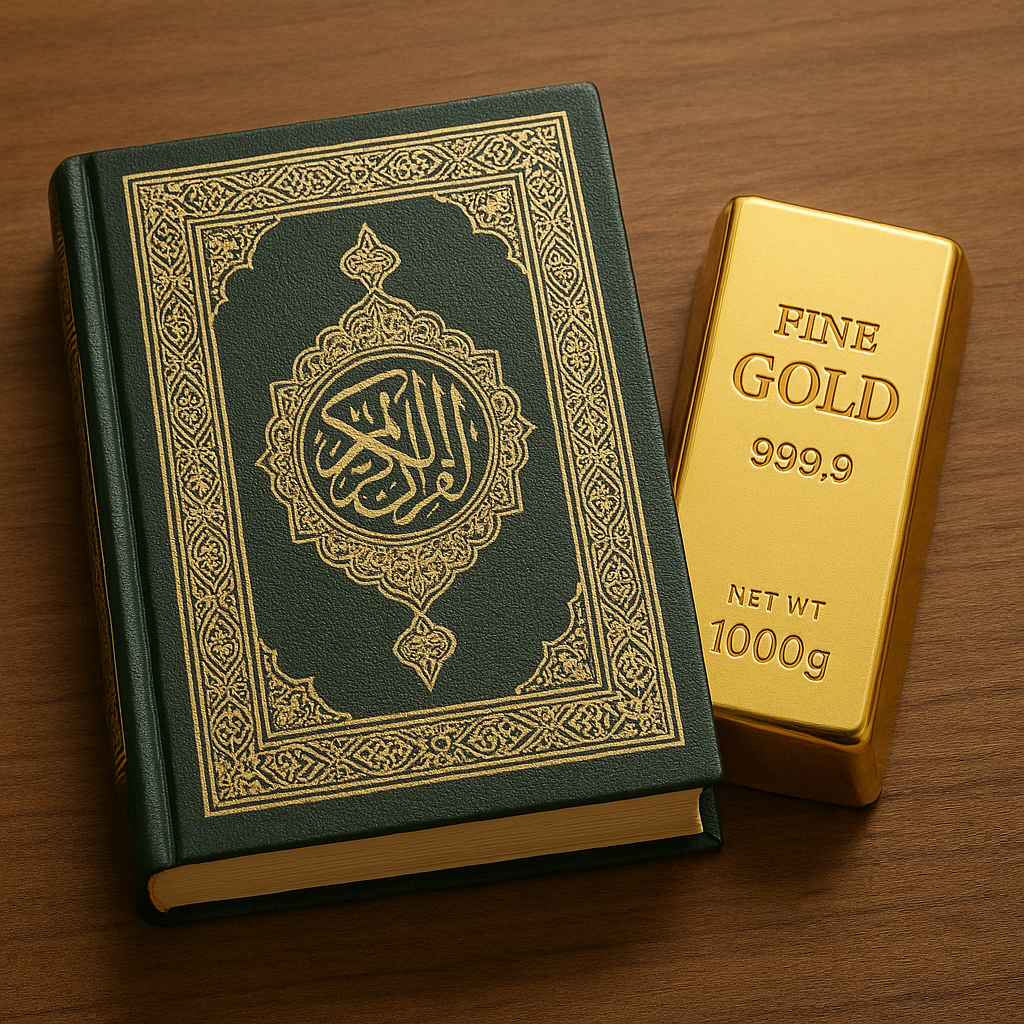
When we talk about gold, what typically comes to mind? For many, it conjures images of glittering jewellery, investment bars stored securely in a vault, or perhaps a commodity to be traded for short-term profit. For a Muslim, however, the perspective on this precious metal transcends all of that. The position of gold in Islam is profoundly special and unique. Its value is not merely measured by fluctuating market prices; it is affirmed and elevated by the highest sources of Islamic guidance—the Holy Qur’an and the Sunnah (the teachings and practices of the Prophet Muhammad, peace be upon him).
Understanding the Islamic perspective on gold opens our eyes to a new dimension of financial stewardship. It ceases to be a simple matter of profit and loss and becomes about preserving wealth in a manner that is wise, stable, and, most importantly, aligned with the principles of Sharia. In today’s uncertain world, where the value of paper currency is constantly exposed to the threat of inflation and complex financial systems, returning to the fundamentals taught by faith offers a unique sense of peace and security. In this discussion, we will explore the key reasons why gold holds such an esteemed position within the Islamic tradition.
1. Recognised in the Qur’an as a Valuable Asset in This Life & the Hereafter
The first and foremost factor that elevates the status of gold in Islam is its direct recognition in the Holy Qur’an. When something is mentioned by Allah (SWT) in His divine scripture, it automatically carries profound significance. This precious metal is no exception. It is mentioned not just as a transient worldly possession, but as a symbol of luxury and reward that extends beyond this life into the hereafter. This dual recognition—as a valuable asset on Earth and a reward in Paradise—gives its value an eternal conviction that time cannot erode. This is a fundamental reason why owning gold is viewed so positively.
It Aligns with Human Nature as Recognised by Allah (SWT)
Many might wonder: is the love for material assets like gold a negative or blameworthy trait? The Qur’an provides a very clear answer in Surah Ali ‘Imran, verse 14, where Allah (SWT) says (what means): “Beautified for people is the love of that which they desire—of women and sons, heaped-up sums of gold and silver, fine branded horses, and cattle and tilled land. That is the enjoyment of worldly life, but Allah has with Him the best return (Paradise).”
This verse is a crucial affirmation. It informs us that the natural human attraction to the beauty and value of gold is not inherently wrong or something to be denied. Rather, it is part of our *fitrah*—the innate disposition that Allah Himself has instilled within us. This means that the desire to own and save gold as a form of wealth is not sinful, as long as it does not distract us from our duties to Allah. The benefit for us today is that we can save in gold with confidence, knowing it is an asset that aligns with our natural instincts, rather than a form of luxury that is frowned upon by our faith.
It is a Reward and Adornment for the Inhabitants of Paradise
Even more powerfully than its recognition as a worldly asset, the Qur’an consistently mentions gold as one of the ultimate pleasures and rewards for believers in Jannah (Paradise). This is described in several chapters. For example, in Surah Al-Hajj, verse 23, Allah (SWT) says (what means): “Indeed, Allah will admit those who believe and do righteous deeds to gardens beneath which rivers flow. They will be adorned therein with bracelets of gold and pearls, and their garments therein will be of silk.”
This same imagery is repeated in Surah Al-Kahf (verse 31) and Surah Fatir (verse 33). When gold is designated as an adornment for the inhabitants of Paradise, it sends a profound message about its inherent value. It signals that this precious metal possesses a standard of quality and beauty so high that it is worthy of being part of the eternal reward. For those of us who hold this asset in the worldly life, this provides an unparalleled psychological and spiritual assurance. The value of gold will never become obsolete or irrelevant, because it is an asset cherished not only in this world but also in the timeless realm of the hereafter.
2. The Currency of the Sunnah and the Foundation of a Just Economic System
Beyond its mention in the Qur’an, this asset has a long and practical history in Islam as the foundation of a fair and stable financial system. This is not merely a theory; it was the standard practice during the lifetime of the Prophet Muhammad (peace be upon him) and his companions. The use of the gold Dinar and the silver Dirham is tangible proof of how an economy can function efficiently without relying on fiat currency (paper money), whose value can be easily manipulated. Understanding the history of gold as the currency of the Sunnah is vital to appreciating its role as an inflation-proof economic tool, free from the element of *riba* (interest).
The Gold Dinar: A Stable and Interest-Free Currency
During the era of the Prophet Muhammad (peace be upon him), major transactions were conducted using the Dinar (a gold coin) and the Dirham (a silver coin). Both of these currencies possessed intrinsic value. This means their worth lay in the precious metal itself, not merely in a government stamp or guarantee. A Dinar was valuable because it was made of gold. This stands in stark contrast to the paper money we use today, where the value of a RM 50 note exists only because it is declared legal tender by the government. Without that guarantee, it is just a piece of polymer.
The primary advantage of a system based on gold is its natural stability. A government cannot “print” more of this metal at will, unlike how it can print paper money. This prevents rampant inflation from occurring. When the money supply is finite and stable, the value of that money is preserved. More importantly, this system makes it difficult for interest-based lending—where money is created from debt—to flourish. For us today, saving a portion of our wealth in physical gold is a way to return to the original, stable principles of wealth preservation and to protect ourselves from the volatility of the modern financial system.
Its Purchasing Power Has Been Proven for 1,400 Years
Perhaps the most practical and astonishing proof of the power of gold as a store of value comes from a famous hadith (prophetic tradition). It is narrated that the Prophet Muhammad (peace be upon him) once gave his companion, Urwah Al-Bariqi, one Dinar to buy a sacrificial sheep. On his way, Urwah skilfully used the Dinar to purchase two sheep. He then sold one of the sheep for one Dinar and returned to the Prophet with one sheep and the original Dinar. The Prophet then prayed for blessings in his business dealings.
The key takeaway from this story is this: one Dinar at that time could purchase a sheep. The standard weight of a gold Dinar is 4.25 grams. To this day, over 1,400 years later, the value of 4.25 grams of gold can still purchase a sheep in many parts of the world. This is not just an economic theory; it is tangible, practical proof from the Sunnah that this metal is the perfect store of value. It is the ultimate protector of wealth against the erosion of inflation. The purchasing power of our paper money may decline every year, but the purchasing power of this precious metal has remained remarkably constant.
3. A Commodity That Comes with Responsibility: The Concept of Zakat
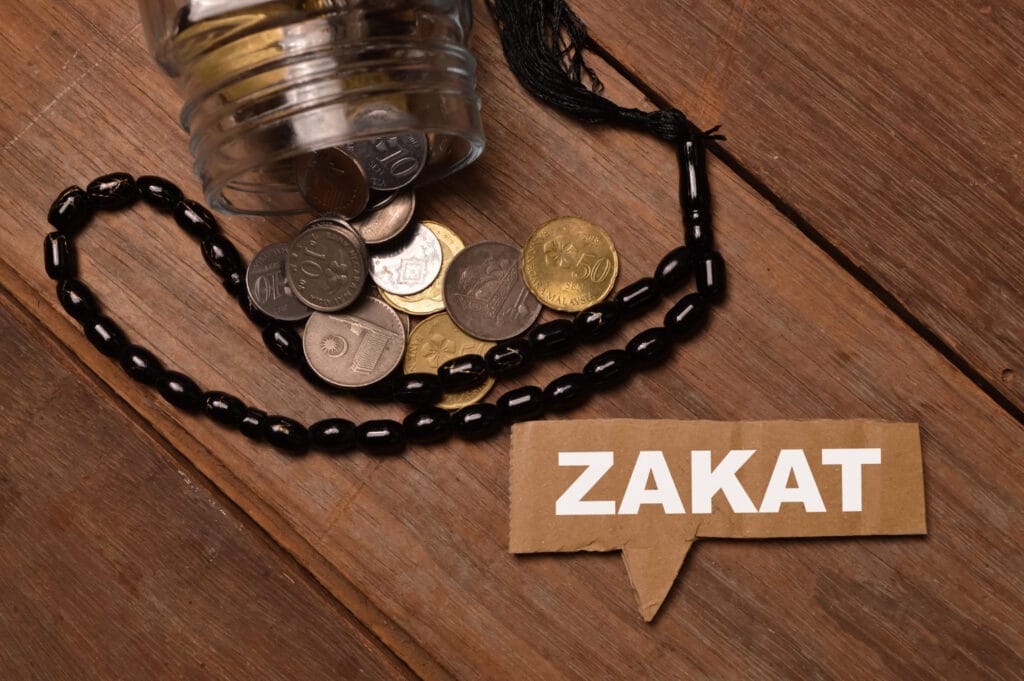
The esteemed position of this metal in Islam does not end with its value as a worldly and heavenly asset, or its function as a just form of money. Islam adds another profound layer of meaning to its ownership: responsibility. The obligation to pay Zakat (obligatory charity) on savings of gold further confirms its status as a form of wealth recognised by Sharia, which must be managed correctly. The concept of Zakat transforms the ownership of gold from a mere act of hoarding wealth into an act of worship, connecting the owner to Allah (SWT) and to the wider community.
Zakat Confirms It as a Legitimate Form of Wealth
In Islamic jurisprudence, Zakat is not obligatory on all types of possessions. For instance, we do not pay Zakat on the house we live in, the car we drive, or the furniture we use. Zakat is only mandated on specific categories of assets that are considered productive, capable of growth, and have a standard, recognised value. The fact that there are very specific and clear rules for Zakat on gold and silver is an undeniable confirmation that the Sharia recognises them as legitimate and significant forms of wealth.
The conditions for Zakat on gold are met when the amount of savings (in the form of bars, coins, or unworn jewellery) reaches the *nisab* (minimum threshold) of 85 grams and has been held for one full lunar year (*hawl*). Once both conditions are met, the owner is obliged to pay 2.5% of the total amount as Zakat. The benefit of this for us as savers is that it provides complete peace of mind. Our act of saving in this commodity is an act in harmony with Islamic principles of wealth management, because it is a category of asset explicitly recognised by the Zakat system itself.
Zakat Purifies and Blesses Your Holdings
Zakat is not merely a duty or a “tax” in Islam. Linguistically, the word ‘Zakat’ carries the meaning of ‘purification’ and ‘growth’. This is the philosophy behind it. When you pay Zakat on your savings, you are not only fulfilling the third pillar of Islam, but you are also purifying the remaining 97.5% of your wealth that stays with you. It cleanses your assets from any right that others (the poor and needy) may have in it, rendering your holdings pure in the sight of Allah (SWT).
In addition to purification, Zakat is promised to make one’s wealth grow and to bring blessings (*barakah*). This may seem counter-intuitive to mathematical logic (as the amount decreases), but it is the promise of Allah. The benefit is that your ownership of this precious metal becomes more than just a worldly investment; it becomes part of a spiritual practice that yields rewards in the hereafter. By fulfilling Zakat, you transform your savings into a cycle of good that not only protects your wealth but also helps those in need and earns the pleasure of your Creator.
4. A Symbol of Trust and Social Responsibility in Islam
The Islamic perspective on this commodity is not limited to theological and economic aspects alone. It also encompasses a profound dimension of social and personal responsibility. The yellow metal often serves as a symbol of trust (*amanah*) in various important matters, from its use as a dowry (*Mahr*) in marriage to the specific regulations regarding men wearing it. This demonstrates that Islam manages human interaction with this valuable asset holistically, ensuring it brings good not only to the individual but to the fabric of society as a whole. It is treated not merely as property, but as a trust to be handled within prescribed boundaries.
The Mahr: A Valuable Gift to Signify a Strong Beginning
In Islam, the *Mahr* is an obligatory gift from the husband to the wife at the time of the marriage contract. It is not a price for the bride, but a sincere gift that symbolises the love, responsibility, and commitment of the man. The Sunnah encourages giving a Mahr in the form of a valuable and durable asset, with the gold Dinar being a primary choice since ancient times.
Giving the Mahr in the form of a solid physical asset like this has immense wisdom. It provides the wife with a tangible form of financial security, which she can use in case of any future hardship. It marks a just and honourable beginning to the marital union, dignifying the woman from the very outset.
The Prohibition for Men: A Test of Obedience and Humility
Another unique aspect of this metal in Islam is the prohibition for men to wear it as jewellery. The Prophet Muhammad (peace be upon him) said in a hadith narrated by Abu Dawood: “Gold and silk have been permitted for the women of my nation and forbidden for its men.” This prohibition is not intended to devalue the asset itself; rather, it is a test of obedience and a means of cultivating the soul.
The wisdom behind it is to prevent men from falling into extravagance, arrogance, and resembling women. It preserves the masculine nature, which should be defined by leadership and inner strength, not external adornment. However, it is crucial to understand that this prohibition applies only to wearing it as decoration. Men are still permitted to own, save, invest, and transact with gold.
Conclusion: Understanding Gold as a Trust and a Protector of Wealth
So, why is this asset so special in Islam? After examining the evidence from the Qur’an and the Sunnah, the answer becomes remarkably clear. It is not just an ordinary precious metal. It is the only physical asset whose value is directly endorsed by revelation as an adornment of this world and a reward in Paradise. It is the only asset with a 1,400-year track record, proven in the Sunnah, as a perfect store of value. It is an asset recognised as a legitimate form of wealth through the system of Zakat, and it carries deep symbolism in social matters like marriage.
Understanding this Islamic perspective ought to change how we view our savings. It allows us to preserve wealth in a way that is not only financially prudent—protecting us from inflation and economic uncertainty—but is also pleasing to our Creator and aligned with the teachings of our faith. Instead of seeing it as just a glittering metal, we can begin to see the ownership of gold as a means of upholding the trust (*amanah*) of the wealth bestowed upon us by Allah, using a method that has proven to be the most stable, just, and blessed throughout history.
✨ WANT TO START SAVING IN GOLD?
With just RM100, you can begin your gold savings journey with Public Gold.
This is the perfect opportunity to build a stronger and more secure financial future.