

If we look at the 13 June 2026 market session, gold did manage to stop falling as badly as before. But that still was not enough to say the market had fully recovered. The better way to read this session is that gold was trying to steady itself again, while the market was still cautious about US interest rate expectations and a firmer US dollar. For Malaysian gold savers, that matters because world spot gold looked almost flat, but local physical gold pricing could still move differently.
- Introduction
- What Happened To Gold On 13 June 2026?
- What Is The Gold Chart Showing?
- Why Did Gold Move This Way?
- What Does This Mean For Malaysian Gold Savers?
- What Practical Action Makes More Sense?
- Conclusion
What Happened To Gold On 13 June 2026?
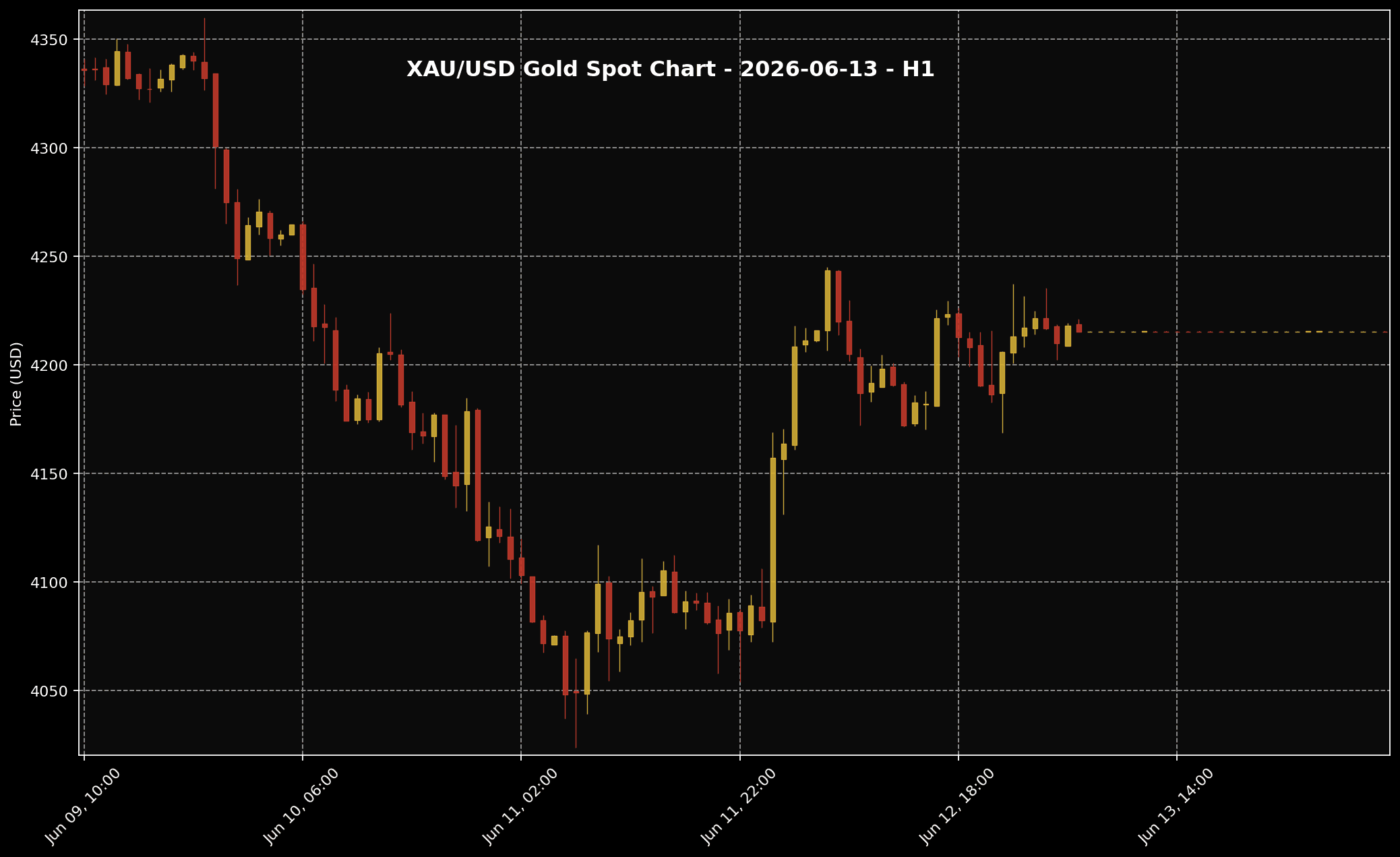 This chart shows the XAU/USD movement for the 13 June 2026 market session. Sifu Gold uses it as a visual reference, not a cue to buy emotionally.
1. On the 13 June 2026 market date, gold did not actually make a very big move compared with the previous session. Based on the main snapshot from the Daily Gold Data Pack, XAU/USD closed at around USD 4,215.36 per troy ounce. Using a USD/MYR reference of around 4.05798, that works out to roughly RM 17,105.86 per troy ounce.
2. Broken down into grams, world spot gold was around USD 135.53 per gram, or about RM 549.97 per gram. That was only slightly higher than the 12 June 2026 market reference. The increase was just around USD 2.29 per troy ounce, or about 0.05%. So this was not a fresh breakout session. It was more a case of gold trying to hold itself together after the heavier drop that came earlier.
3. The important point here is simple: this global spot price is not the same as Malaysia’s local physical gold price. So if readers see world gold moving only a little, they should not assume local gold pricing must move in exactly the same way or by the same amount.
What Is The Gold Chart Showing?
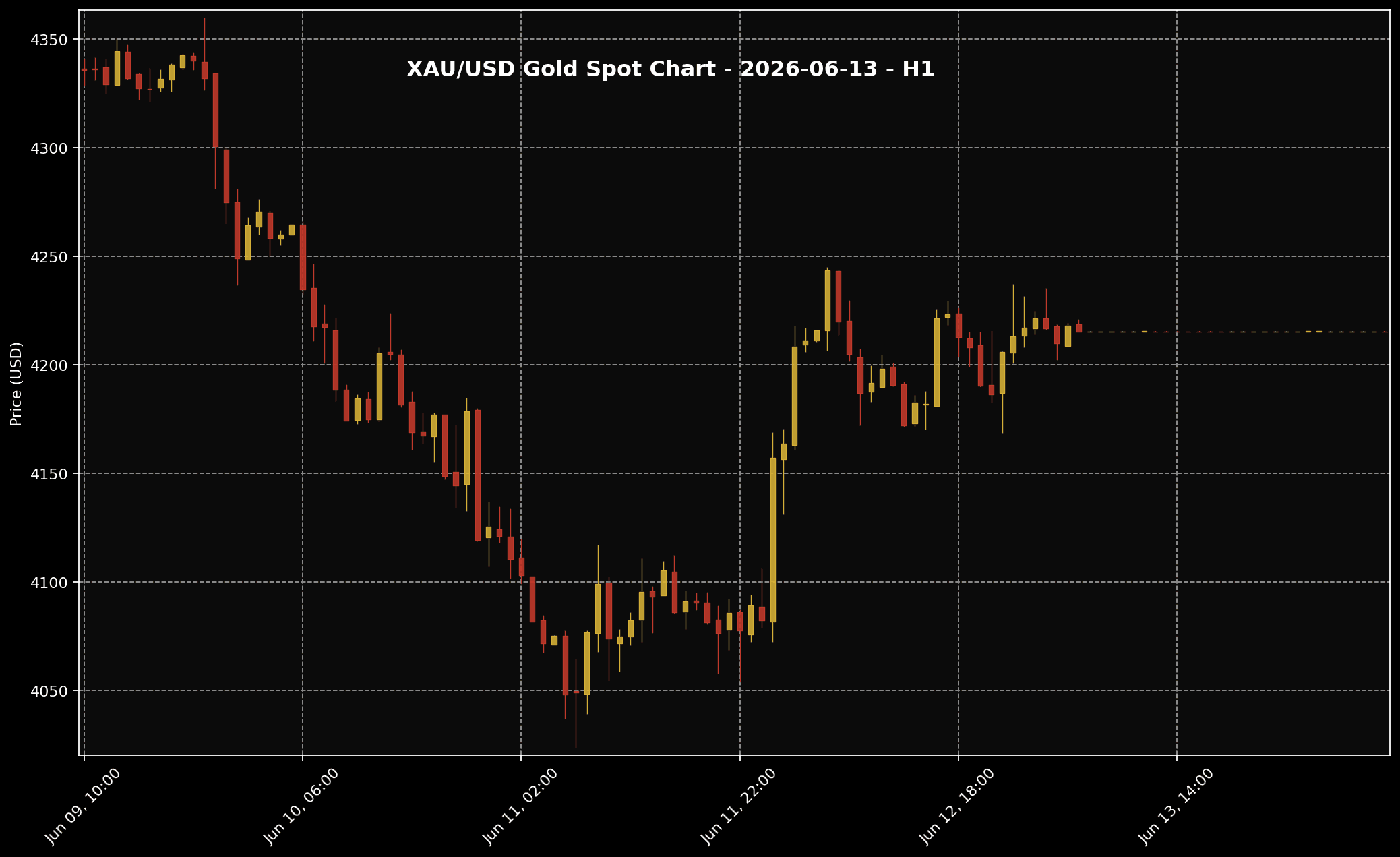 This chart helps readers see the gold price structure for the 13 June 2026 market session. It is used as market context, not as a trading signal.
1. If we read the XAU/USD H1 chart for 13 June 2026, the picture is fairly clear. Before this session, gold had already gone through a deep drop. Price fell from around the USD 4,340 to USD 4,345 area, then reached the lower USD 4,040 to USD 4,050 zone. So the background coming into this session was still one of heavy pressure.
2. After that selloff, gold did stage a fairly sharp rebound. Price climbed back into the USD 4,200 zone and briefly tested the area around USD 4,240 to USD 4,245. But in the later part of the chart, the move started to look more choppy and range-bound rather than strongly upward. The clearest short-term stabilisation band on the chart looked to be around USD 4,185 to USD 4,225.
3. The last visible price on the chart sat around USD 4,215. That puts gold in the middle-to-upper part of that recent range, but still below the stronger rebound peak seen earlier. In plain English, the sharp fall had eased and the rebound had already happened, but the structure still did not look fully repaired. This is not a buy or sell signal. It is simply a chart reading to help readers understand what kind of market gold was sitting in.
Why Did Gold Move This Way?
 The US dollar is often one of the key factors influencing gold prices. When the dollar is firmer, gold can face more noticeable pressure.
1. The clearest reason for this kind of session is that the market was still cautious about US interest rate expectations. When the market feels the Federal Reserve may not be in a hurry to loosen policy, the US dollar often stays firmer. And when the dollar stays firm, gold usually finds it harder to extend its rise because gold is priced in US dollars.
2. On top of that, market confidence still did not look fully rebuilt. Gold was trying to recover from the earlier drop, but the recovery kept running into resistance. So instead of a session with clear new momentum, what we got was a session that looked more like stabilisation. Reuters and Kitco, at headline level, pointed in the same direction: gold lost some momentum as the market refocused on Fed expectations and dollar strength.
3. So the chain is quite straightforward. Gold fell first, then it tried to rebound, but a firmer dollar and the shadow of higher-for-longer rates stopped the market from pushing gold much further upward. That is why the 13 June session makes more sense as a holding-and-resetting session, not a full recovery session.
What Does This Mean For Malaysian Gold Savers?
 For Malaysian gold savers, the key point is not only whether prices rise or fall. What matters more is budget, discipline and a clear purpose.
1. For Malaysian gold savers, the key is not just whether XAU/USD went up or down. We also need to look at currency impact and the way local pricing is formed. On 13 June 2026, world spot gold was around RM 549.97 per gram. But the Public Gold GAP 24K reference for the same day was RM 598 per gram, compared with RM 594 per gram on 12 June 2026.
2. That means even though the global gold session only changed slightly, the local reference still rose by RM 4 per gram from the previous day. That is normal. Local physical gold pricing is not a direct copy of the world spot price. It can be affected by USD/MYR, physical product premiums, buy-sell spread, and the way local prices are set.
3. So if someone looks at world gold moving almost sideways and then assumes local pricing should also stay unchanged, that is not always accurate. For Malaysian savers, the important lesson is that the gap between world spot and local physical pricing is real. That is why the decision to buy now or wait a bit should never be based on just one global number alone.
What Practical Action Makes More Sense?
 When gold prices move quickly, better decisions usually come from disciplined planning, not panic reactions.
1. In my view, a session like this is better treated as a reminder to stay disciplined. Gold was no longer falling as badly as before, but the market still had not shown a fully convincing recovery. So if you already have a monthly gold-saving plan, a gradual buying approach still makes sense.
2. If this month’s budget is comfortable, you can continue buying in stages based on what you can afford. If your budget is tight, there is no need to force it. There is also no need to chase the price just because gold has stopped falling for a while. More importantly, do not commit the full budget at once simply because price looks a bit more stable. Better decisions usually come from following a plan, not from reacting to a chart emotionally.
3. For readers who are just getting started, this session is also a good reminder of one basic lesson: a market that stops falling is not automatically a market that has turned strong again. So the main focus still stays the same. Protect your cash flow, protect your emergency fund, and build your gold saving step by step if gold is genuinely part of your long-term plan.
Conclusion
If we step back and look at the full picture, 13 June 2026 was not a day when gold made a major fresh surge. It was more a day when gold tried to recover after the earlier drop, but still did not look strong enough to say momentum had clearly returned. The firmer US dollar and the market’s concern over rate expectations were still acting as a ceiling on that recovery. For Malaysian gold savers, the takeaway is clear. Do not look at world spot alone. Watch the USD/MYR effect, understand the difference between local and global pricing, and check your own budget properly. If you are saving gold for the long term, make decisions in a more structured way. Buy gradually if it suits your plan, hold back for now if your budget is tight, and avoid rushed decisions. If you want to start with a smaller step, Public Gold GAP can be one way to begin saving gold gradually from RM100. The important thing is not to rush, but to make sure the step fits your own budget and has a clear purpose behind it.