

Gold came under clear pressure on 18 June 2026. This was not just a small dip. The bigger story was that the market still leaned towards a hawkish Federal Reserve, the US dollar turned firmer again, US bond yields stayed high, and safe-haven urgency eased a little. So if you saw gold falling and immediately thought it looked cheaper, it is worth looking at the full picture first. Once you see what really pushed the move, it becomes much easier to decide what makes sense for your own gold-saving plan.
- Introduction
- What Happened To Gold On 18 June 2026?
- What Is The Gold Chart Showing?
- Why Did Gold Move This Way?
- What Does This Mean For Malaysian Gold Savers?
- What Practical Action Makes More Sense?
- Conclusion
What Happened To Gold On 18 June 2026?
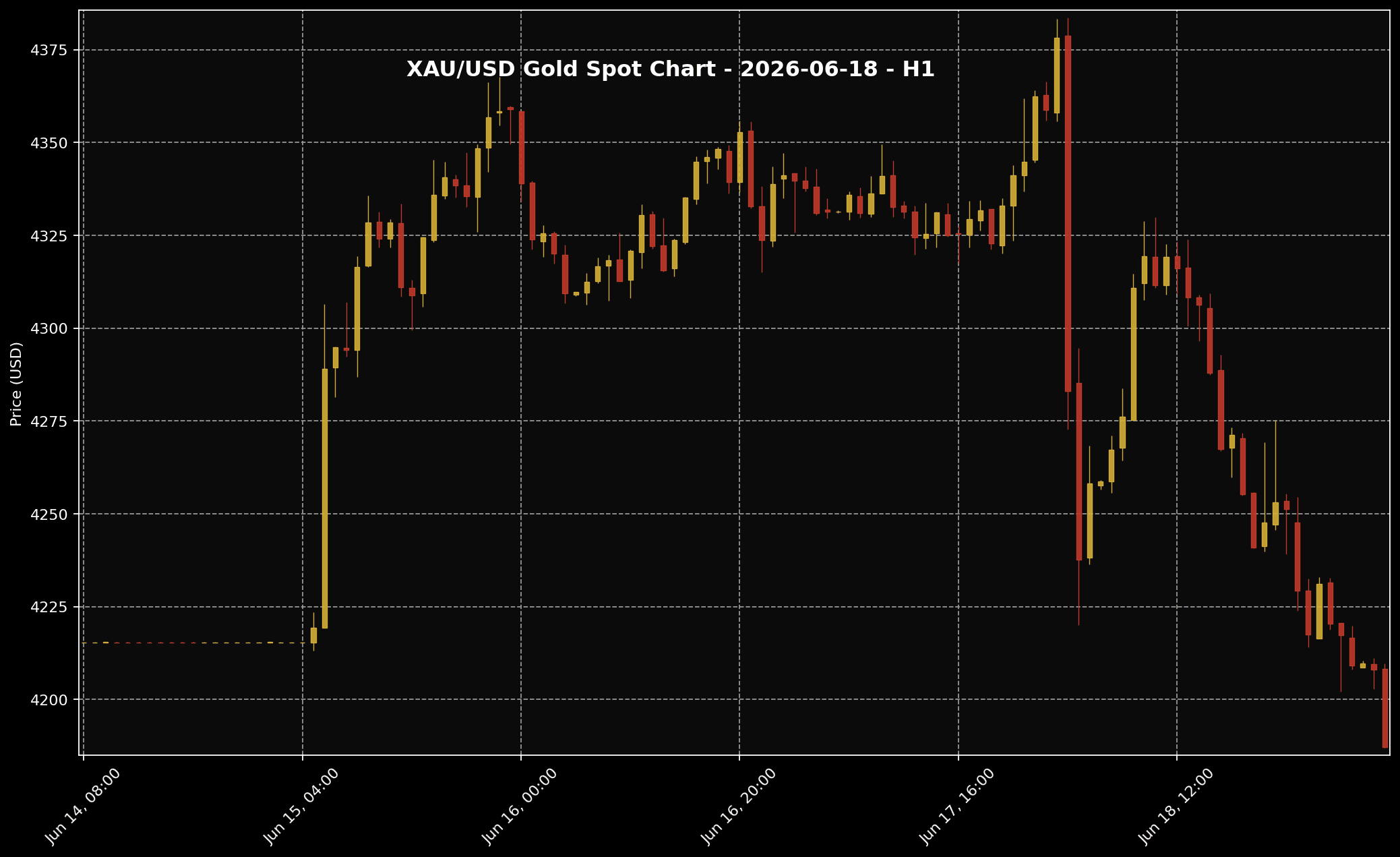 This chart shows the XAU/USD movement for the 18 June 2026 market session. Sifu Gold uses it as a visual reference, not a cue to buy emotionally.
1. During the 18 June 2026 session, gold was around USD 4,235.91 per troy ounce based on the main snapshot taken at 11:00 PM Malaysia time. Using USD/MYR at around 4.11808, that put the world gold price at roughly RM 17,443.81 per troy ounce, or about RM 560.83 per gram.
2. If we compare that with 17 June 2026, the drop was quite obvious. XAU/USD fell from around USD 4,355.31 to USD 4,235.91. That was down about USD 119.41 per ounce, or roughly 2.74%. In Ringgit terms for the global spot price, the reading also slipped from about RM 569.39 per gram to RM 560.83 per gram.
3. The important part here is this: gold fell even though USD/MYR also moved higher. Usually, when the US dollar strengthens against the Ringgit, the local impact of a global gold drop can feel a bit softer. But this time, the fall in gold itself was big enough that the weakness in the Ringgit could only cushion it slightly. In simple terms, 18 June 2026 was not a quiet sideways session. Gold was clearly under pressure, and the move was tied to a broader macro story rather than a random one-day wobble.
What Is The Gold Chart Showing?
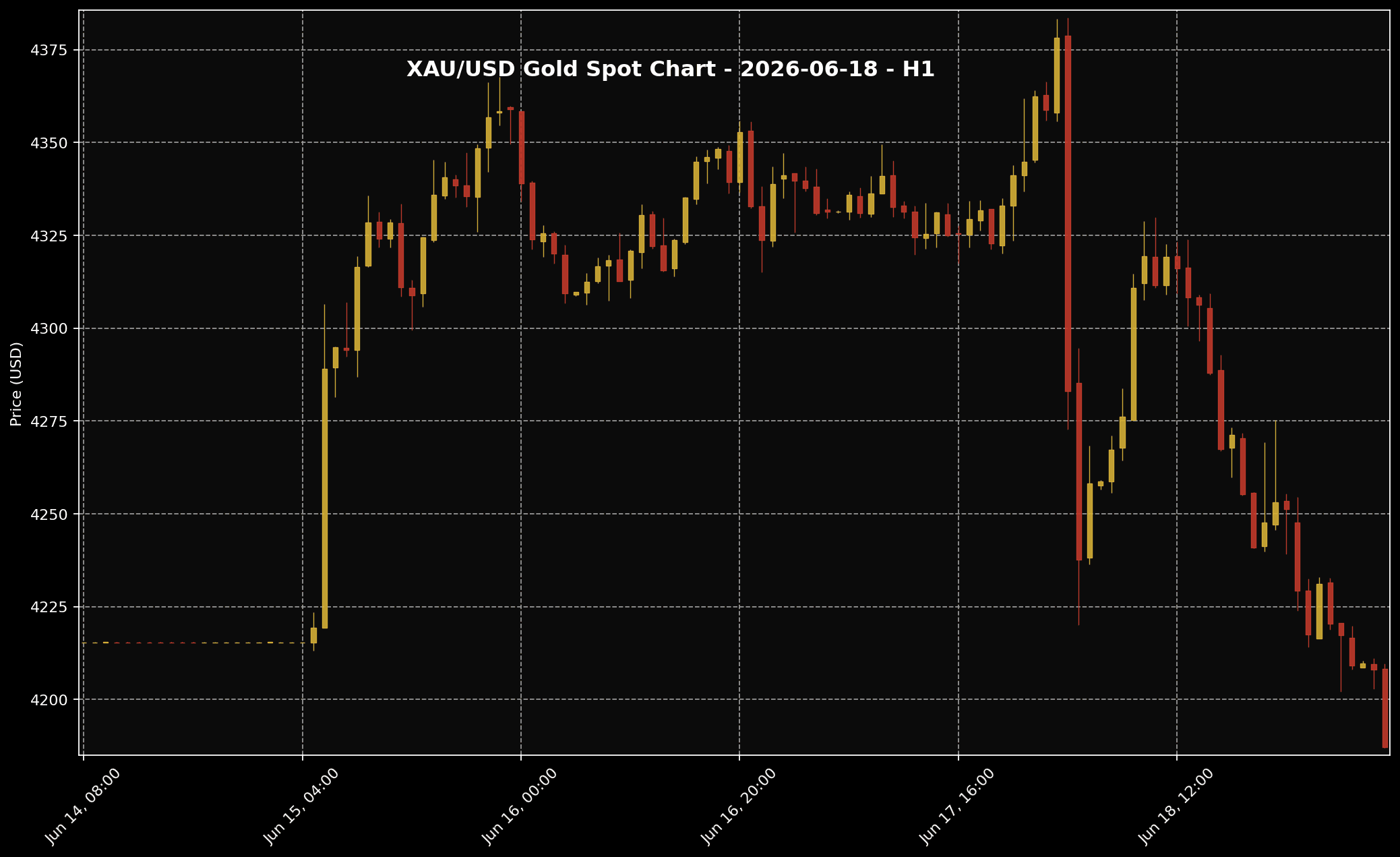 This chart helps readers see the gold price structure for the 18 June 2026 market session. It is used as market context, not as a trading signal.
1. If we look at the H1 chart for 18 June 2026, the market structure was quite clear. Gold opened higher at around USD 4,362.83 and even pushed up to the day’s high near USD 4,383.62 early in the session. But after that, sellers took control and the price dropped quickly.
2. The day’s low came in around USD 4,220.02. After reaching that area, gold did try to steady itself and bounce a little. Still, that recovery only went so far. Price never got back near the opening zone, let alone retake the earlier high. By the final H1 close, gold was still around USD 4,235.91, which was well below the day’s open.
3. For me, the safest way to read this chart is that the market still looked weak. This was not a normal sideways session, and it also did not look strong enough to call a convincing recovery. A more accurate reading is that gold sold off hard first, then tried to stabilise, but there was still not enough evidence to say bullish momentum had properly taken over again. This is not a buy or sell signal. It is simply a market structure reading to help readers see the condition of gold more clearly.
Why Did Gold Move This Way?
 The US dollar is often one of the key factors influencing gold prices. When the dollar is firmer, gold can face more noticeable pressure.
1. The main pressure came from the market still reading the Federal Reserve as hawkish. In plain English, investors still felt US interest rates could stay higher for longer. When that is the mood, gold usually struggles to get strong support because gold does not pay interest the way bonds or cash instruments do.
2. That pressure became more direct when the US dollar strengthened and US Treasury yields stayed high. These two factors often weigh on gold together. A firmer dollar makes gold more expensive for buyers using other currencies. Higher yields also raise the opportunity cost of holding gold, because some investors start comparing it with assets that offer regular returns.
3. US economic data did not give gold much breathing room either. Weekly jobless claims came in close to expectations, so the market did not read that as a sign that the US economy was weakening quickly. On top of that, the Philly Fed manufacturing reading improved more than expected. That did not suddenly turn the whole outlook bullish, but it was enough to stop the market from rushing into softer rate expectations. There was one more layer to the story. Safe-haven urgency eased slightly as US-Iran de-escalation reduced some of the market’s geopolitical anxiety. So the full picture was quite straightforward: a hawkish Fed set the tone, the stronger dollar and high yields became the main pressure channels, US data did not help gold much, and safe-haven support was a bit less urgent than before.
What Does This Mean For Malaysian Gold Savers?
 For Malaysian gold savers, the key point is not only whether prices rise or fall. What matters more is budget, discipline and a clear purpose.
1. For Malaysian gold savers, one thing matters a lot here: the global spot price is not the same thing as the local physical gold price. Many people see XAU/USD falling and assume local physical gold must drop by the same amount. In reality, it does not work that neatly.
2. On 18 June 2026, the GAP 24K reference price also moved lower, from around RM 621 per gram on 17 June to RM 612 per gram on 18 June. So yes, there was a local effect that matched the global gold decline. But the local move is still shaped by other factors too, including USD/MYR, product premiums, buy-sell spreads, and the pricing structure of physical gold itself.
3. That is why, if someone is watching the price of 1 gram or saving monthly through a programme such as RM100 bit by bit, the most useful question is not just whether gold went up or down. A better question is whether the move came mainly from global gold, from the currency side, or from both at once. In this case, the main pressure clearly came from the global gold market. The weaker Ringgit only softened the local impact a little. So for Malaysian savers, the more sensible reading is this: the global market was under pressure, but any decision on physical gold still needs to be based on the actual local price you will pay, not on the world chart alone.
What Practical Action Makes More Sense?
 When gold prices move quickly, better decisions usually come from disciplined planning, not panic reactions.
1. My view is simple: do not let one down day push you into an emotional decision. When gold drops quite quickly, two reactions usually show up. One is fear because the price looks weak. The other is excitement because it suddenly feels like a bargain. Both reactions can lead to messy decisions if they are not tied back to budget and purpose.
2. If you already have a monthly allocation for gold saving, then buying gradually still makes more sense. That approach helps you avoid depending too much on one specific day. If this month’s budget feels tight, there is no need to force it. Protecting cash flow, emergency savings and your regular commitments still comes first.
3. If you prefer to wait until things look clearer, that is also a reasonable approach. With gold still dealing with a firmer US dollar and high yields, watching the real local price first may be the more organised move. What matters is that you do not go in heavily all at once just because the market has fallen. A simple way to think about it is this: if your goal is long-term gold saving, then discipline and affordability matter more than chasing a one-day price reaction. If the budget is comfortable, you can continue little by little. If the setup still feels unclear or your finances are stretched, it is perfectly fine to hold back and review again later.
Conclusion
On 18 June 2026, gold fell clearly because the market still favoured the hawkish Fed story, a firmer US dollar, high bond yields and slightly lower safe-haven urgency. The chart also showed that selling pressure remained dominant even though there was an attempt to stabilise after the day’s low. For Malaysian gold savers, the main message is not just that gold went down. The more useful takeaway is understanding why it went down, how the Ringgit affects the local reading, and why the global spot price does not automatically match the physical gold price you actually pay. If your budget is comfortable, gradual accumulation can still make sense. If things still look unclear or the budget is tight, there is no need to force a move. In this kind of market, discipline usually helps more than reacting too quickly.