

What happened to gold on 8 July 2026 was not the simple safe-haven story many readers might expect. Yes, tension involving the US and Iran kept geopolitical risk in the picture. But that was not the part of the market that ended up in control. Oil moved higher, the US dollar strengthened, and US bond yields also pushed up. That combination left gold under pressure into the close. For Malaysian gold savers, the more useful question is not just whether gold fell, but why it struggled and what that same move looks like once it is translated into Ringgit.
- Introduction
- What Happened To Gold On 8 July 2026?
- What Is The Gold Chart Showing?
- Why Did Gold Move This Way?
- What Does This Mean For Malaysian Gold Savers?
- What Practical Action Makes More Sense?
- Conclusion
What Happened To Gold On 8 July 2026?
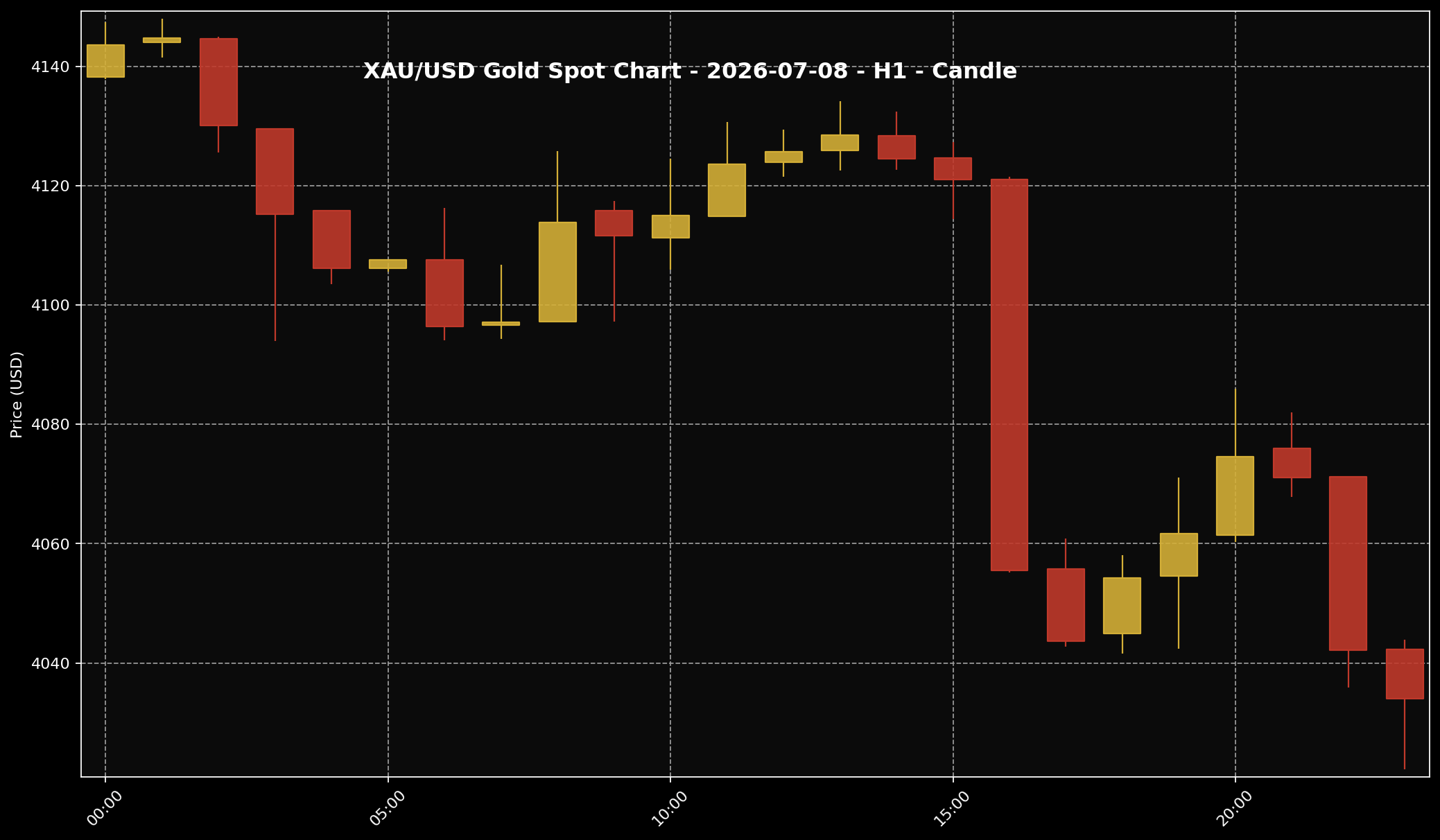 This chart shows the XAU/USD movement for the 8 July 2026 market session. Sifu Gold uses it as a visual reference, not a cue to buy emotionally.
1. By the approved 11:00 PM Malaysia time snapshot on 8 July 2026, global spot gold was around USD4,034.01 per troy ounce. That works out to roughly USD129.70 per gram. Using the approved USD/MYR reference near 4.07729 at the same snapshot, the same global spot price came to about RM16,447.82 per troy ounce, or around RM528.81 per gram. These Ringgit figures are global spot conversions, not local physical retail prices in Malaysia.
2. The bigger point is that gold still finished the session under pressure even though the geopolitical backdrop looked supportive on the surface. Tension involving the US and Iran helped keep risk sentiment alive, but the market paid more attention to surging oil, a firmer US dollar and higher US bond yields. So instead of getting a clear safe-haven lift, gold lost ground into the close.
3. For Sifu Gold readers, this is one of those sessions that reminds us gold does not move on headlines alone. Sometimes the market hears the same news, but reacts more strongly to the inflation and interest-rate implications behind it. That was the more dominant story on 8 July 2026.
What Is The Gold Chart Showing?
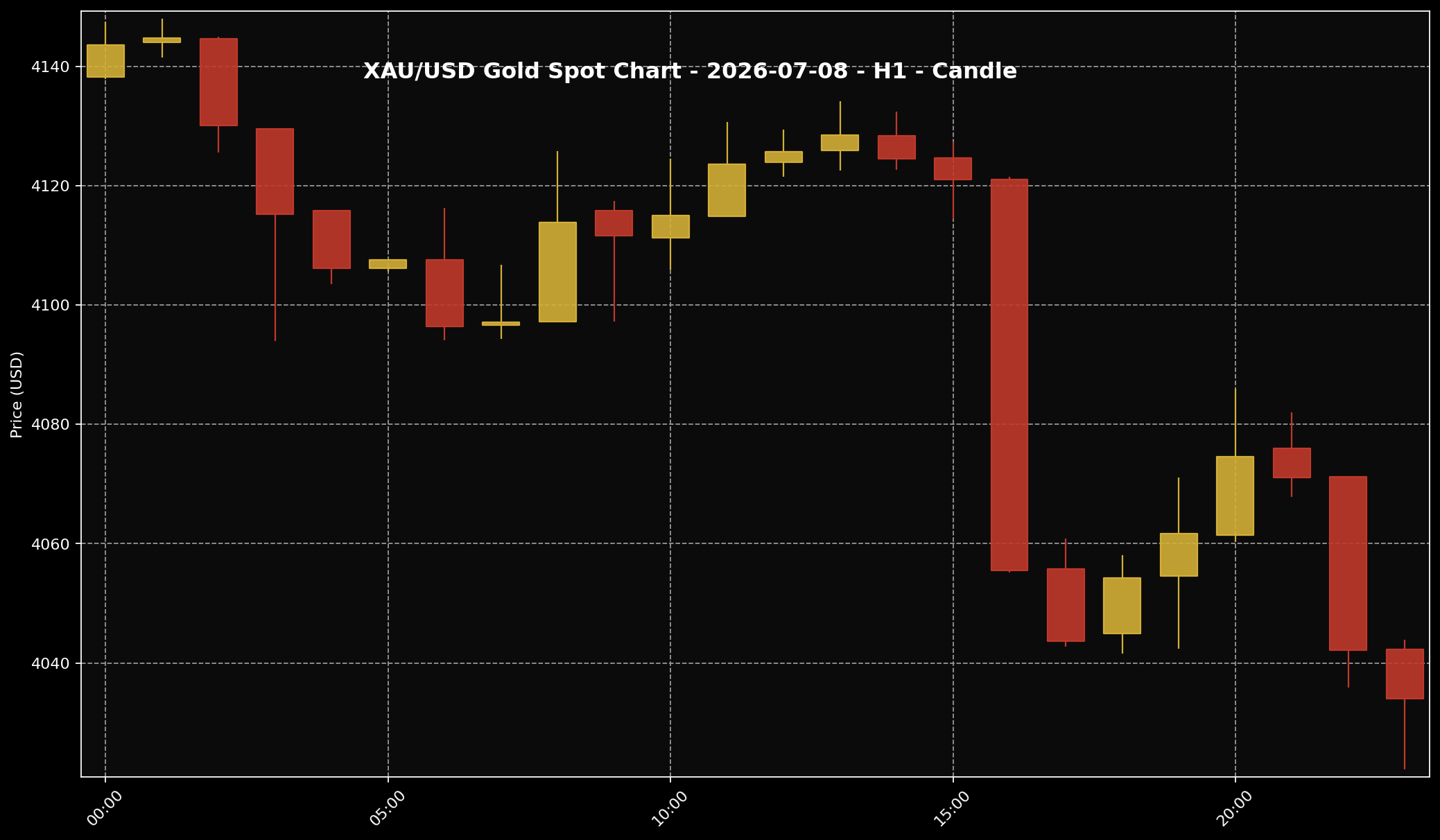 This chart helps readers see the gold price structure for the 8 July 2026 market session. It is used as market context, not as a trading signal.
1. If we keep the chart reading simple, the H1 structure for 8 July 2026 looked like a market that tried to recover but could not hold its footing. Gold started the wider session from a higher area, dropped first, then tried to stabilise and push back up. That early shape already suggested the market was becoming more cautious rather than building fresh upside momentum.
2. During the middle part of the session, gold did manage a rebound into the low USD4,120s to USD4,130s area. That showed there was still some buying interest. But the move did not last. Selling pressure returned later, the market slipped back more clearly, and gold eventually closed near USD4,034. In plain terms, it looked more like a recovery attempt that ran out of strength than a proper turnaround.
3. The final hourly candle fits that reading as well. It opened around USD4,042.30, reached roughly USD4,043.86, fell to about USD4,022.20, and then closed near USD4,034.01. Put simply, gold still ended the session in the lower half of that final range. That is not the kind of close that suggests the market had found strong new momentum by the end of the day.
Why Did Gold Move This Way?
 The US dollar is often one of the key factors influencing gold prices. When the dollar is firmer, gold can face more noticeable pressure.
1. The clearest explanation is that several layers moved together at the same time. Fresh US-Iran tension pushed oil prices higher. Once oil jumps, the market starts thinking more seriously about inflation risk. And when inflation worries come back into focus, traders also start reassessing how quickly the Federal Reserve can afford to become less aggressive.
2. That shift matters because it usually supports the US dollar and lifts US bond yields. Gold does not pay interest, so when bond yields rise, some investors find bonds more attractive in the short term. At the same time, a stronger US dollar can make gold feel more expensive for buyers using other currencies. That is why a story that begins with geopolitical tension can still end with gold under pressure.
3. That broader reading is also consistent with the evidence behind this session. Kitco pointed to the oil spike, firmer yields and a stronger dollar as the main pressures on gold. Reuters body-backed reporting via MarketScreener added another important layer: markets were also waiting for Fed minutes, while US-Iran strikes capped gold’s upside. So this was not a one-factor move. Gold still had a safe-haven case behind it, but the market gave more weight to rate and inflation pressure.
What Does This Mean For Malaysian Gold Savers?
 For Malaysian gold savers, the key point is not only whether prices rise or fall. What matters more is budget, discipline and a clear purpose.
1. For Malaysian gold savers, looking at XAU/USD alone is never enough. Yes, gold closed lower in US dollar terms. But once the same move is translated into Ringgit, the picture still looks fairly firm at about RM528.81 per gram based on the approved global spot conversion. That is why a softer day for gold in USD does not always feel like a large drop from a Malaysia-based point of view.
2. The reason is straightforward. There are always two layers moving together: the global gold price itself, and the Ringgit against the US dollar. If the US dollar stays firm, the Ringgit version of the gold price can still look elevated even when global spot gold is under pressure. That makes USD/MYR a very important part of the story for anyone following gold from Malaysia.
3. One more point should stay clear. The RM528.81 per gram figure above is only a global spot conversion into Ringgit. It is not the same as a local physical retail gold price. Physical pricing in Malaysia can include other layers such as product premium, buy-sell spread, operating costs and local pricing structure. So when global gold weakens, local physical prices do not always fall at exactly the same pace.
What Practical Action Makes More Sense?
 When gold prices move quickly, better decisions usually come from disciplined planning, not panic reactions.
1. From my point of view at Sifu Gold, a session like this is more useful as a reminder to plan properly than a reason to react quickly. If gold saving is already part of your monthly budget, a gradual buying approach can still make sense. The aim is not to guess the perfect lowest price for one day. The aim is to keep building grams in a way that stays realistic and sustainable.
2. At the same time, it still makes sense not to go in heavily all at once just because gold had a weaker session. Markets can turn quickly when several big drivers are in play together, especially the Fed story, the US dollar, bond yields and geopolitical risk. Splitting the budget into smaller parts usually gives more flexibility than committing the full budget at once.
3. If the market still feels unclear, waiting is also a valid disciplined choice. A simple framework helps here: Is this part of a long-term saving plan? Is the money already budgeted? Do you understand the difference between global spot gold and local physical pricing? When those answers are clear, the next step usually becomes more practical and less emotional.
Conclusion
Gold struggled on 8 July 2026 because the market did not treat the geopolitical backdrop as a simple safe-haven boost. Higher oil prices brought inflation worries back into focus, that helped keep the US dollar and US bond yields firm, and gold ended the session under pressure. For Malaysian gold savers, the better way to read a session like this is to look at the full picture: global spot gold, USD/MYR, and the difference between a Ringgit spot conversion and a local physical retail price. If gold saving is already part of your long-term plan, a gradual approach based on budget and discipline still makes more sense than reacting to one daily move. For readers who want to start small, Gold Accumulation Program by Public Gold allows you to begin saving gold from as low as RM100.