

What happened to gold on 13 July 2026 was not the usual simple safe-haven story. Middle East tension stayed in the background, but the market reacted first through oil, inflation worries, and higher US yields. That made the US dollar firmer as well, and gold lost support through the session. For Malaysian gold savers, the more useful question is not just why gold fell, but how to read that move properly once the same global price is translated into Ringgit.
- Introduction
- What Happened To Gold On 13 July 2026?
- What Is The Gold Chart Showing?
- Why Did Gold Move This Way?
- What Does This Mean For Malaysian Gold Savers?
- What Practical Action Makes More Sense?
- Conclusion
What Happened To Gold On 13 July 2026?
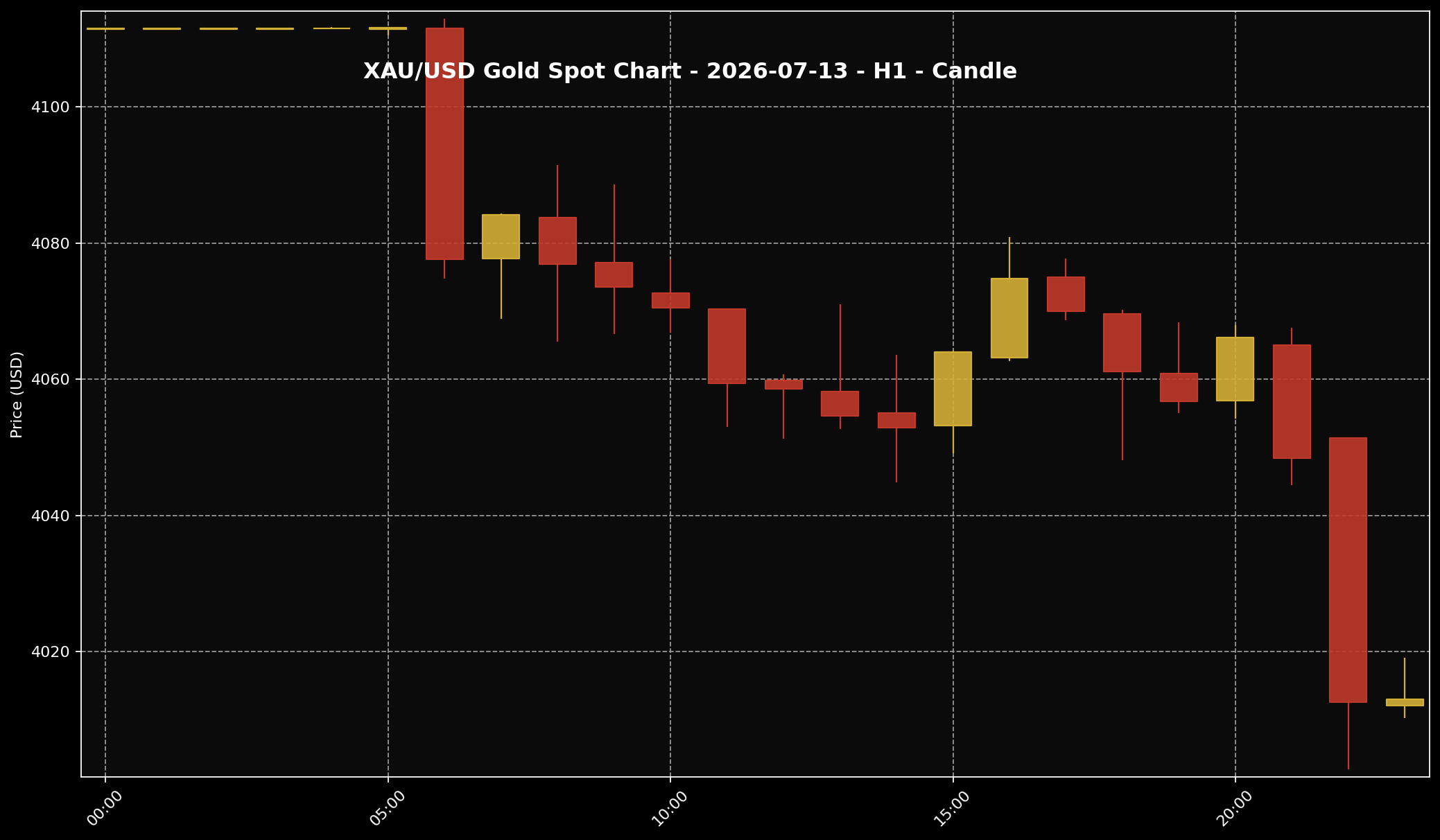 This chart shows the XAU/USD movement for the 13 July 2026 market session. Sifu Gold uses it as a visual reference, not a cue to buy emotionally.
1. On 13 July 2026, gold finished the session under pressure. The approved market snapshot showed XAU/USD at around USD4,012.94 per troy ounce. Broken down further, that worked out to roughly USD129.02 per gram. Using the same USD/MYR reference of 4.07094, the global spot equivalent came to about RM16,336.44 per troy ounce, or around RM525.23 per gram. These Ringgit figures are global spot conversions, not local physical retail gold prices in Malaysia.
2. The important part of the story is that gold did not fall for a random reason. The market was reacting to a fresh jump in oil prices after renewed Middle East tension. In many cases, readers would expect geopolitical stress to help gold. This time, though, the market focused more on what higher oil could do to inflation. Once that inflation concern came back into the picture, gold started facing stronger pressure.
3. For Sifu Gold readers, the early takeaway is quite clear. This session did not mean gold had suddenly lost its long-term role. It simply meant that, on that day, the market gave more weight to higher yields and a firmer US dollar than to the usual safe-haven appeal. That is why global gold looked weak even while the wider geopolitical backdrop still looked serious.
What Is The Gold Chart Showing?
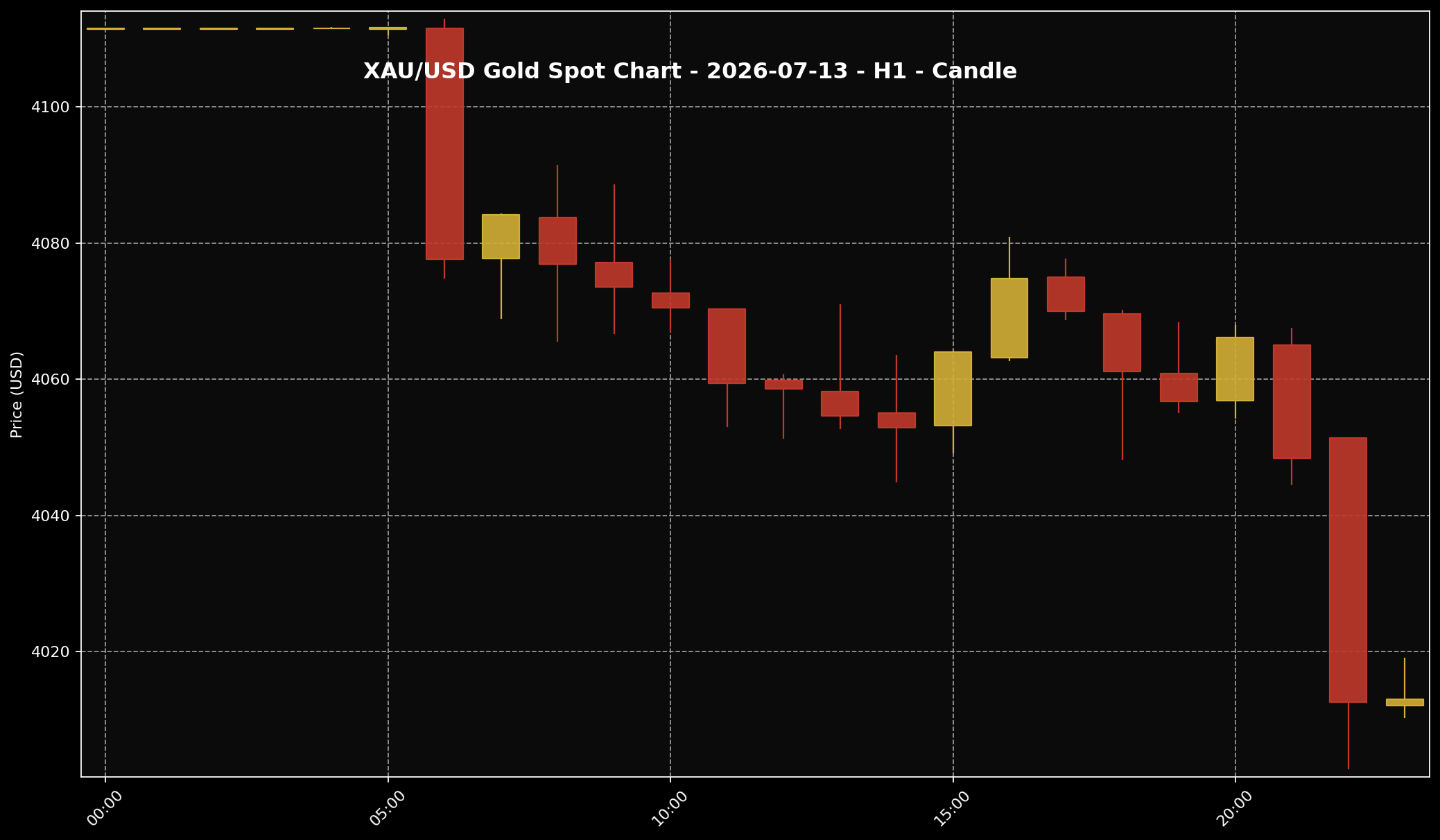 This chart helps readers see the gold price structure for the 13 July 2026 market session. It is used as market context, not as a trading signal.
1. If we read the H1 chart in a simple way, the overall tone of the session leaned lower. Selling pressure was already visible early on, and after that gold only managed short attempts to steady itself. There were a few candles that hinted at a rebound, but those moves were not strong enough to change the broader direction of the day.
2. After the first drop, price action became more cautious and uneven. Gold did bounce at times, but each bounce lost momentum fairly quickly. When a chart behaves like that, it usually means buyers are present, but they still do not have enough strength to take back control. In plain English, recovery attempts were there, but sellers remained the stronger side overall.
3. By the later part of the session, gold slipped again and ended near the weaker end of the daily range. So the safest chart reading here is not a dramatic technical call. It is simply this: gold stayed in a weak session, tried to recover, but that recovery did not last. For Sifu Gold, that is already enough as a market structure explanation without turning the article into trading language.
Why Did Gold Move This Way?
 The US dollar is often one of the key factors influencing gold prices. When the dollar is firmer, gold can face more noticeable pressure.
1. The main driver came through a fairly clear chain reaction. Renewed tension in the Middle East pushed oil prices higher. Once oil jumped, the market started worrying again that inflation pressure could pick up. And when inflation worries return, interest-rate expectations can shift as well. In this case, the market started leaning back towards the idea that the Federal Reserve might need to stay tighter for longer, or at least remain less friendly to gold in the near term.
2. From there, two things happened together: the US dollar strengthened, and Treasury yields moved higher. Gold usually finds that combination difficult. Put simply, investors start seeing interest-bearing assets such as US government bonds as more attractive in the short run, while gold itself does not pay income. So even though the original backdrop was geopolitical, the market response moved more through oil, inflation, and rate expectations.
3. That also explains why gold did not enjoy the kind of safe-haven support many people might have expected. It was not because gold had become irrelevant. It was because the market chose to price the inflation effect first. Once the story is being read through inflation, yields, and the dollar, gold can come under pressure quite quickly.
What Does This Mean For Malaysian Gold Savers?
 For Malaysian gold savers, the key point is not only whether prices rise or fall. What matters more is budget, discipline and a clear purpose.
1. For Malaysian gold savers, a session like this is a useful reminder that gold does not always move in one simple direction for one simple reason. Sometimes geopolitics supports gold directly. At other times, the same geopolitical event lifts oil first, then feeds into inflation worries, then strengthens the US dollar and Treasury yields. When that happens, gold can weaken even when the outside news still looks as though it should have been supportive.
2. Another important point is the difference between global spot gold and what people actually feel in Malaysia. In this session, the spot conversion of around RM525.23 per gram gives a helpful Ringgit picture of the global gold price. But that still is not the same as local physical gold pricing. Local prices can behave differently because they also reflect product premiums, buy-sell spreads, operating costs, logistics, and local pricing structure.
3. So if someone sees global gold falling, it does not automatically mean local physical prices will fall by the same amount or at the same speed. The better way to read it, in my view at Sifu Gold, is through two layers at once: first, what happened to the global gold price; second, how USD/MYR and local physical pricing shape what Malaysian buyers finally see.
What Practical Action Makes More Sense?
 When gold prices move quickly, better decisions usually come from disciplined planning, not panic reactions.
1. If you already have a monthly budget set aside for gold saving, a weaker session like this can be used to review your buying plan rather than to react emotionally. A gradual approach usually makes more sense. Small staged purchases can help you build grams more steadily instead of relying too heavily on one single price point.
2. At the same time, it still makes sense not to go in heavily all at once just because gold fell for a day. The market remains sensitive to oil, the US dollar, and Treasury yields. If those factors keep pressing on gold, short-term price swings can stay quite sharp. That is why I would rather see readers protect their budget, keep household and family commitments in place, and make sure core savings are not disrupted.
3. If you still feel unsure, that is fine too. It can be more disciplined to wait, watch the main drivers, and make a clearer decision later. The key things worth following are the US dollar, Treasury yields, USD/MYR, and the gap between global spot gold and local physical prices. In gold saving, the real goal is not to catch the perfect bottom every time. It is to stay consistent, understand what you are buying, and move according to your own means.
Conclusion
On 13 July 2026, gold fell not because the market had given up on gold altogether, but because the oil spike brought inflation worries back into focus and lifted pressure from the US dollar and Treasury yields. That is what weighed on gold through the session and stopped any rebound attempt from lasting. For Malaysian gold savers, the better reading is to understand the story behind the move first, then match that with your own budget and saving approach. If you already have a plan to build gold bit by bit, staying with a gradual method usually makes more sense. And for anyone just starting, Gold Accumulation Program by Public Gold allows you to begin saving gold from RM100.