

What happened to gold on 14 July 2026? Earlier in the session, it was still sitting near a two-week low, so the market tone did not look especially strong. Then the US inflation numbers came in softer than expected, and that changed the mood quite quickly. The US dollar eased, Treasury yields moved lower, and gold found room to recover. For Malaysian gold savers, the more useful question is not just whether gold went up, but why it moved that way and how the same global price looks once it is translated into Ringgit.
- Introduction
- What Happened To Gold On 14 July 2026?
- What Is The Gold Chart Showing?
- Why Did Gold Move This Way?
- What Does This Mean For Malaysian Gold Savers?
- What Practical Action Makes More Sense?
- Conclusion
What Happened To Gold On 14 July 2026?
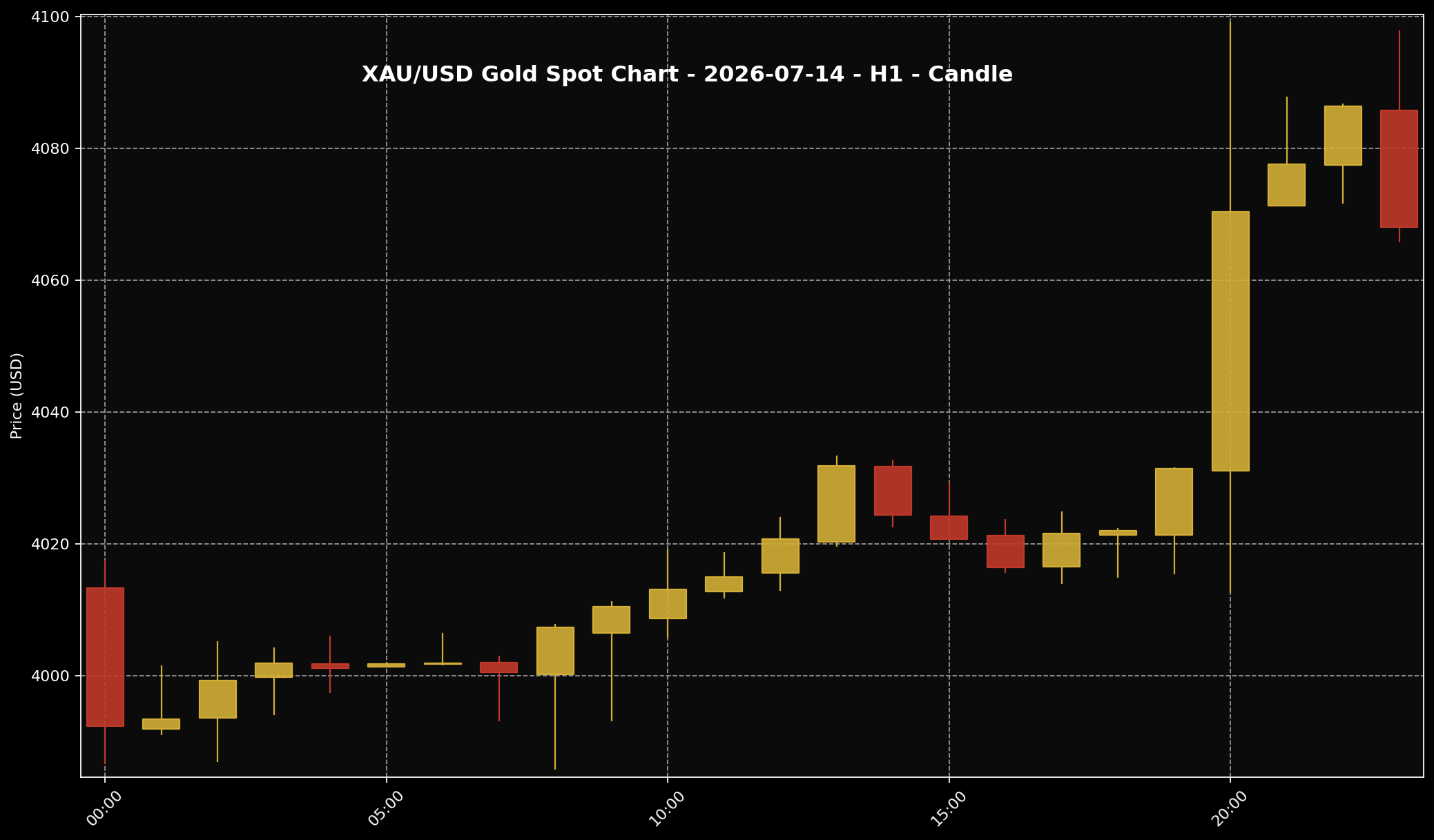 This chart shows the XAU/USD movement for the 14 July 2026 market session. Sifu Gold uses it as a visual reference, not a cue to buy emotionally.
1. By the approved session-close reference around 11:00 PM Malaysia time, global spot gold was around USD4,068.05 per troy ounce. That works out to roughly USD130.79 per gram. Using USD/MYR at about 4.07822 at the same snapshot, the same global spot reading comes to around RM16,590.42 per troy ounce or about RM533.39 per gram. These are global spot gold conversions into Ringgit, not local physical retail prices in Malaysia.
2. The bigger story is that gold did not start the day from a position of strength. Reuters-linked evidence through the validated publisher route shows the market came into the session from a two-week low, so traders were already watching the US inflation release closely. Once the CPI reading came in softer than expected, the tone changed and gold began to recover.
3. Kitco framed the move in a very similar way. Softer inflation reduced some of the pressure coming from Fed rate expectations, while the US dollar and Treasury yields moved lower. That gave gold enough breathing room to climb back. So 14 July 2026 makes more sense as a rebound session after earlier weakness, rather than a random up day with no clear trigger behind it.
What Is The Gold Chart Showing?
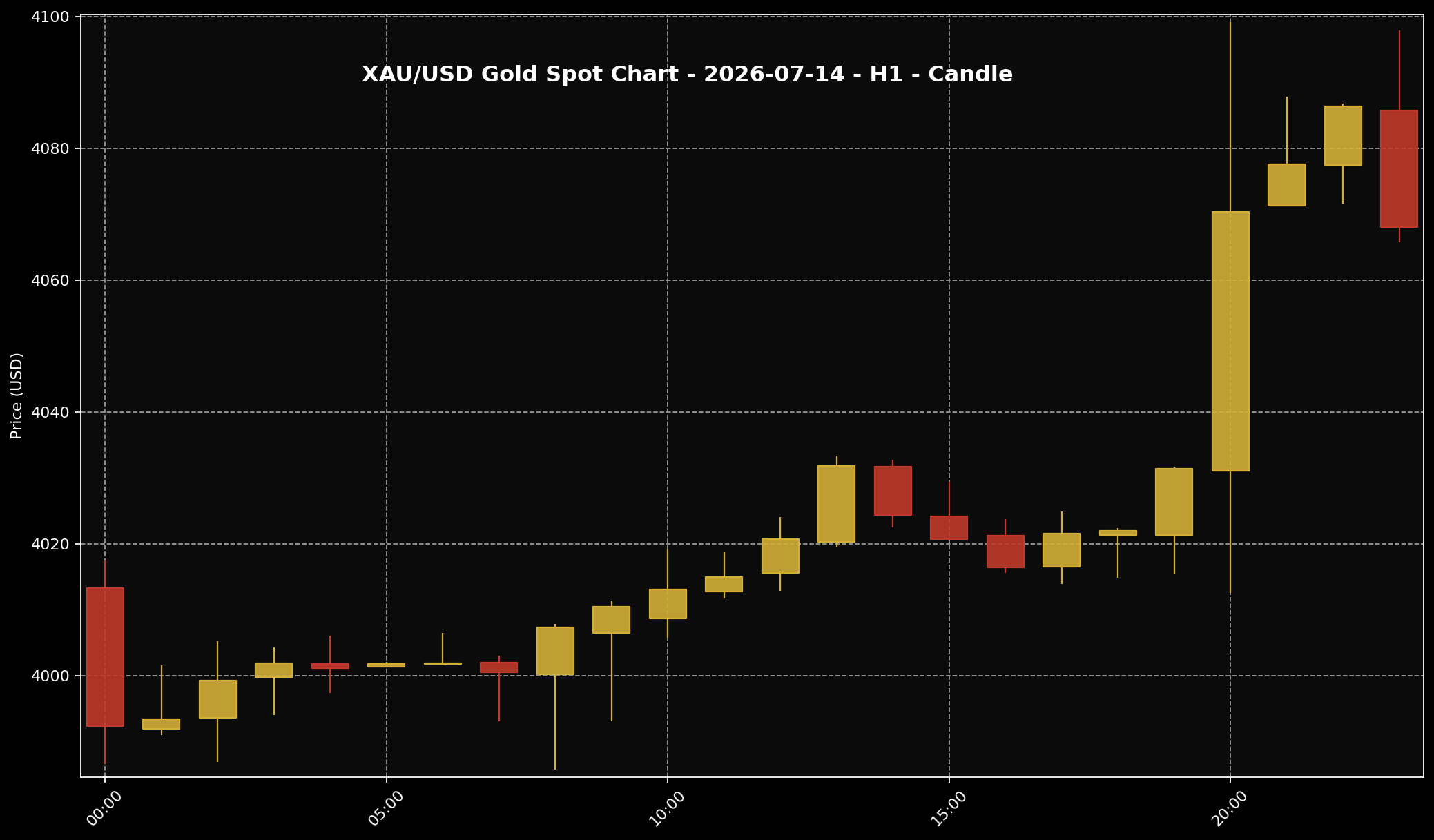 This chart helps readers see the gold price structure for the 14 July 2026 market session. It is used as market context, not as a trading signal.
1. If we read the approved H1 chart in a simple way, the session looks like a recovery from the lower part of the range rather than a clean trend breakout. Early in the day, gold was still under pressure and traded below the USD4,000 area. After that, the candles started to build upward in a more orderly way, which fits the idea that buyers came back once the macro backdrop became less negative.
2. Through the middle part of the session, gold paused around the USD4,020 to USD4,030 zone before pushing higher again. Later in the day, the move stretched toward the USD4,080 to USD4,090 area. There was a small pullback from the intraday high into the close, so the final reading near USD4,068 looks more like a solid rebound with some normal volatility, not a straight-line surge.
3. In plain English, the chart says gold managed to lift itself from early weakness and finish the day in a much better position than where it began. At the same time, it also suggests the upper area still drew some reaction from the market. For Sifu Gold readers, the safest takeaway is that the structure improved during the session, but the market was still reacting to macro news rather than settling into a fully clear new trend.
Why Did Gold Move This Way?
 The US dollar is often one of the key factors influencing gold prices. When the dollar is firmer, gold can face more noticeable pressure.
1. The main trigger was softer-than-expected US consumer inflation. When inflation cools more than the market expected, traders start to rethink how much pressure is still on the Federal Reserve to keep rates tight. Gold is very sensitive to that shift because the rate story affects two things that matter a lot for gold: the US dollar and US bond yields.
2. The chain reaction is fairly straightforward. If the market thinks rate pressure may ease a little, the US dollar can lose some support and Treasury yields can fall as well. That matters because gold does not pay interest. So when bond yields become a bit less attractive and the dollar softens, gold often finds more room to recover. Kitco’s same-day coverage tied the rebound to exactly that kind of move.
3. Reuters helps with the setup behind the day. Gold was already coming into the session from a weak patch near a two-week low, so it did not take a huge surprise to get a stronger reaction. Once the inflation data leaned in gold’s favour, the rebound became more visible. That is what made 14 July 2026 feel different from a routine chart bounce. There was a clear event, and there was a clear reason the market responded to it.
What Does This Mean For Malaysian Gold Savers?
 For Malaysian gold savers, the key point is not only whether prices rise or fall. What matters more is budget, discipline and a clear purpose.
1. For Malaysian gold savers, the first thing to notice is that gold recovered globally, but the Ringgit translation still matters just as much as the US dollar headline. At the approved close, the global spot conversion was still around RM533.39 per gram. So even on a day when gold rebounded, it could still feel expensive when viewed through a normal Malaysian saver’s budget.
2. It also helps to separate global spot gold from local physical pricing. When this article refers to roughly USD4,068.05 per troy ounce or about RM533.39 per gram, that is a global spot reference translated into Ringgit. Local physical gold pricing in Malaysia can look different because it includes other layers such as product premium, buy-sell spread, operating costs, logistics, and the live USD/MYR effect. That is why a shop or savings platform may not show the same number as the global spot conversion.
3. The sentiment message matters too. This session shows that gold can react quickly when the market starts to think Fed pressure may be easing. But for gold savers, the main lesson is not to chase one positive day in isolation. The more useful reading is to understand how US inflation, the dollar, Treasury yields, and Ringgit pricing all combine to shape the gold price that people in Malaysia actually feel.
What Practical Action Makes More Sense?
 When gold prices move quickly, better decisions usually come from disciplined planning, not panic reactions.
1. If you already set aside a monthly budget for gold, a staggered approach still makes more sense than trying to guess one perfect level. A day like this is a reminder that gold can move quite quickly when major data comes out. Building grams gradually is usually a steadier way to respond than trying to time every rebound.
2. At the same time, it is still better not to go in heavily all at once just because gold bounced on one session. The 14 July move was supportive for gold, but the wider macro story is not finished. The US dollar, Treasury yields, and the next round of economic data can still change the daily tone. Household commitments, emergency savings, and basic cash flow should stay in good shape before adding more gold exposure.
3. If you still feel unsure, waiting is also a valid decision. You can watch whether this recovery develops into something more durable or whether it was mainly a one-day reaction to the CPI release. For me at Sifu Gold, the better approach is to measure any gold decision against your plan, your monthly budget, and your real purpose for buying, not against the emotion of a single session move.
Conclusion
On 14 July 2026, gold rebounded after softer US inflation eased some of the pressure tied to rate expectations, while a weaker US dollar and lower Treasury yields gave the move extra support. That helped gold recover from the area of a two-week low and finish the session on a much better footing. For Malaysian gold savers, the key message is simple. A rebound in gold matters, but the bigger value comes from understanding why it happened and what that same move looks like in Ringgit. If you already have a long-term gold-saving plan, building gradually still makes more sense than reacting to one day of price action. For those who want to start small, Gold Accumulation Program by Public Gold allows you to begin saving gold from RM100.