

What happened to gold on 22 July 2026? Gold did try to climb again. Buyers came in early, the price pushed above the USD4,120 area, and the market looked more alive for a while. But the story did not stay simple. As oil moved higher, inflation worries and the coming Federal Reserve meeting came back into focus. For Malaysian gold savers, this was not a clean breakout story. It was more like gold trying to rebound, while the market still had reasons to stay careful.
- Introduction
- What Happened To Gold On 22 July 2026?
- What Is The Gold Chart Showing?
- Why Did Gold Move This Way?
- What Does This Mean For Malaysian Gold Savers?
- What Practical Action Makes More Sense?
- Conclusion
What Happened To Gold On 22 July 2026?
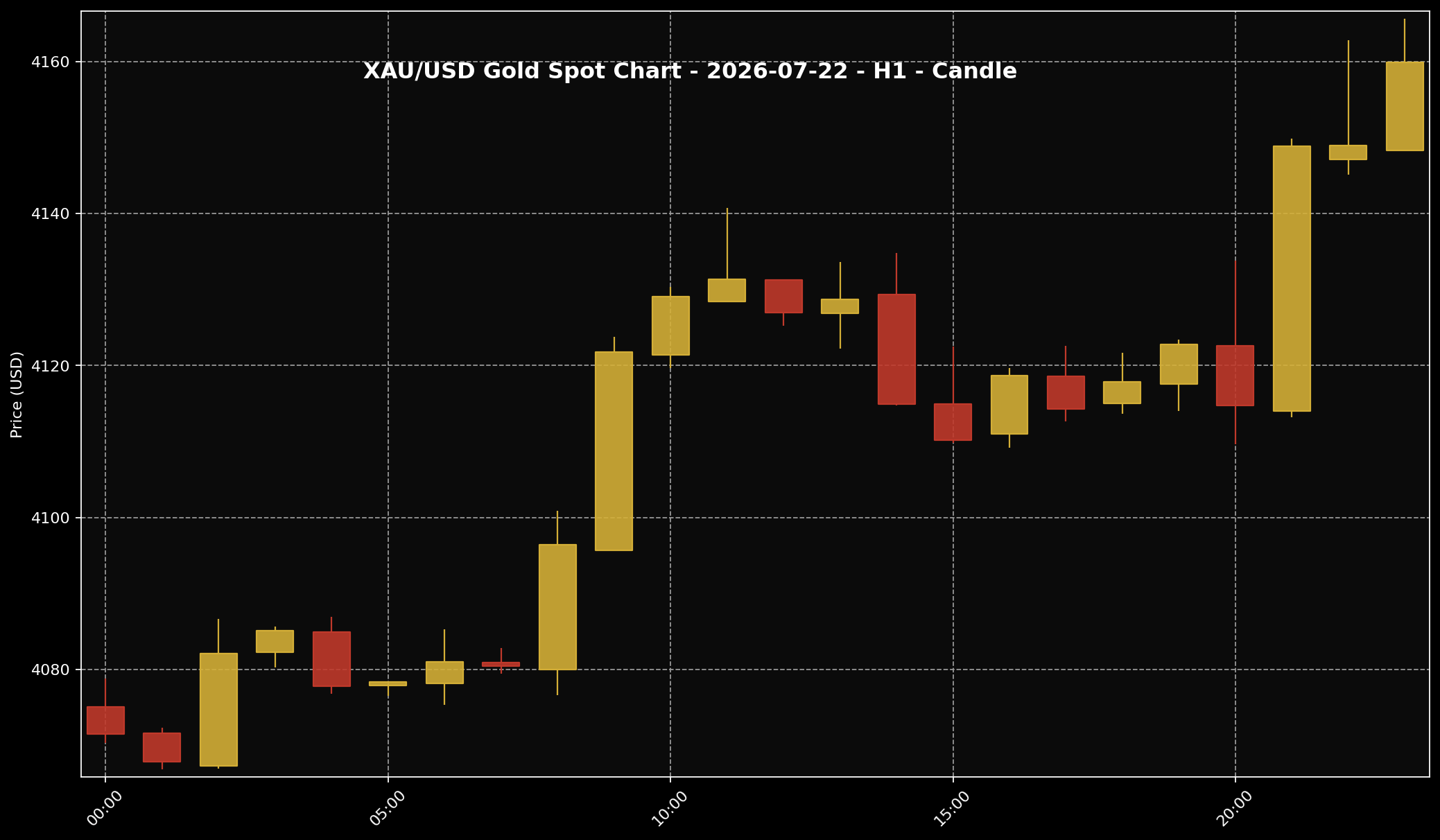 This chart shows the XAU/USD movement for the 22 July 2026 market session. Sifu Gold uses it as a visual reference, not a cue to buy emotionally.
1. At the approved reference snapshot around 11:00 PM Malaysia time, global spot gold was around USD4,159.87 per troy ounce. In gram terms, that works out to about USD133.74 per gram. Based on USD/MYR around 4.08682, the same global spot reference was about RM17,000.64 per troy ounce, or roughly RM546.58 per gram.
2. That Ringgit conversion matters for Malaysian readers, but the line must be clear. These are global spot gold figures converted into Ringgit. They are not the same as local physical retail gold prices in Malaysia. Physical gold prices can include premiums, buy-sell spreads, product structure, local pricing rules, operating costs and the exchange rate at the time.
3. The day itself was not a straight one-way move. Gold did rally above USD4,120 earlier as buyers tested the upper area. Later, the move lost some of that clean strength as the market watched higher oil prices and the coming Fed meeting. Put simply, gold was trying to recover, but the market was not ready to give it a completely clear path higher.
What Is The Gold Chart Showing?
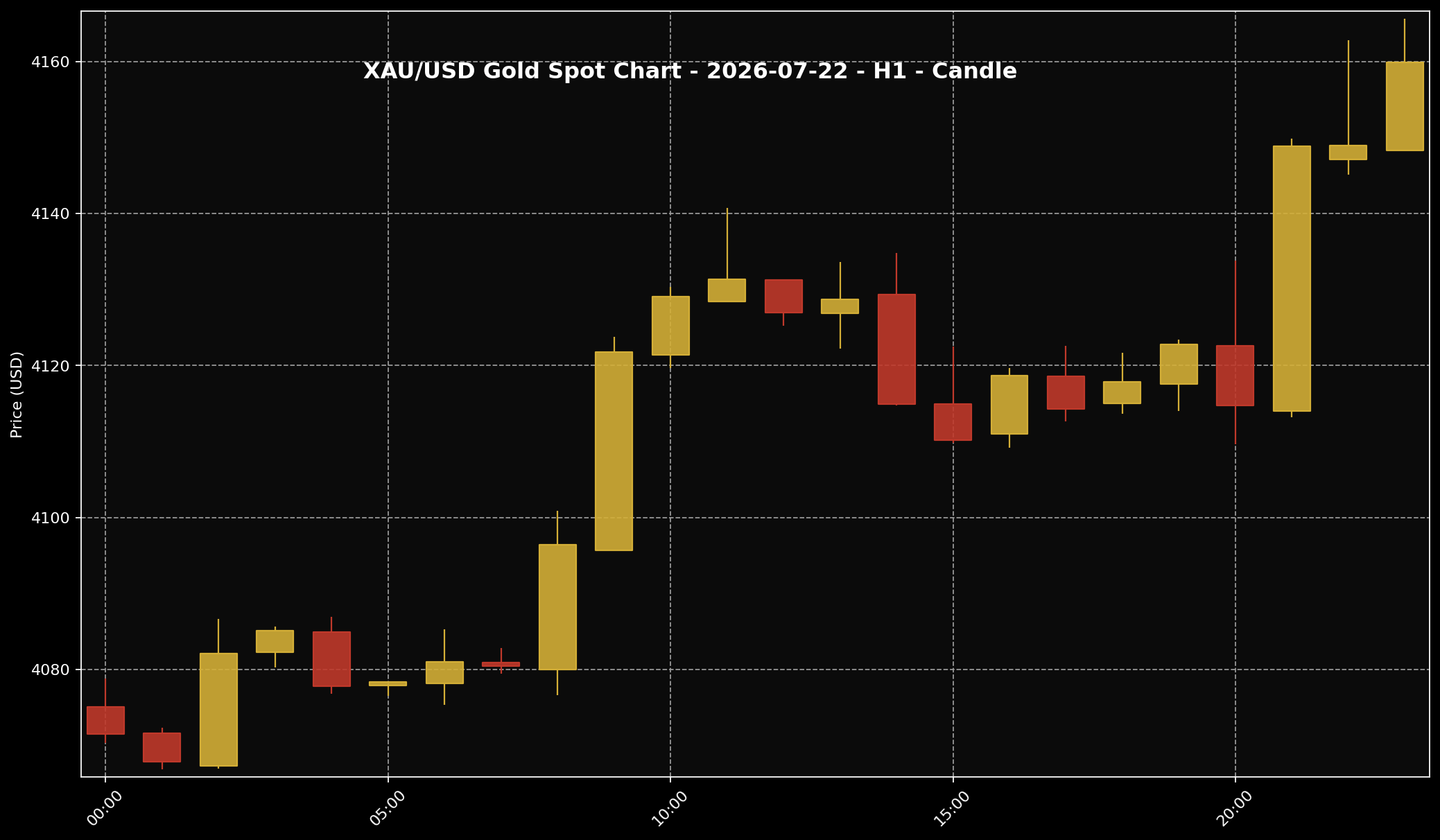 This chart helps readers see the gold price structure for the 22 July 2026 market session. It is used as market context, not as a trading signal.
1. If we look at the H1 chart for 22 July 2026, gold started from a lower area around the USD4,070 to USD4,080 zone before buyers became more visible. From there, the price moved back above USD4,100 and started testing the area above USD4,120. That tells us there was a real rebound attempt, not just a small random movement.
2. But the chart also shows that gold did not climb in a straight line. After pushing into the higher area, the price pulled back and moved through a tighter range for part of the session. That usually tells us one simple thing: buyers were there, but the market was still waiting for a stronger reason to keep pushing gold higher.
3. Near the end of the session, gold moved higher again and the final H1 candle closed around USD4,159.87. That candle closed above where it opened, but still below the H1 high near USD4,165.68. For me, the safer reading is that gold still had rebound momentum, but it was not yet a clean breakout. This is only a market structure reading, not a trading instruction.
Why Did Gold Move This Way?
 The US dollar is often one of the key factors influencing gold prices. When the dollar is firmer, gold can face more noticeable pressure.
1. The main story came from a mix of three things: buyers trying to lift gold again, oil moving higher, and the market waiting for the Fed. When oil rises, traders often start thinking again about inflation risk. If inflation looks harder to bring down, the Fed may have less room to sound relaxed on interest rates. That kind of rate story can limit how far gold can run.
2. The Fed is the central bank of the United States. When the market is waiting for a Fed meeting, many investors prefer to hold back before making bigger decisions. If they think US interest rates may stay high for longer, gold can lose momentum because gold does not pay interest like bonds do. So even when there is buying interest in gold, some investors still compare it with assets that offer a fixed return.
3. At the same time, the Middle East conflict was still part of the market background. Geopolitical tension can support gold because many people see gold as a safer asset during uncertain periods. But if the same issue also pushes oil higher and brings inflation worries back, the effect becomes mixed. That is why the 22 July move looked like a rebound attempt, but one still limited by Fed, oil and inflation concerns.
What Does This Mean For Malaysian Gold Savers?
 For Malaysian gold savers, the key point is not only whether prices rise or fall. What matters more is budget, discipline and a clear purpose.
1. For Malaysian gold savers, the useful point is not just whether gold was “up” or “down”. The better question is what kind of market we are dealing with. On this day, gold showed that buying interest was still there, but the move was not strong enough to confirm a fresh direction by itself. If you are collecting grams for the long term, this kind of session is better used as a checkpoint, not a reason to react emotionally.
2. The next point is USD/MYR. Global gold is quoted in US dollars, but Malaysian buyers feel the price in Ringgit. When USD/MYR changes, the same global spot price can look different once translated into local terms. That is why the RM546.58 per gram reference is useful. It helps us understand global spot gold in Ringgit, but it is still not the price of physical gold sold locally.
3. For physical gold, the price people see normally has extra layers. There can be product premiums, buy-sell spreads, logistics, local pricing rules and currency movement. So it is not helpful to read the XAU/USD chart as if it moves one-to-one with local physical gold. The better approach is to use the chart to understand the bigger market direction, then check the current physical price before deciding based on your own budget.
What Practical Action Makes More Sense?
 When gold prices move quickly, better decisions usually come from disciplined planning, not panic reactions.
1. If you already have a monthly budget for gold saving, staged buying still makes more sense than trying to guess the lowest price. The market on 22 July 2026 had not given a very clear direction yet. So if your plan is to keep accumulating, do it within your own affordability and do not commit the full budget at once.
2. If this month’s budget is tight, there is no need to force it. Gold can be a useful long-term saving asset for many people, but household commitments, debt payments, cash flow and emergency funds still come first. For me, discipline in gold saving does not mean buying every time the price moves. It means knowing when to buy, how much you can afford, and when waiting is the better decision.
3. Over the next few days, the things worth watching are the Fed tone, oil prices, USD/MYR and whether gold can stay around the higher area. If these factors remain mixed, gold may move within a range first. So the more practical move is simple: review your budget, split purchases if needed, understand the difference between global spot and physical pricing, and make the decision based on your own saving plan.
Conclusion
The conclusion for 22 July 2026 is quite straightforward. Gold tried to extend its rebound, and buyers did manage to bring the price into a higher area. But the move was still held back by the market’s focus on the Fed meeting, higher oil prices, inflation risk and the geopolitical backdrop. So this session is better read as a rebound with limits, not a confirmed new direction. For Malaysian gold savers, do not chase one day of price movement. Check your budget, understand the difference between global spot gold and local physical gold pricing, and continue gradually if that fits your plan. If you are just starting, the Gold Accumulation Program by Public Gold allows gold saving from as low as RM100. Start within your means, build grams bit by bit, and keep the discipline so your decision is not driven by daily market emotion.