

What happened to gold on 23 July 2026? The story was not as simple as “geopolitics should push gold higher”. Yes, Middle East tension was still in the background. But this time, the market focused more on what that tension could do to oil prices, inflation and the Fed. When oil moved higher, inflation worries came back. Then US yields and the US dollar became stronger parts of the story, and gold ended up under pressure.
- Introduction
- What Happened To Gold On 23 July 2026?
- What Is The Gold Chart Showing?
- Why Did Gold Move This Way?
- What Does This Mean For Malaysian Gold Savers?
- What Practical Action Makes More Sense?
- Conclusion
What Happened To Gold On 23 July 2026?
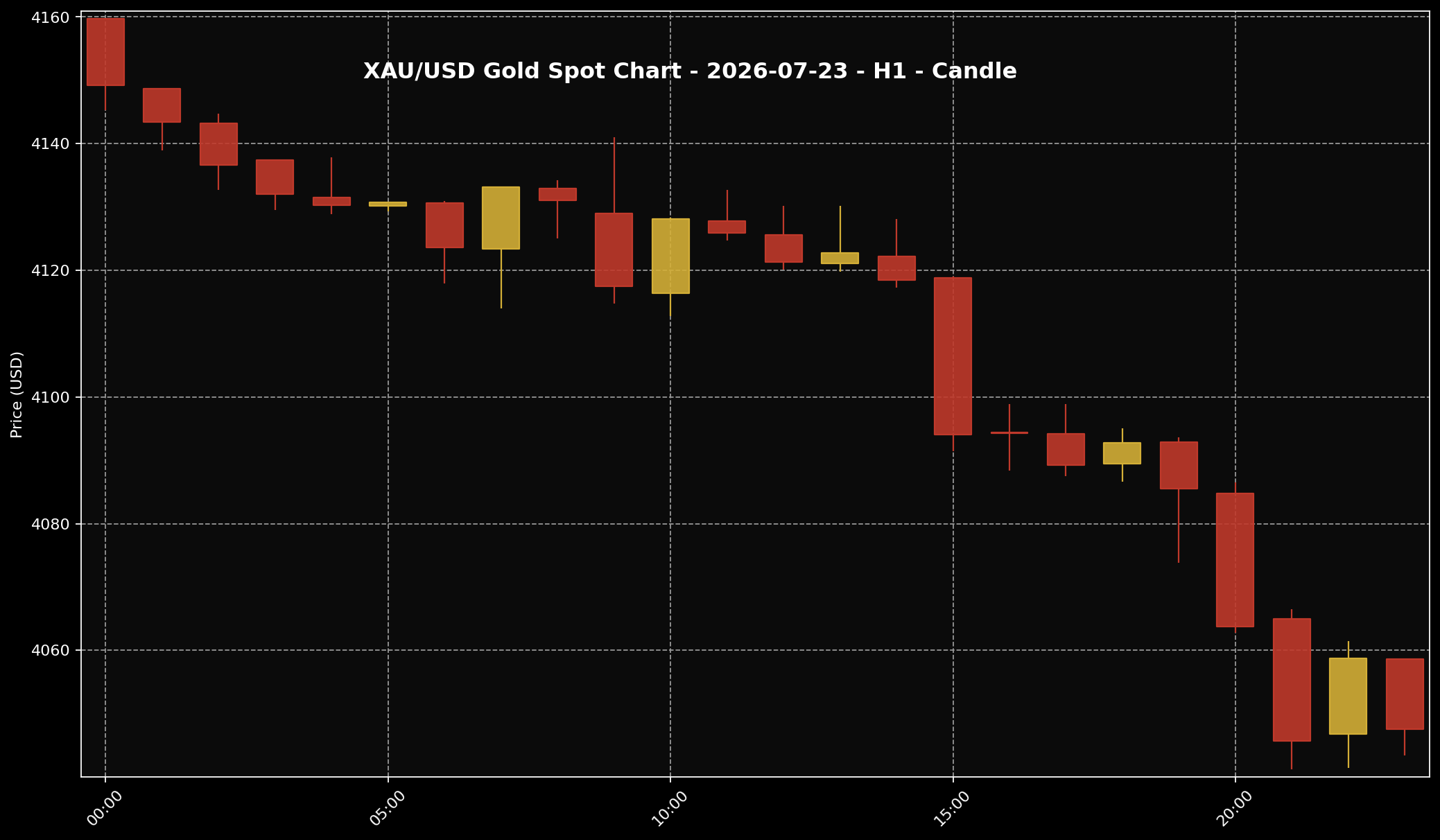 This chart shows the XAU/USD movement for the 23 July 2026 market session. Sifu Gold uses it as a visual reference, not a cue to buy emotionally.
1. Around the 11:00 PM Malaysia time reference snapshot, global spot gold was around USD4,047.52 per troy ounce. That works out to about USD130.13 per gram. With USD/MYR around 4.08883 at the same snapshot, the same global spot reference was about RM16,549.63 per troy ounce, or around RM532.08 per gram.
2. For Malaysian readers, that Ringgit number helps give a clearer picture. But it is still a global spot conversion, not a local physical retail price in Malaysia. It is not the Public Gold price, and it is not a GAP 24K quote. Local physical gold prices can include the global spot price, USD/MYR movement, product premiums, buy-sell spread and local pricing structure.
3. For the 23 July session, gold was under pressure. Kitco pointed to weaker gold and silver as US Treasury yields rose, the US dollar firmed and crude oil surged. Reuters gave the bigger storyline: Middle East tension pushed oil higher, and that brought inflation worries and Fed rate expectations back into focus. So even though safe-haven demand was still around, it was not strong enough to carry gold higher that day.
What Is The Gold Chart Showing?
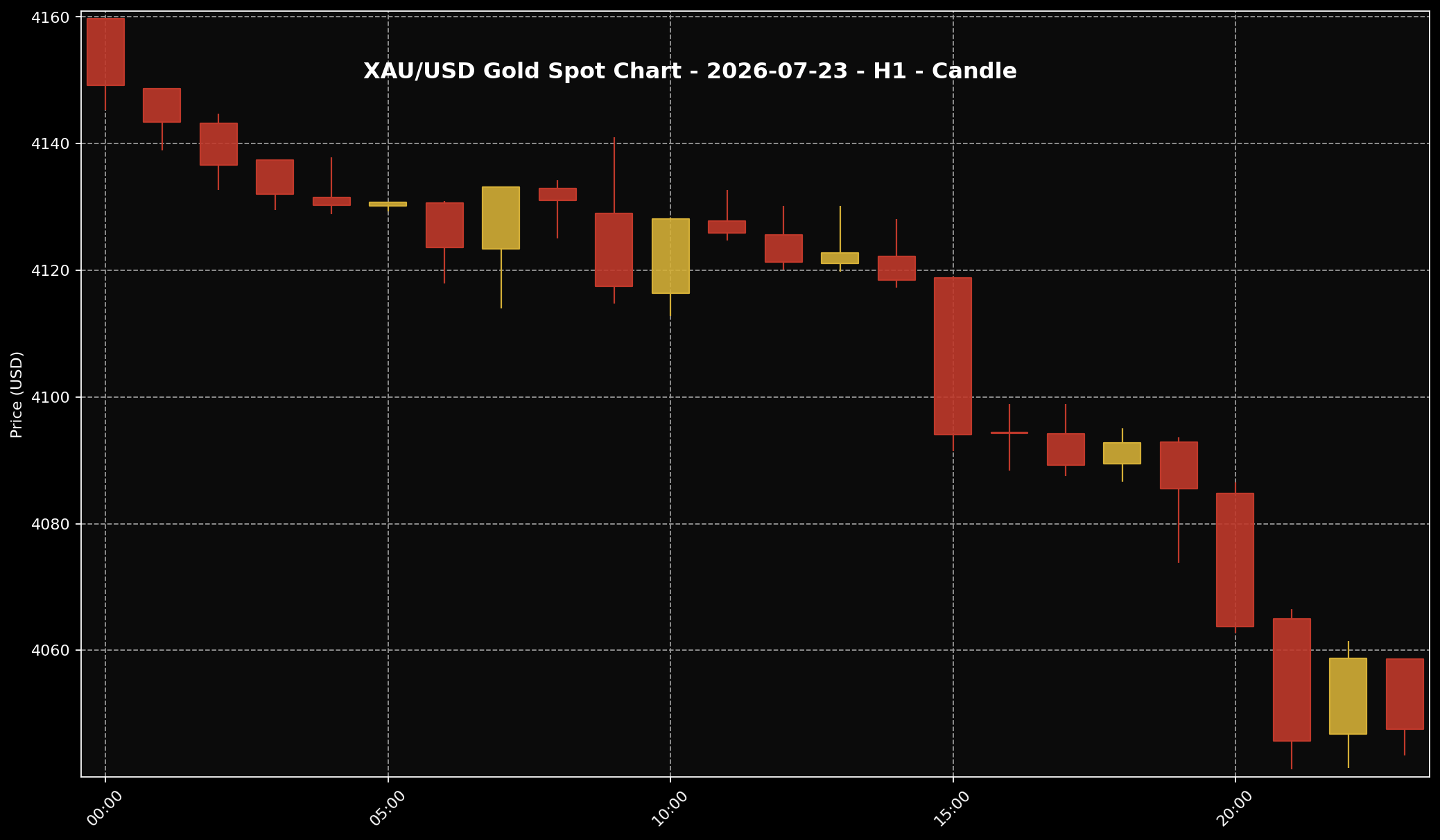 This chart helps readers see the gold price structure for the 23 July 2026 market session. It is used as market context and price-structure reference only.
1. If we look at the H1 XAU/USD chart for 23 July 2026, the price structure looked weaker from the early part of the session into the later part of the day. Gold started nearer the higher zone, around the USD4,140 to USD4,160 area, but it did not hold that level for long. From there, the candles gradually moved lower.
2. The more obvious pressure came after the middle part of the session. Gold slipped towards the USD4,090 area, then moved lower again towards the USD4,060 zone and below it by the later snapshot. Put simply, buyers were not strong enough to pull gold back into the higher range that day. The chart matched the news story: the market was not treating gold as a clean safe-haven winner in that session.
3. I would only read this chart as market structure, not as a trading setup. There is no need to treat this as a trading instruction. The useful point for Sifu Gold readers is this: when the US dollar, US yields and Fed rate worries become louder, gold can find it harder to climb even when there is geopolitical tension in the background.
Why Did Gold Move This Way?
 The US dollar is often one of the key factors influencing gold prices. When the dollar is firmer, gold can face more noticeable pressure.
1. The main story began with Middle East tension. Normally, that kind of risk can support gold because some investors see gold as a safe-haven asset. But this time, the market looked at the oil side of the story first. If tension pushes oil higher, energy costs can rise. If energy costs rise, inflation can become harder to bring down.
2. Once inflation worries came back, the market quickly turned its attention to the Fed. The Fed is the US central bank. If inflation stays sticky, traders may expect US interest rates to stay higher for longer, or may see less room for rate cuts. Reuters reported that gold fell as the oil rally brought Fed rate expectations back into focus. That is an expectation story, not a certainty, but it still matters for gold.
3. From there, the pressure reached gold through two familiar channels. When US Treasury yields rise, investors have more interest-paying alternatives. Gold does not pay interest. When the US dollar strengthens, gold becomes more expensive for buyers using other currencies. So the chain was quite clear: Middle East tension lifted oil, oil revived inflation worries, Fed expectations came back into focus, yields and the dollar firmed, and gold came under pressure.
What Does This Mean For Malaysian Gold Savers?
 For Malaysian gold savers, the key point is not only whether prices rise or fall. What matters more is budget, discipline and a clear purpose.
1. For Malaysian gold savers, the main point is not just that gold fell for one day. The better question is why it fell. On 23 July 2026, gold did not fall because gold suddenly lost its role as a long-term store of value. It fell because the market was weighing inflation risk, US rates, Treasury yields and the US dollar more heavily than the safe-haven side of the geopolitical story.
2. The Malaysian angle adds another layer. Global gold is priced in US dollars, but Malaysian buyers eventually feel the price in Ringgit. That is where USD/MYR matters. Sometimes global spot gold can fall, but the local price may not fall as much if the Ringgit is weaker against the US dollar. The opposite can also happen when currency movement changes the local translation.
3. If you save physical gold, it is better not to read XAU/USD as though it moves one-to-one with the price you see locally. The RM532.08 per gram figure in this article is a global spot conversion. Local physical gold can include premiums, spread and product structure. So before making a decision, compare the global move with the local physical price, check the spread, and make sure the purchase still fits your own saving budget.
What Practical Action Makes More Sense?
 When gold prices move quickly, better decisions usually come from disciplined planning, not panic reactions.
1. The way I see it at Sifu Gold, a day like this is better used for planning, not chasing price movement. If you already have a monthly gold-saving budget, buying in smaller stages can still make sense if it fits your cash flow. The focus is not to catch the lowest price perfectly. The focus is to build grams consistently without disturbing your bigger financial plan.
2. If the budget is tight this month, there is no need to force it. Gold can be useful for long-term saving, but home commitments, family needs, debt payments, emergency funds and daily cash flow still come first. Do not go in heavily all at once just because gold dropped for one day. A more practical approach is to split the budget and make decisions that still feel manageable.
3. If you are still unsure, check a few things first: the US dollar, US Treasury yields, the Fed story, USD/MYR and the current local physical gold price. If those factors are still mixed, waiting for a clearer setup is also a disciplined decision. For gold savers, the aim is not to react to every daily candle. The aim is to build a gold-saving habit with a budget you can continue.
Conclusion
For 23 July 2026, gold came under pressure because the market focused more on higher oil, inflation worries and Fed rate expectations. Middle East tension still carried a safe-haven element, but that was outweighed by stronger pressure from US yields, the US dollar and the inflation story. For Malaysian gold savers, this is a useful reminder that gold does not move because of one factor alone. Global spot price, USD/MYR, local physical pricing, premiums and spread all need to be seen together. If the budget is ready, buying in stages can still fit a long-term saving plan. If the budget is not comfortable yet, it is better to check first. For those starting small, the Gold Accumulation Program by Public Gold allows you to begin saving gold from as low as RM100, based on your own affordability.