

What happened to gold on 30 July 2026? It was not a day where gold fell apart, and it was not a day where gold broke higher with a clear new direction either. Gold held up, but the market was still dealing with a mixed story. A less aggressive US dollar helped at times, while US Treasury yields and the Federal Reserve rate story kept pressure in the background. For Malaysian gold savers, the useful way to read this is simple: look at the global price, translate it into Ringgit, then decide based on budget and plan.
- Introduction
- What Happened To Gold On 30 July 2026?
- What Is The Gold Chart Showing?
- Why Did Gold Move This Way?
- What Does This Mean For Malaysian Gold Savers?
- What Practical Action Makes More Sense?
- Conclusion
What Happened To Gold On 30 July 2026?
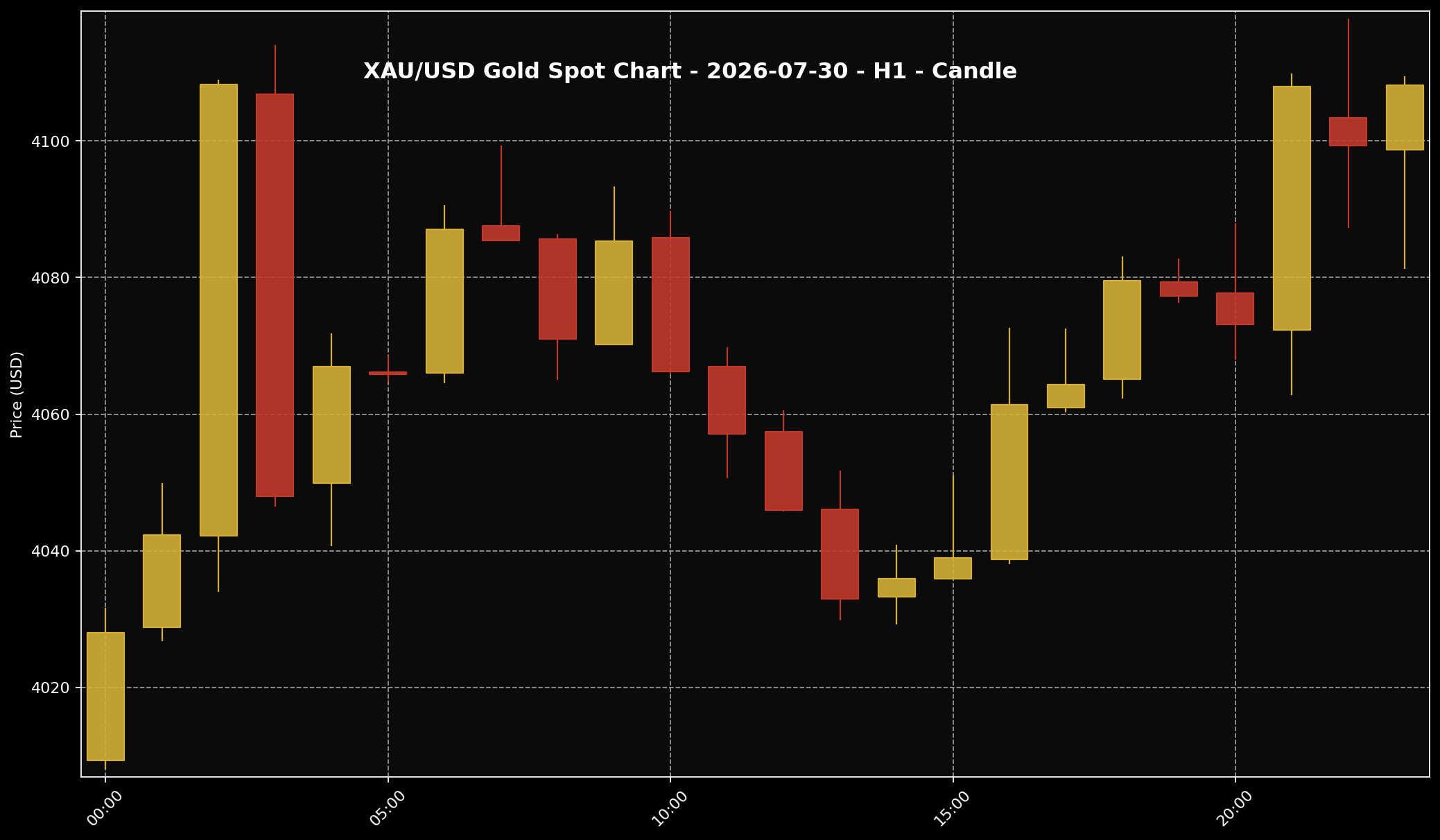 This chart shows the XAU/USD movement for the 30 July 2026 market session. Sifu Gold uses it as a visual reference, not a cue to buy emotionally.
1. At around 11:00 PM Malaysia time, global spot gold was around USD4,108.14 per troy ounce. That works out to about USD132.08 per gram. Using the USD/MYR rate of around 4.0898 at the same time, the same global spot price was roughly RM16,801.46 per troy ounce, or about RM540.18 per gram.
2. That Ringgit number is a global spot conversion. It is not the same as the local physical gold price in Malaysia. Physical gold prices can include other factors such as USD/MYR movement, product premium, buy-sell spread, stock, logistics, product structure and local pricing conditions.
3. The main story was that gold was still holding above the important USD4,000 area, but the move was not strong enough to say the market had found a clean new direction. A less aggressive US dollar gave gold some breathing room, but Treasury yields and the Fed rate story still kept buyers cautious.
What Is The Gold Chart Showing?
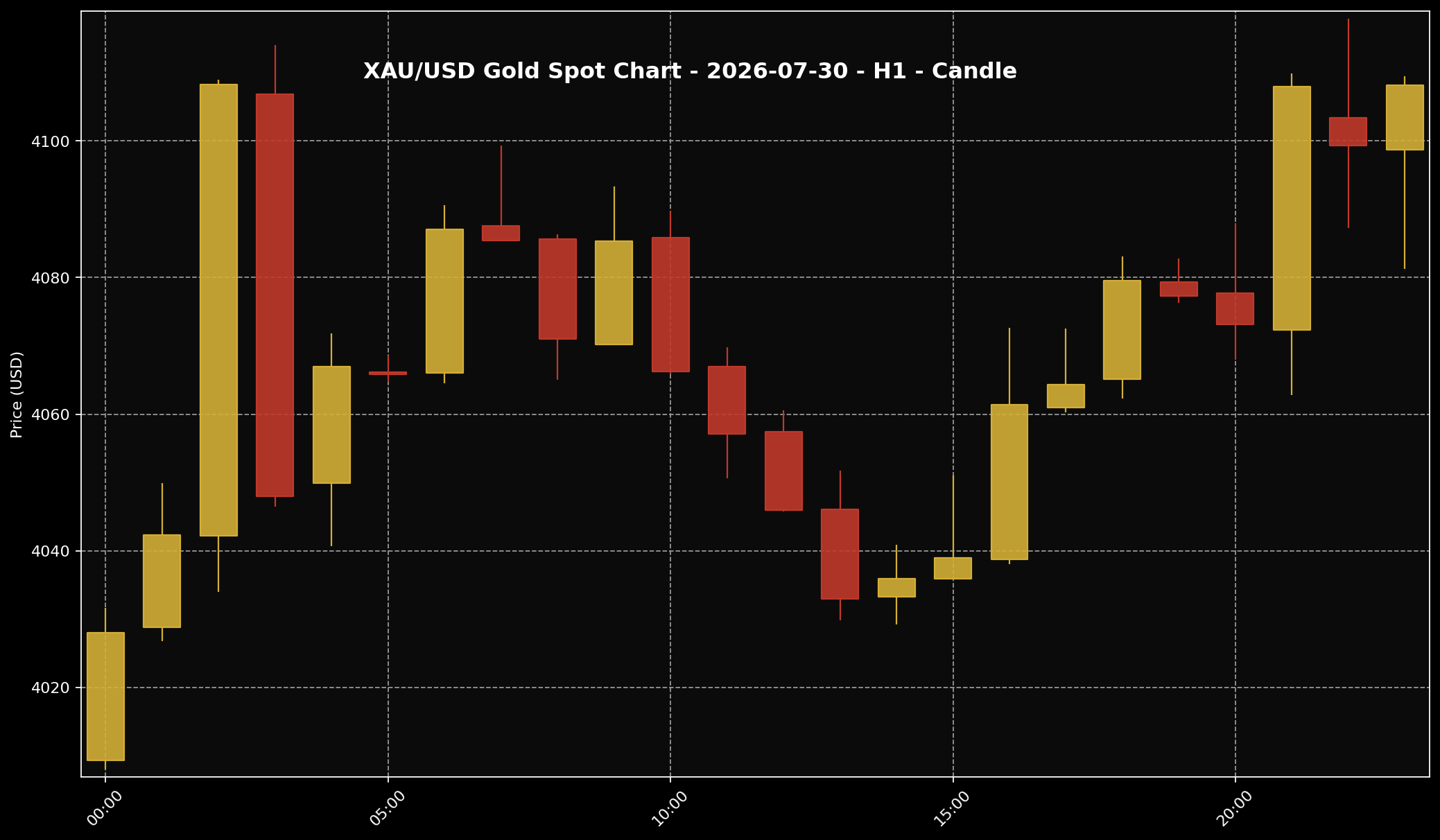 This chart helps readers see the gold price structure for the 30 July 2026 market session. It is used as market context and price-structure reference only.
1. The H1 chart showed gold moving lower during part of the session, then trying to recover towards the later part of the day. The 11:00 PM Malaysia-time candle closed around USD4,108.14, near the upper part of that candle’s range. Put simply, gold did not look like it was breaking down at that point.
2. Still, I would not read this chart as a signal. It is better to treat it as a simple market-structure clue. Gold was holding, reacting, and trying to find direction. There was a rebound after the lower move, but the structure was still not clean enough to call it a strong new push higher.
3. The area around USD4,000 remained important as a broad psychological reference for the market. As long as gold holds above that kind of area, buyers have not fully stepped away. But while Treasury yields and the Fed story are still hanging around, gold can continue to move up and down in a sensitive range.
Why Did Gold Move This Way?
 The US dollar is often one of the key factors influencing gold prices. When the dollar is firmer, gold can face more noticeable pressure.
1. The reason was not one single clean trigger. It was a mix of several things. Kitco pointed to gold staying near support while the market digested US GDP, PCE data, the Fed keeping rates unchanged, firm Treasury yields and resilient US jobless claims. In plain English, the market still had reasons to think US rates may not fall too quickly.
2. Reuters also showed the same push-and-pull feeling during the day. Gold came under pressure when US Treasury yields moved higher. The simple reason is this: gold does not pay interest. When US bonds offer more attractive returns, some investors may prefer those bonds first, and that can make gold harder to push higher.
3. At the same time, gold also had support when the US dollar became less aggressive. Global gold is priced in USD. When the dollar is not too strong, gold can feel a little easier to buy for people outside the United States. That helped gold steady again. So the story was not one-way. It was a tug of war between yield and Fed pressure on one side, and softer dollar conditions plus Middle East tension in the background on the other.
What Does This Mean For Malaysian Gold Savers?
 For Malaysian gold savers, the key point is not only whether prices rise or fall. What matters more is budget, discipline and a clear purpose.
1. For Malaysian gold savers, looking at XAU/USD alone is never enough. Gold moves globally in US dollars, but we feel the price locally in Ringgit. That is why USD/MYR matters. In this snapshot, the global spot price translated to about RM540.18 per gram using USD/MYR around 4.0898.
2. That RM540.18 per gram figure is useful because it gives us a local reference for global spot gold. But it should not be compared directly with the price of physical gold in Malaysia as if both are exactly the same thing. Physical gold can carry premium, spread, product costs, stock conditions and local pricing structure.
3. The way I would read this for Sifu Gold readers is this: gold was still supported, but the bigger pressure had not disappeared. So the focus should not be on trying to guess the lowest price of the day. A better focus is to understand why the price moved, check personal affordability, and make sure any gold-saving decision does not disturb other commitments.
What Practical Action Makes More Sense?
 When gold prices move quickly, better decisions usually come from disciplined planning, not panic reactions.
1. If you already have a monthly gold-saving budget, buying gradually still makes more sense than trying to chase one perfect price. Gold can move quickly when the market changes its view on the Fed, the US dollar or Treasury yields. Staged buying helps reduce the emotional pressure that comes when prices move up and down.
2. If this month’s budget is tight, there is no need to force it. Gold can be useful for long-term saving, but home commitments, family needs, business cash flow, debt and emergency savings still come first. Do not go in heavily all at once just because the price looks interesting for a day or two.
3. If you are still unsure, it is perfectly reasonable to watch a few things first: the US dollar, US Treasury yields, Fed rate expectations, USD/MYR and local physical gold prices. For me, consistent gold savers usually become stronger because they follow a plan, not because they manage to guess every daily price movement correctly.
Conclusion
For 30 July 2026, gold held up, but it had not fully escaped Fed and Treasury-yield pressure. A less aggressive US dollar helped gold at certain points, but the market still did not have a strong enough reason to push gold in one clear direction. For Malaysian gold savers, the practical reading is to check the global price in Ringgit, understand the difference between global spot and local physical gold prices, and arrange the budget according to affordability. If the saving plan is already in place, gradual accumulation can continue. If the budget is not comfortable yet, waiting and reorganising the plan is also a disciplined decision.