

What happened to gold on 6 August 2026? Gold was still holding above the USD4,200 area, but the move was not a clean one-way climb. The market had some support from easing US rate-hike worries and lower Treasury yields. At the same time, a firmer US dollar and weaker safe-haven demand stopped gold from moving much further. For Malaysian gold savers, this was a session to read carefully, not just from one headline or one price level.
- Introduction
- What Happened To Gold On 6 August 2026?
- What Is The Gold Chart Showing?
- Why Did Gold Move This Way?
- What Does This Mean For Malaysian Gold Savers?
- What Practical Action Makes More Sense?
- Conclusion
What Happened To Gold On 6 August 2026?
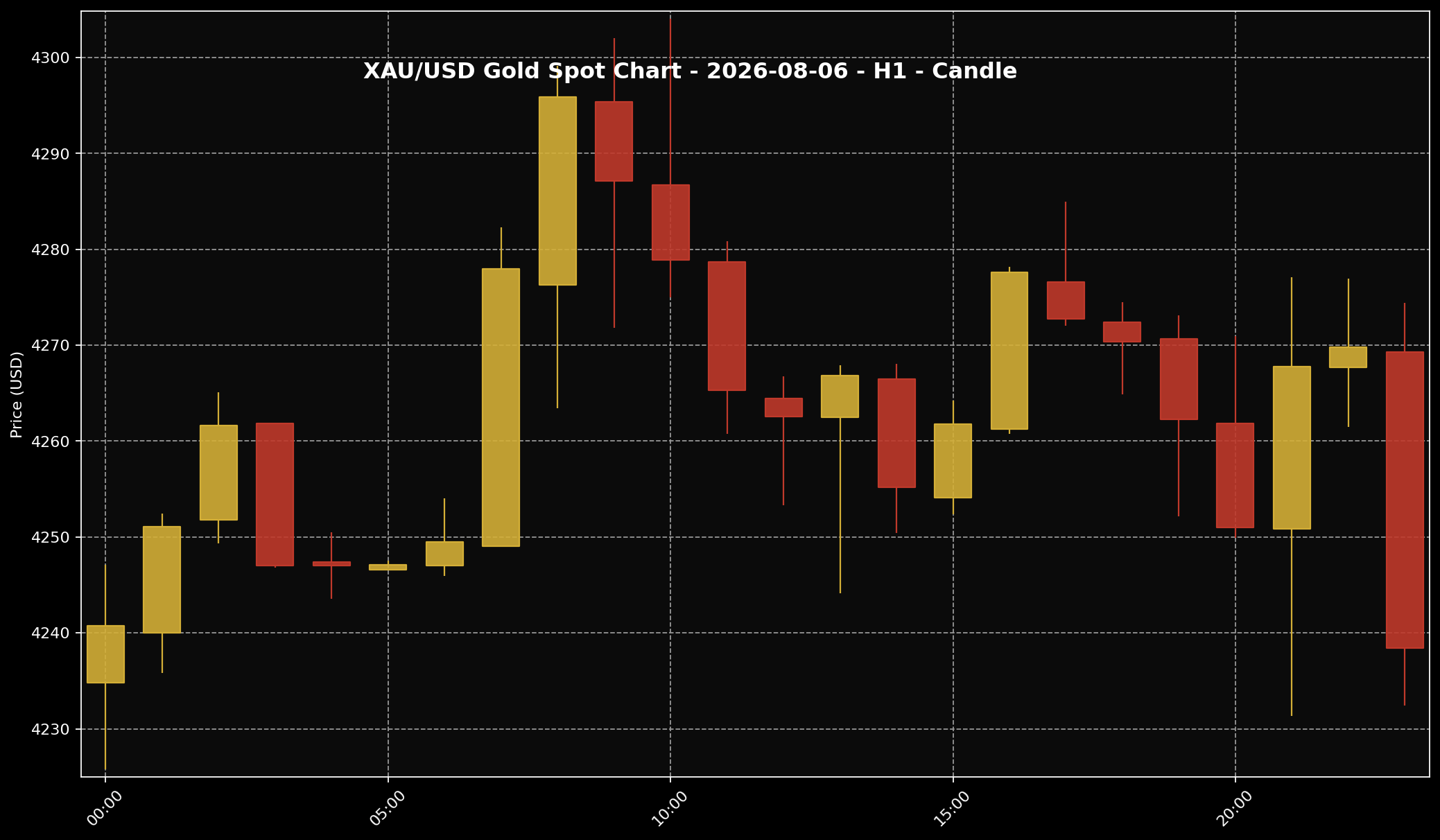 This chart shows the XAU/USD movement for the 6 August 2026 market session. Sifu Gold uses it as a visual reference, not a cue to buy emotionally.
1. If we look at the 6 August 2026 session, gold was still trading at a high level compared with recent sessions. At around 11:00 PM Malaysia time, the XAU/USD reference was around USD4,238.43 per troy ounce. In gram terms, that works out to about USD136.27 per gram. Using the USD/MYR rate of around 4.08966 at the same time, this global spot reference was roughly RM17,333.72 per troy ounce, or about RM557.29 per gram.
2. The Ringgit number needs to be read properly. This is global spot gold translated into Ringgit. It is not the same as local physical retail gold pricing in Malaysia. Local physical prices can differ because they may include product premium, buy-sell spread, operating cost, logistics and local price updates. So for Malaysian readers, this number is useful as a global market reference, not a one-to-one comparison with physical gold products.
3. The bigger story was quite simple. Gold still had support because the market was less worried about more aggressive US rate hikes. When that fear cools, gold usually gets more room to hold because gold does not pay interest like bonds. But the move was not smooth. The US dollar was still firm, and some safe-haven demand faded as the geopolitical premium linked to the Strait of Hormuz became less dominant.
What Is The Gold Chart Showing?
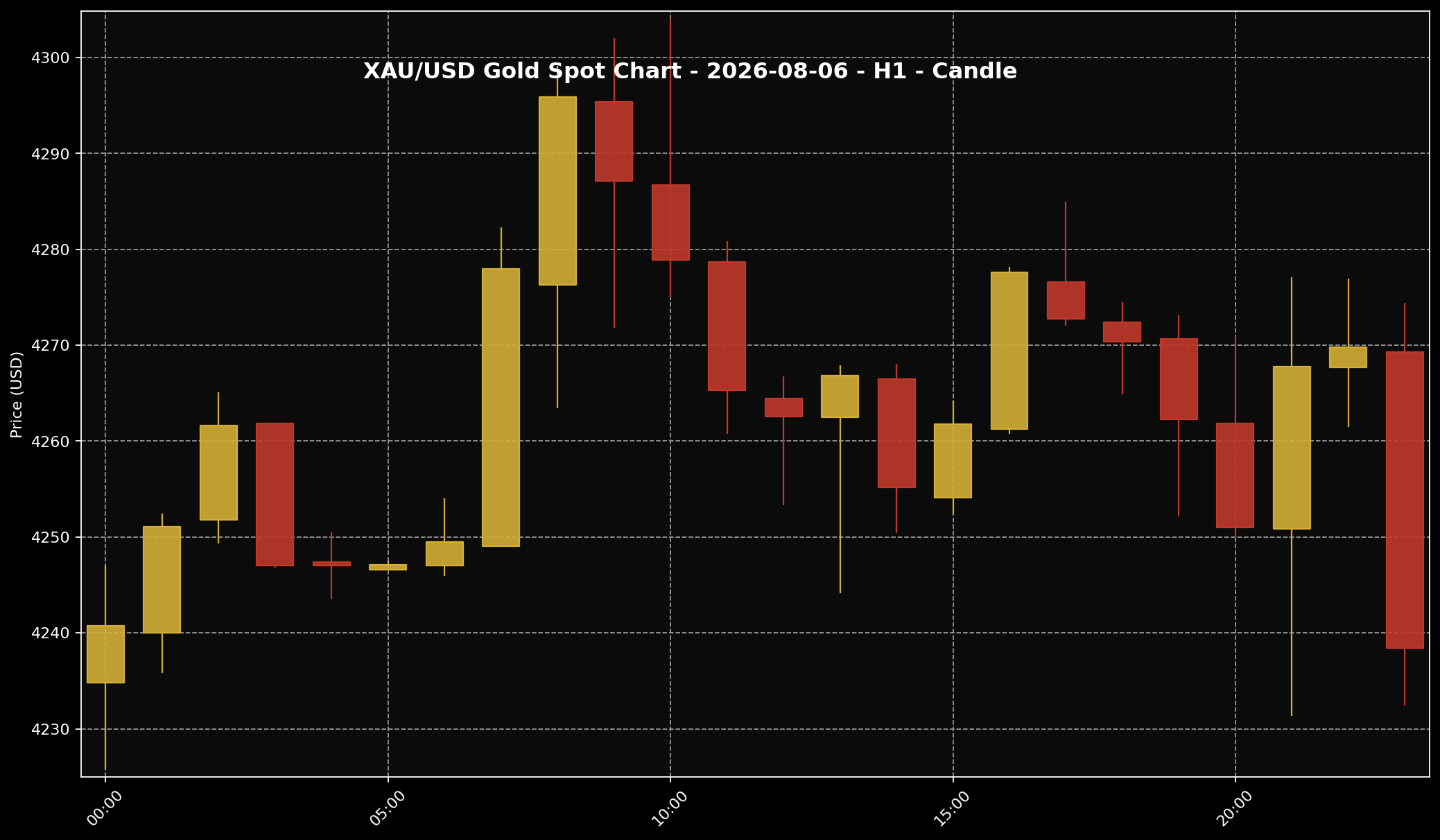 This chart helps readers see the gold price structure for the 6 August 2026 market session. It is used as market context and price-structure reference only.
1. The H1 XAU/USD chart for 6 August 2026 showed gold trying to stay strong around the upper USD4,200 area, after previously moving close to the USD4,300 zone. That tells us buyers were still present. The market had not walked away from gold. In a simple chart-reading sense, the USD4,200 area was still an important zone that gold managed to defend during the session.
2. But the final candle around 11:00 PM Malaysia time told a more mixed story. That candle opened around USD4,269.29, reached about USD4,274.42, fell as low as roughly USD4,232.45, and closed near USD4,238.43. Put simply, gold stayed above USD4,200, but late-session momentum faded. The close was nearer to the lower part of the candle range than the upper part.
3. So the chart was not saying “gold is breaking out strongly”. A better reading is this: gold was still supported, but it had not found enough strength to move clearly in one direction. This is not a buy or sell signal. It is only a simple way to understand market structure. For gold savers, this kind of chart is a reminder not to judge the whole day from one price level alone.
Why Did Gold Move This Way?
 The US dollar is often one of the key factors influencing gold prices. When the dollar is firmer, gold can face more noticeable pressure.
1. The main reason came from the US interest-rate story. When the market becomes less worried about more aggressive rate hikes, gold often gets some support. A rate hike simply means borrowing costs may go higher. When rates are expected to rise, investors may prefer assets that pay interest, such as bonds. When that worry eases, gold usually faces less pressure.
2. Lower US Treasury yields also helped. Treasury yields are basically the return investors can get from holding US government bonds. When those yields fall, gold does not look as weak from a return point of view, even though gold itself does not pay interest. That is why falling yields can support gold, at least in the short term.
3. But there was another side to the story. The US dollar was still firm, and that limited gold’s upside. Gold is usually priced in USD globally. When the dollar is stronger, buyers using other currencies often need to pay more for the same amount of gold. On top of that, safe-haven demand was not as strong as before. Safe-haven demand means demand for gold when investors feel they need protection from uncertainty. With the Hormuz-related premium reduced, gold had support, but not a free path higher.
What Does This Mean For Malaysian Gold Savers?
 For Malaysian gold savers, the key point is not only whether prices rise or fall. What matters more is budget, discipline and a clear purpose.
1. For Malaysian gold savers, the first point is this: do not read XAU/USD alone. Gold may be holding at a high level in US dollar terms, but the local feel depends on USD/MYR as well. For this session, USD/MYR was around 4.08966, putting the global spot conversion at about RM557.29 per gram. Again, that is a global spot conversion, not the local physical retail price.
2. The second point is that a session like this shows why physical gold saving should not be treated like short-term chart chasing. Gold had support from the rate and yield story, but it also faced pressure from a firm US dollar and changing safe-haven demand. If we only look at one headline, the market may sound very strong. If we look at the whole picture, the session was more mixed.
3. The third point is local pricing. When someone buys physical gold, the price is not just global spot divided by grams. There can be a buy-sell spread, product premium, operating cost, logistics and local pricing structure. The way I would read this for Malaysian savers is simple: use global spot as a guide for market direction, then check the actual local physical price before making a decision based on your own budget.
What Practical Action Makes More Sense?
 When gold prices move quickly, better decisions usually come from disciplined planning, not panic reactions.
1. If you already have a monthly gold-saving plan, a session like this is better used as a time to review your budget, not as a reason to chase price. If your gold budget is already set aside, small staged buying can still make more sense than committing the full budget at once. The aim is not to guess the lowest price. The aim is to build grams with discipline.
2. If your budget is tight this month, there is no need to force it. Gold can be a good long-term savings asset, but basic commitments still come first. In my view, gold saving works best when it comes from money that has already been planned for saving, not money meant for home needs, family needs, emergency funds or required monthly commitments.
3. If you are still unsure, watch four things first: global gold direction, USD/MYR, US Treasury yields and US rate-expectation news. After that, check the current local physical gold price. When these pieces are read together, the decision usually becomes clearer. For gold savers, the better step is not to react to one candle or one headline, but to follow your plan, stay within your means and build gradually.
Conclusion
The conclusion for 6 August 2026 is that gold was still holding above USD4,200 because US rate-hike worries had eased and US Treasury yields were lower. But the move was not clearly one-way because the US dollar was still firm and safe-haven demand had faded. So the story was not “gold is surging strongly”. It was more a case of gold staying supported while the market was still trying to find clearer direction. For Malaysian gold savers, the main focus is to read global gold together with USD/MYR, understand the difference between global spot and local physical pricing, and plan purchases around budget. If you already have a savings plan, continue in stages. If the budget is not suitable yet, check your own cash flow first. For those who are just starting to build gold savings little by little, the Gold Accumulation Program by Public Gold allows you to start saving gold from as low as RM100, based on your own ability and plan.