

What happened to gold on 11 August 2026? The story was not a sharp fall, and it was not a clean push higher either. Gold was still sitting near a two-month high, but the market became more careful because traders were waiting for US inflation data. At the same time, the Strait of Hormuz situation still gave gold some safe-haven support. So the day was more of a mixed session than a one-way move.
- Introduction
- What Happened To Gold On 11 August 2026?
- What Is The Gold Chart Showing?
- Why Did Gold Move This Way?
- What Does This Mean For Malaysian Gold Savers?
- What Practical Action Makes More Sense?
- Conclusion
What Happened To Gold On 11 August 2026?
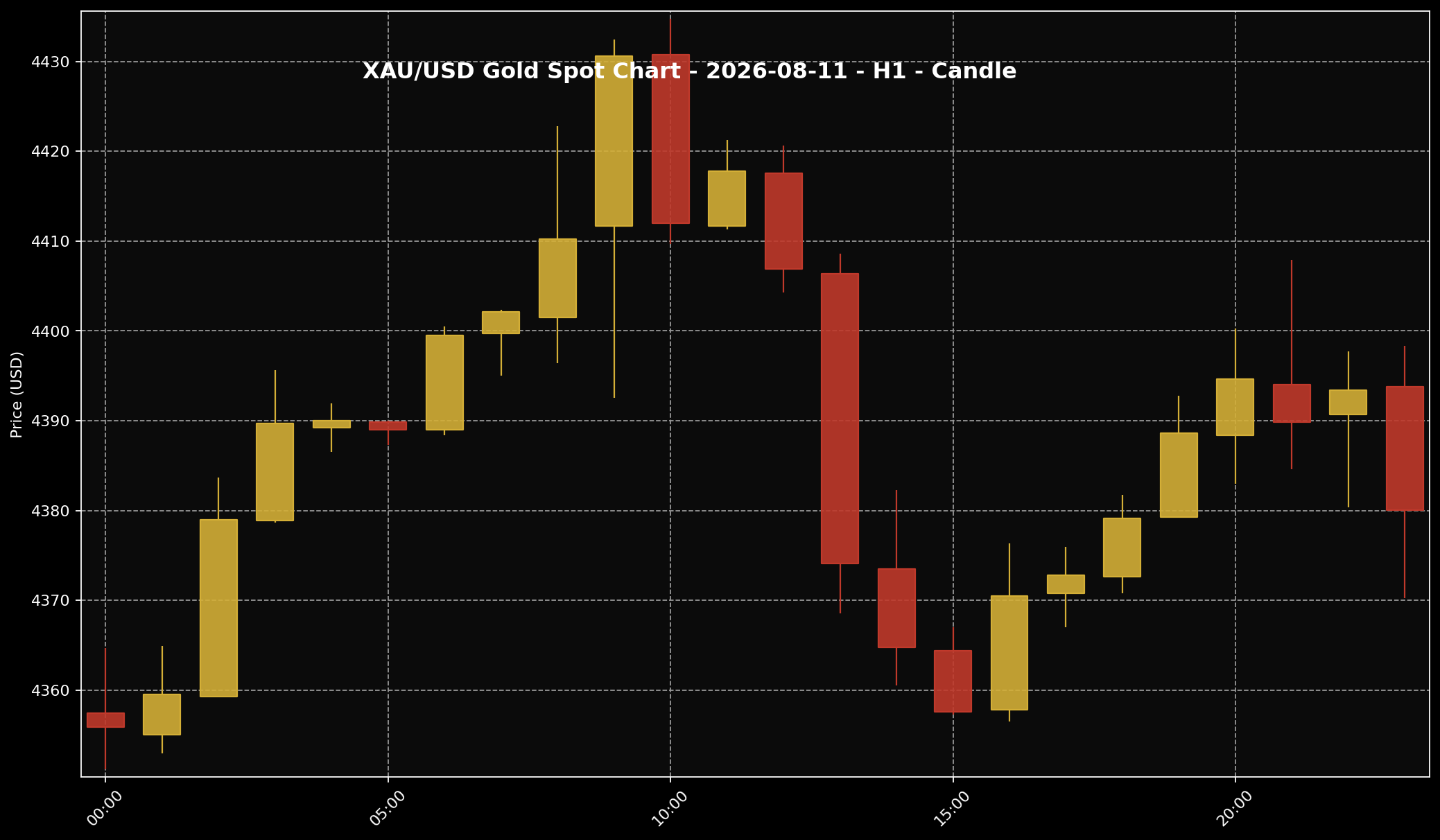 This chart shows the XAU/USD movement for the 11 August 2026 market session. Sifu Gold uses it as a visual reference, not a cue to buy emotionally.
1. Around 11:00 PM Malaysia time, global spot gold was around USD4,380.05 per troy ounce. In gram terms, that works out to about USD140.82 per gram. Using USD/MYR around 4.09217 at the same snapshot, the global spot value was roughly RM17,923.91 per troy ounce, or about RM576.27 per gram.
2. That Ringgit translation matters for Malaysian readers, but there is one important point. These figures are global spot conversions. They are not the same as local physical gold retail prices in Malaysia. Local physical pricing can include product premiums, buy-sell spread, operating cost, logistics, local pricing structure and the movement of USD/MYR.
3. The market story was mixed. Gold had already climbed towards a two-month high, so some traders reduced earlier gains instead of chasing the move higher. At the same time, the market was waiting for US inflation data. That made both buyers and sellers more careful before the next big signal came out.
What Is The Gold Chart Showing?
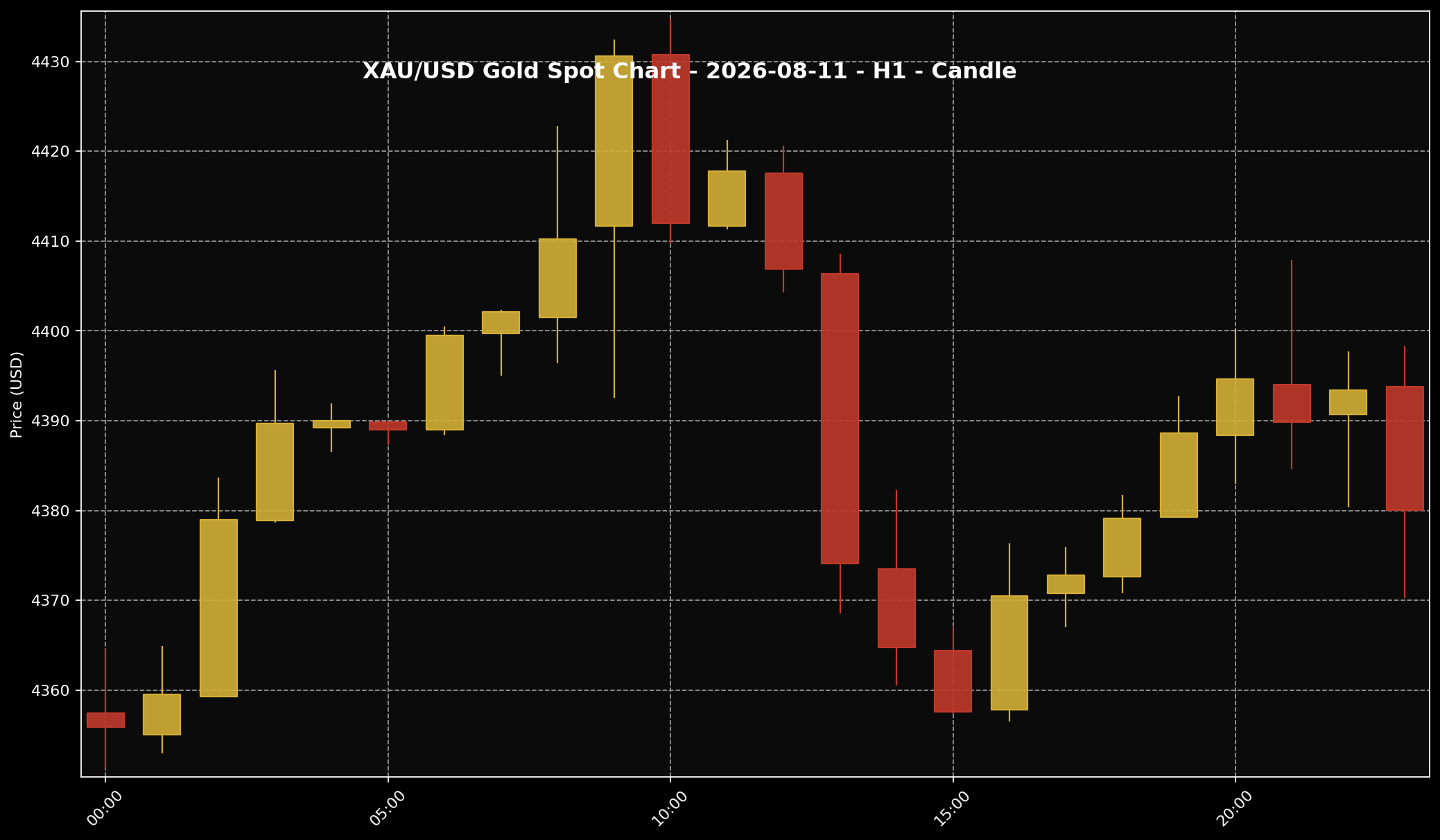 This chart helps readers see the gold price structure for the 11 August 2026 market session. It is used as market context and price-structure reference only.
1. Looking at the H1 chart for 11 August 2026, gold had already pushed up from the lower area earlier in the day. It moved higher towards the upper zone, then gave back part of that strength. Put simply, gold did look strong earlier, but that strength did not fully hold into the later snapshot.
2. The reference candle around 11:00 PM Malaysia time opened near USD4,393.82, reached a high around USD4,398.31, dipped to about USD4,370.26, and closed around USD4,380.05. So the chart was not showing a major collapse. It showed gold staying in a high area, then getting capped and moving back into a more controlled range.
3. For gold savers, this kind of chart is better read as market structure, not as an instruction. It tells us that the market was reassessing price after a strong run. When gold has already moved higher, it is normal to see some back-and-forth movement in one session. The chart helps us understand price behaviour, but it should be used as market context rather than an instruction to act.
Why Did Gold Move This Way?
 The US dollar is often one of the key factors influencing gold prices. When the dollar is firmer, gold can face more noticeable pressure.
1. The biggest reason was the US inflation data that the market was waiting for. Inflation data, often called CPI, gives the market a clue about whether prices in the US are still rising quickly or starting to cool. If inflation stays high, traders may think US interest rates need to stay high for longer. When that happens, gold can find it harder to push higher.
2. Why do US interest rates matter to gold? Because gold does not pay interest or dividends. If US bonds are offering attractive returns, some investors may prefer those interest-paying assets for a while. That can limit gold’s momentum, even when people are still interested in gold as a long-term asset.
3. But the day was not only about pressure. The Strait of Hormuz situation also gave gold some support. When geopolitical tension rises, gold often gets attention as a safe-haven asset. That is why gold did not simply fall away from the high area even though the US dollar was firmer and the rate backdrop was still not easy for gold. The market was weighing both sides at the same time: US inflation uncertainty and safe-haven demand.
What Does This Mean For Malaysian Gold Savers?
 For Malaysian gold savers, the key point is not only whether prices rise or fall. What matters more is budget, discipline and a clear purpose.
1. For Malaysian gold savers, the useful point is not only whether gold moved up or down in US dollars. We save, compare and plan in Ringgit. So when gold moves in USD, the local feeling can still change depending on USD/MYR. Two people can read the same global gold story, but the local price can still feel high once it is translated into Ringgit.
2. At the global spot level, around RM576.27 per gram suggests that gold was still sitting in a high area for Malaysian readers. But again, that is not the final physical retail price. If someone is buying physical gold, the final price usually includes premium, buy-sell spread and product structure. So it is better to compare three things together: global spot gold, USD/MYR and the actual local physical price.
3. The way I see it at Sifu Gold, gold still has long-term support from wealth protection and global risk factors. But in the short term, price can still move around because the market is waiting for major data. For someone collecting gold bit by bit, the focus should not be guessing the lowest price. The focus should be building grams with discipline, checking the budget, and knowing the difference between global spot price and the physical price actually paid.
What Practical Action Makes More Sense?
 When gold prices move quickly, better decisions usually come from disciplined planning, not panic reactions.
1. If you already have a monthly gold-saving budget, staged buying still makes more sense than trying to catch one perfect price. For example, the budget can be split into smaller purchases instead of being committed at one time. This keeps the decision from depending too much on one market day.
2. If the monthly budget is tight, there is no need to force it. Gold can be useful for long-term saving, but home commitments, family needs, emergency funds and daily cash flow still come first. Do not go in heavily all at once just because the price is moving. Gold saving should support your financial plan, not make your cash flow feel squeezed.
3. If you are still unsure, check a few things first: the global gold price, USD/MYR, local physical prices, buy-sell spread and your own budget. If those still fit your plan, a small staged purchase can be considered. If not, waiting for a clearer setup is also a disciplined decision. The key is not to buy because of FOMO, and not to sell just because of one daily move.
Conclusion
In short, gold on 11 August 2026 was still near its two-month high, but the market did not yet have a strong new direction. US inflation data was the main thing traders were waiting for, while the Strait of Hormuz situation continued to support gold as a safe-haven asset. That is why the session is better read as a market weighing several factors, not as a simple one-way move. For Malaysian gold savers, I would keep the focus on budget and discipline. If you already have a monthly gold-saving plan, continue in stages according to what you can afford. If the local physical price still feels high or the budget is not comfortable yet, check first before deciding. For those who are just starting to collect grams gradually, the Gold Accumulation Program by Public Gold allows you to start saving gold from as low as RM100, without needing to commit a large amount straight away.