

What happened to gold on 14 August 2026? Gold found support after weaker US retail sales made the market rethink how aggressive the Federal Reserve may need to be with interest rates. That helped reduce some pressure from the US dollar. But this was not a clean “everything is bullish now” kind of day. The market was still digesting the earlier inflation story, so the move looked more like daily support than a confirmed big change in direction.
- Introduction
- What Happened To Gold On 14 August 2026?
- What Is The Gold Chart Showing?
- Why Did Gold Move This Way?
- What Does This Mean For Malaysian Gold Savers?
- What Practical Action Makes More Sense?
- Conclusion
What Happened To Gold On 14 August 2026?
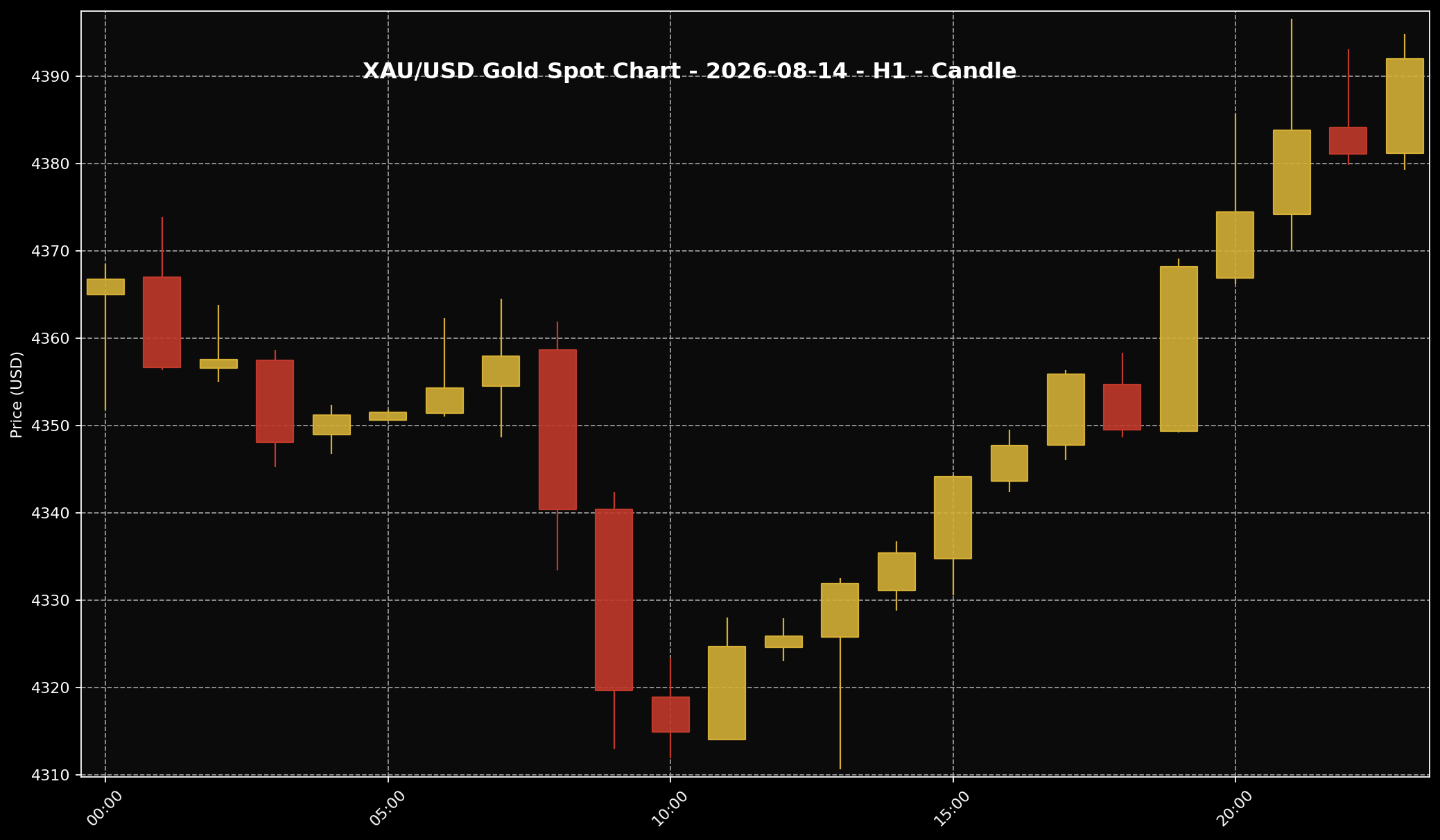 This chart shows the XAU/USD movement for the 14 August 2026 market session. Sifu Gold uses it as a visual reference, not a cue to buy emotionally.
1. At the reference snapshot around 11:00 PM Malaysia time, global spot gold was around USD4,391.92 per troy ounce. Converted into grams, that was roughly USD141.20 per gram. Using USD/MYR at around 4.08579, the same global spot reference was about RM17,944.47 per troy ounce, or around RM576.93 per gram.
2. These Ringgit figures are global spot conversions. They are not local physical retail gold prices in Malaysia. Physical gold prices can differ because they may include product premium, buy-sell spread, operating cost, logistics, product structure, local pricing and currency movement.
3. The main story was simple enough: weaker US retail sales made the market think the Fed may not need to push interest rates too aggressively. When that idea gained traction, the US dollar became less of a burden for gold. That gave gold room to recover, even though the wider market was still not completely done with the inflation and Treasury yield story.
What Is The Gold Chart Showing?
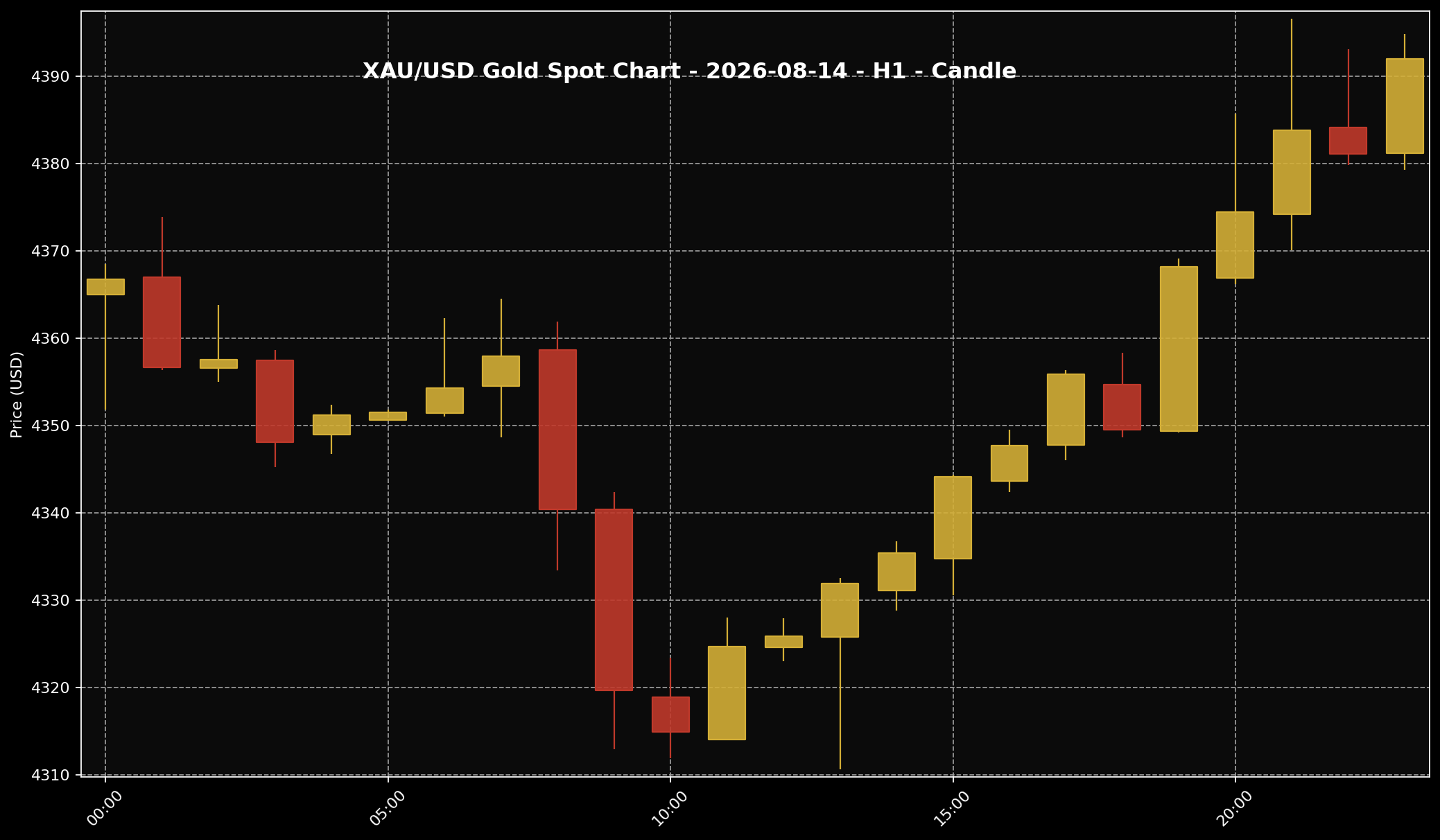 This chart helps readers see the gold price structure for the 14 August 2026 market session. It is used as market context and price-structure reference only.
1. Looking at the H1 XAU/USD chart, gold did not move in one straight line from start to finish. Earlier in the session, price was still moving around the USD4,350 to USD4,360 area. After that, gold dipped lower towards the USD4,310 to USD4,320 zone before buyers started to come back in.
2. The more useful part is what happened after that dip. Gold started to climb back gradually, candle by candle, from the lower part of the session towards the upper area again. By the later part of the session, price was back around the USD4,380 to USD4,390 zone. The final reference candle closed around USD4,391.92, near the upper part of its own range.
3. Put simply, the chart showed gold being pushed down first, then finding support again towards the end of the session. I would not read this as a trading signal. For Sifu Gold readers, the better use of this chart is to understand the market mood: gold tried to recover when the US dollar and Fed-rate expectations started to shift.
Why Did Gold Move This Way?
 The US dollar is often one of the key factors influencing gold prices. When the dollar is firmer, gold can face more noticeable pressure.
1. The clearest daily trigger came from US retail sales. When retail sales came in weaker, the market started to think the Fed may have more room to avoid another aggressive rate move. This matters for gold because gold does not pay interest. When interest rates are expected to stay high, some investors prefer assets that pay a return. When that pressure eases a little, gold usually gets more breathing space.
2. The US dollar also played a big role. Global gold prices are usually quoted in US dollars. When the dollar weakens, gold can become more attractive to buyers outside the United States because the same gold does not feel as expensive in other currencies. That helped gold during this session.
3. But I would still keep the story balanced. Reuters described a wider weekly picture where investors were unwinding part of an inflation-fuelled rally. Kitco also pointed to firmer Treasury yields, linked to renewed oil-market risk, as a counterweight. So the full picture is this: gold rose because the dollar and Fed expectations gave it support, but inflation and US bond yields were still on the market’s radar.
What Does This Mean For Malaysian Gold Savers?
 For Malaysian gold savers, the key point is not only whether prices rise or fall. What matters more is budget, discipline and a clear purpose.
1. For Malaysian gold savers, the first point is that this is not only a “gold moved in USD” story. When global gold moves, Malaysian readers still need to look at how that price translates into Ringgit. At the reference snapshot, global spot gold was around RM576.93 per gram after conversion using USD/MYR at about 4.08579.
2. But that RM576.93 per gram should not be read as a local physical retail price. It is only the global spot price translated into Ringgit. When you buy physical gold in Malaysia, the price you see usually includes more than the raw global spot price. There can be product premium, buy-sell spread, operating cost, logistics and local pricing structure.
3. The more useful lesson, in my view, is the connection between US economic data, the US dollar, US Treasury yields, USD/MYR and the gold price Malaysian savers actually feel. Once that chain is clearer, it becomes easier not to react only because one candle moved up or one headline came out. You can look at your gold-saving plan with better structure.
What Practical Action Makes More Sense?
 When gold prices move quickly, better decisions usually come from disciplined planning, not panic reactions.
1. If you already have a monthly gold-saving budget, a session like this can be a good time to review your plan. Not because the price must keep rising after this. The point is that when the market is mixed, small staged buying usually fits long-term gold savers better than trying to guess the lowest price of the day.
2. If this month’s budget is tight, there is no need to force it. Gold can be useful as a savings asset, but family commitments, home commitments, emergency funds and monthly cash flow still matter. Do not go in heavily all at once just because the price looks like it is moving up or because you feel you might miss out. Gold saving should follow ability, not one day’s emotion.
3. If you are still unsure, waiting and watching is also a valid choice. You can monitor the US dollar, US Treasury yields, Fed rate expectations, USD/MYR and local physical gold prices. The better question is not “must I buy today or wait?” A more useful question is: does this fit my budget, do I understand the buy-sell spread, and am I building grams for the long term?
Conclusion
My conclusion is that gold found support on 14 August 2026 because weaker US retail sales reduced expectations for a more aggressive Fed path. A less pressured US dollar helped gold recover, and the H1 chart showed price climbing from the lower part of the session back towards the upper area by the end of the day. But the inflation and Treasury yield story was still not fully out of the picture. So for Malaysian gold savers, the more sensible approach is to follow your budget, understand the difference between global spot and local physical pricing, and buy gradually if that is already part of your savings plan. If you are just starting, the Gold Accumulation Program by Public Gold allows you to begin saving gold from as low as RM100, which can suit those who want to build grams bit by bit according to their own ability.