

What happened to gold on 20 August 2026? Gold was still sitting in a high price area, but the move was not clean in one direction. Earlier support came from lower US Treasury yields. Later, the market started looking again at stronger US data, inflation concerns, some investors locking in earlier gains, and a rebound in yields. For Malaysian gold savers, the useful point is this: gold still had support, but the market had not found a strong new reason to chase it much higher.
- Introduction
- What Happened To Gold On 20 August 2026?
- What Is The Gold Chart Showing?
- Why Did Gold Move This Way?
- What Does This Mean For Gold Savers?
- Conclusion
What Happened To Gold On 20 August 2026?
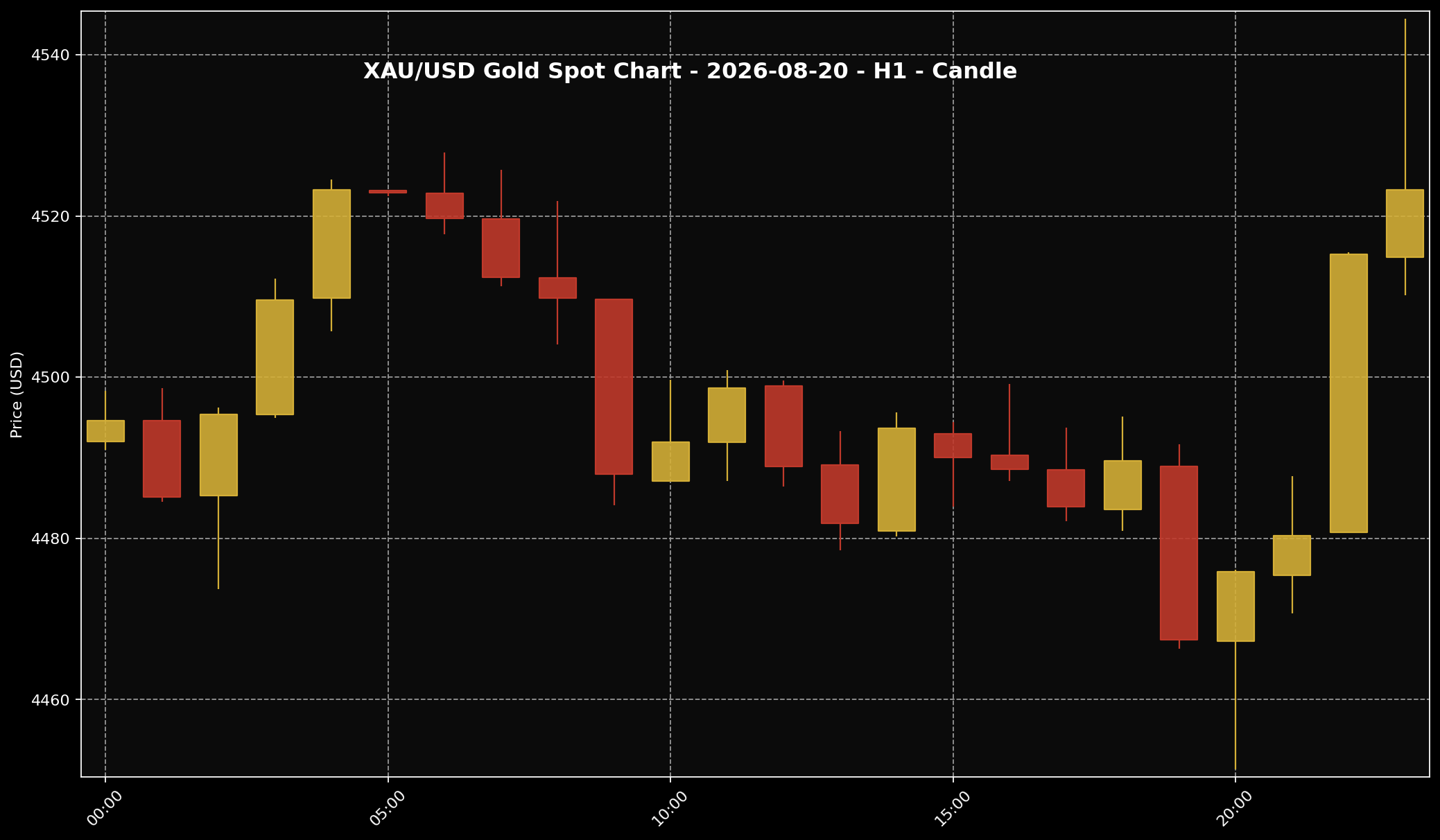 This chart shows the XAU/USD movement for the 20 August 2026 market session. Sifu Gold uses it as a visual reference, not a cue to buy emotionally.
1. On 20 August 2026, gold did not give a simple one-way story. The approved price reference around 11:00 PM Malaysia time showed XAU/USD around USD4,523.21 per troy ounce. In gram terms, that was about USD145.42 per gram. Using USD/MYR around 4.04564, the same global spot reference was roughly RM18,299.27 per troy ounce, or about RM588.34 per gram. These Ringgit figures are global spot conversions, not local physical retail gold prices in Malaysia.
2. Put simply, gold was still supported by the earlier move, but the market did not keep pushing it higher in a straight line. Lower US Treasury yields had helped gold hold near a stronger area. Then stronger US economic data, inflation worries, and a rebound in yields came back into the picture. That made gold look firm at one point, but less convincing when it tried to move further.
3. For readers who save gold in Malaysia, this kind of move matters because it shows a market that still respects gold, but is not fully relaxed about the bigger US rate story. Gold was not collapsing, but it was also not racing higher without resistance. That is why I would read the day as mixed: supported, but capped.
What Is The Gold Chart Showing?
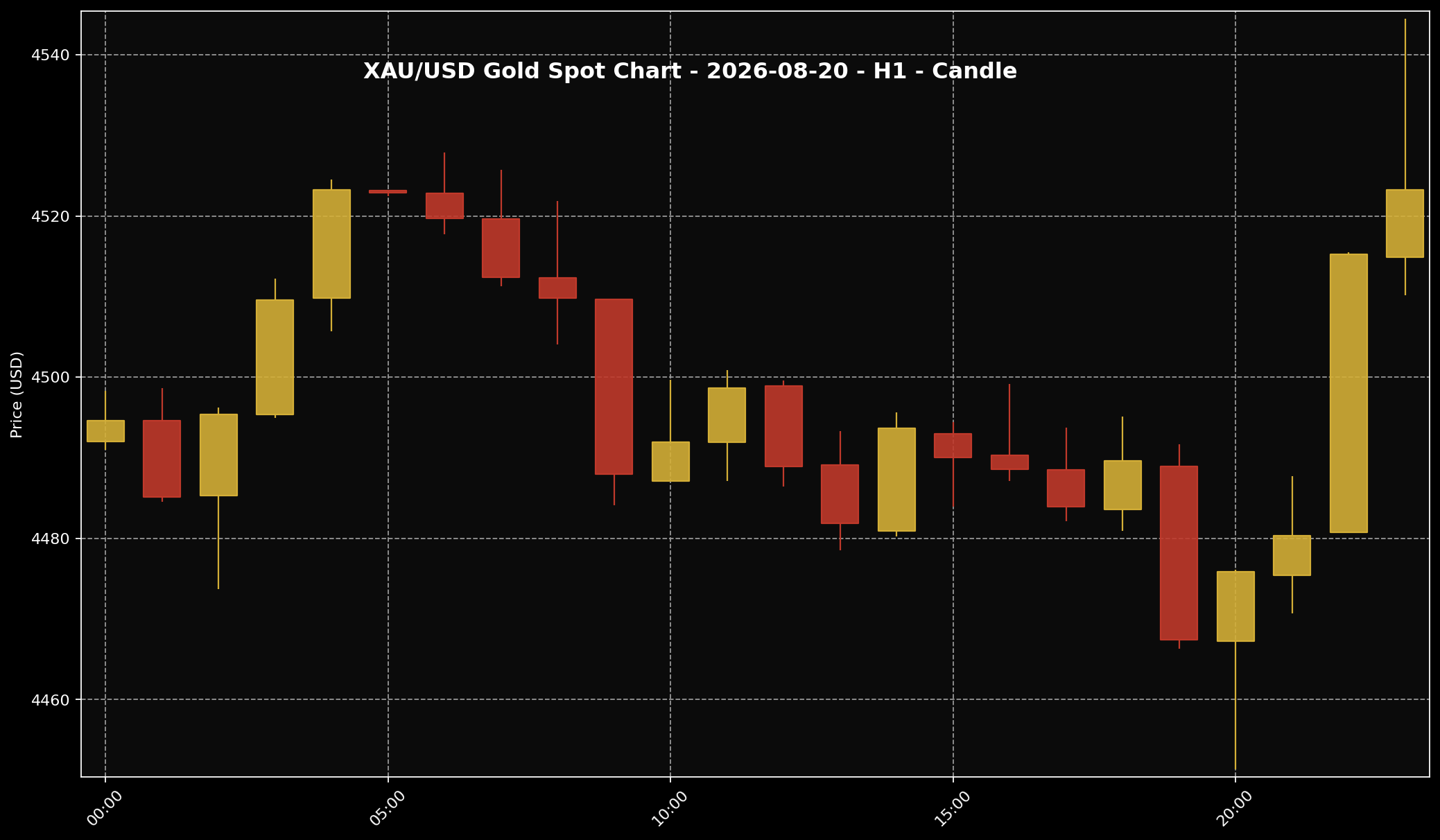 This chart helps readers see the gold price structure for the 20 August 2026 market session. It is used as market context and price-structure reference only.
1. The H1 chart for 20 August 2026 showed an active session. Gold moved higher earlier, then slipped back into the middle of the day’s range, before trying to stabilise and push up again later. That tells us buyers were still around, but sellers also appeared whenever gold moved into higher areas. So the chart was not showing a dead market. It was showing a market still deciding how much further it wanted to go.
2. The final H1 candle in the reference data opened around USD4,514.91, dipped to about USD4,510.12, rose as high as around USD4,544.49, and closed near USD4,523.21. That is quite a wide movement inside one hourly candle. In simple terms, gold was still able to test the upper area, but the move was not smooth enough to call it a clean continuation higher.
3. I would treat this chart as a market-structure reading only. It helps us understand the rhythm of the day: gold tried to move up, faced some pushback, then found buyers again. That is useful for context, but it is not a buy or sell signal. For Sifu Gold readers, the chart is there to explain behaviour, not to turn the article into a trading setup.
Why Did Gold Move This Way?
 The US dollar is often one of the key factors influencing gold prices. When the dollar is firmer, gold can face more noticeable pressure.
1. The main story came from a few things moving together: US Treasury yields, stronger US data, inflation concerns, and investors locking in earlier gains after the rally. When yields fall, gold often gets more support because bonds become less attractive by comparison. But when yields rise again, gold has to compete with assets that pay income. That is one reason gold can lose momentum even when it still looks high on the chart.
2. Kitco’s daily gold coverage pointed to stronger-than-expected US labour and regional manufacturing data trimming part of the earlier precious-metals rally. In plain English, stronger US data can make the market think the Federal Reserve may not need to rush into easier policy. That can make gold’s next move harder, because gold usually prefers a backdrop where rates and yields are not pushing too strongly against it.
3. Reuters-linked market coverage through the validated publisher route also supported the same wider storyline. Gold had been helped earlier by lower bond yields, but later the market had to balance inflation concerns, hopes for lower real rates, and some investors reducing exposure after the recent rally. So the day became a tug of war. One side still saw support for gold. The other side did not want to chase it too far while US data, inflation and yields were still in focus.
What Does This Mean For Gold Savers?
 For Malaysian gold savers, the key point is to understand the gap between global spot price and local physical price, then act according to budget and discipline.
1. For Malaysian gold savers, I would not read 20 August 2026 as a simple “gold is strong, so rush” kind of day. The better reading is this: gold was still in a high global price area, but the market was sensitive to US data, inflation and Treasury yields. That means daily price movement can still shift quickly, even when the longer-term interest in gold remains alive.
2. Also, the global spot price is not the same as the physical gold price people see locally. The spot conversion was about RM588.34 per gram based on USD/MYR around 4.04564, but local physical gold pricing can include currency movement, product premium, buy-sell spread, operating cost and local pricing structure. So XAU/USD is a useful benchmark, but it should not be treated as the exact price of physical gold in Malaysia.
3. From a practical angle, start with budget first. If you already have a monthly gold-saving plan, small staged buying is usually more organised than committing the full budget at once. If cash flow is tight, check commitments and emergency funds first. If the market still feels unclear to you, waiting until your own budget and the price picture look clearer can also be a disciplined decision.
Conclusion
The main takeaway for 20 August 2026 is that gold stayed high, but the rally did not move cleanly higher. Lower US Treasury yields helped earlier, but stronger US data, inflation concerns, investors locking in earlier gains, and a rebound in yields later made the market more cautious. For Malaysian gold savers, the key is not to read the day too simply. Look at the global price, translate it into Ringgit, and remember the difference between spot gold and local physical pricing. If you want to keep saving gold, let it follow your plan, your budget and your own cash flow. Gold Accumulation Program by Public Gold allows you to start saving gold from as low as RM100, which can be a practical way to build grams gradually according to your own affordability.