

Table of Contents
- Introduction: The Trust Behind the Glitter of Gold
- The 2 Main Conditions for Gold Zakat: Nisab and Hawl
- How to Calculate Gold Zakat on Savings (Bars, Dinars, Coins)
- How to Calculate Gold Zakat on Jewellery (Worn Items)
- Conclusion: Fulfil Your Duty, Purify Your Wealth
Introduction: The Trust Behind the Glitter of Gold
For a Muslim, the ownership of gold is seen as more than just an investment or a way to protect wealth. More than that, it is a trust (*amanah*) from Allah (SWT) that comes with responsibilities. One of the most important of these responsibilities, which is often overlooked or misunderstood, is the obligation to pay Zakat on the gold one owns. Many people understand that Gold Zakat is obligatory, but how to calculate it often becomes a point of confusion. Is the method the same for a gold bar stored in a safe as it is for a bracelet worn every day? The answer is no.
There is a very big and important difference between the calculation method for Gold Zakat on savings and Gold Zakat on jewellery. Confusion in this matter can lead to you either overpaying or underpaying your Zakat. This complete guide will take you step-by-step to calculate both types of Gold Zakat correctly and easily, based on the latest guidance in Malaysia. Let’s fulfil our responsibility with the correct knowledge.
The 2 Main Conditions for Gold Zakat: Nisab and Hawl

Before we get into the formulas and calculation examples, it is crucial that we first understand the two basic conditions that must be met simultaneously before Gold Zakat becomes obligatory upon you. If either one of these conditions is not met, then you are not yet obliged to pay Zakat for that year. These two conditions, the Nisab and the Hawl, are the determinants for the obligation of paying Gold Zakat.
1. Reaching the Nisab (The Minimum Weight Threshold)
The Nisab is the minimum weight of gold set by Shariah law as a benchmark to determine whether a person is considered “wealthy enough” to pay Zakat. Based on the hadith of the Prophet Muhammad (peace be upon him) and the consensus (*ijma*) of the scholars, the Nisab for pure gold is 20 dinars, the weight of which is equivalent to 85 grams. Therefore, the **Nisab for Gold Zakat in 2025** (and for previous years) is **85 grams** of pure gold (999.9 or 24-carat purity).
This means that if the total weight of all the gold you own (whether in the form of savings or jewellery) is less than 85 grams, then you are not yet obliged to pay Gold Zakat. The obligation only begins when your ownership reaches or exceeds this level. The Nisab is the first gateway to the obligation of paying Gold Zakat.
2. Completing the Hawl (The Ownership Period of One Year)
The Hawl is the period of ownership of the gold. The condition is that the gold that has reached the Nisab must have been in your possession for one full lunar year (a year in the Hijri calendar), which is approximately 354 or 355 days. Zakat is only obligatory on the gold that has been in your possession for more than this Hawl period. This Hawl period is counted from the first day your gold ownership reaches the Nisab level of 85 grams.
For example, if you buy 50 grams of gold in January and then add another 40 grams in June (making your total 90 grams, which is over the Nisab), then your Hawl count begins from that day in June. Your Gold Zakat will only become obligatory in June of the following year, on the condition that your total ownership at that time is still above the Nisab. Understanding these two conditions is the foundation before calculating your Gold Zakat amount.
How to Calculate Gold Zakat on Savings (Bars, Dinars, Coins)

This is the calculation method for the simplest and most straightforward category of gold: gold that you buy with the sole intention of investment or savings. This includes gold bars, gold coins, dinars, and even jewellery that you have **never worn** even once during the one-year Hawl period. For this category, the calculation of Gold Zakat is very direct. Let’s look at the steps.
1. Step 1: Determine the Total Weight of Your Savings Gold
The first step is to take an inventory and add up the weight of all the investment gold items you own. It doesn’t matter if they come in different shapes or brands. What’s important is the total weight. For example, let’s say in your savings, you have:
- 1 x 50g gold bar
- 1 x 20g gold bar
- 2 x 1 Dinar coins (the weight of each is 4.25g, so the total is 8.5g)
Total Combined Weight: 50g + 20g + 8.5g = **78.5 grams**.
2. Step 2: Check the Nisab and Hawl Conditions
Now, we check if the conditions we discussed earlier have been met.
- Nisab: Your total gold weight is 78.5 grams. This figure is **less than** the 85-gram Nisab.
- Hawl: Since the Nisab condition has not been met, the Hawl condition becomes irrelevant for this year.
In this scenario, the Gold Zakat on savings is **not obligatory** for you to pay because your total ownership has not yet reached the minimum threshold. You only need to start monitoring it when your savings increase in the future.
3. Step 3: An Example Calculation If the Conditions Are Met
Now, let’s change the scenario. Let’s say your savings total **95 grams** and you have held them for over a year. The Nisab condition (95g > 85g) and the Hawl have been met. Therefore, Gold Zakat is obligatory on the **entire 95 grams**. You need to find the current price of gold per gram (you can refer to the buy-back price on a Zakat institution’s website or a bullion dealer). Let’s assume the current price is RM300/gram.
- Total Value of the Gold: 95 grams x RM300 = **RM28,500**.
- Zakat Rate: The rate set for Gold Zakat is 2.5%.
- Total Zakat to be Paid: 2.5% x RM28,500 = **RM712.50**.
This is the total amount of Gold Zakat on savings that you need to pay for that year.
How to Calculate Gold Zakat on Jewellery (Worn Items)
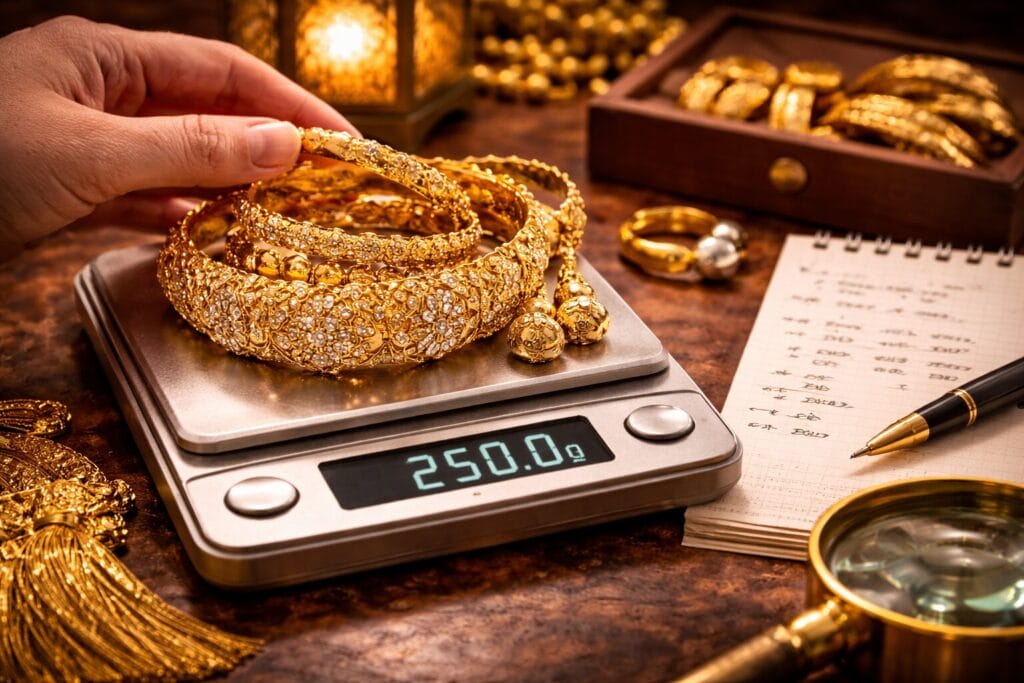
This is the calculation method for jewellery (such as rings, necklaces, bracelets, and earrings) that you wear, even if it’s only once during the one-year Hawl period. The calculation method is slightly different and is more lenient compared to savings gold. This is because Islam recognises that jewellery is a necessity of adornment for women. The calculation for Gold Zakat on jewellery involves an important concept called the *’Uruf*.
1. Step 1: Understand the Important Concept of the ‘Uruf (A Customary Exemption Limit)
The *’Uruf* is the limit on the weight of jewellery worn that is considered “not excessive” and “reasonable” according to the local customs of a society. In the context of Gold Zakat on jewellery, it functions as an exemption limit. Zakat is only obligatory on the weight of the gold that **exceeds** this *’Uruf* limit. This is a leniency (*rukhsah*) given in Islam. What is important to know is that this customary limit varies by state in Malaysia, as set by the respective state’s Islamic religious council.
For example (these rates can change, so always check with your local zakat authority for the latest figures):
- Federal Territories (Kuala Lumpur, Putrajaya & Labuan): 800 grams
- Selangor: 800 grams
- Johor: 850 grams
- Negeri Sembilan: 200 grams
You must refer to the *’Uruf* rate in the state where you reside.
2. Step 2: Determine the Zakat-able Weight of Your Jewellery (After Deducting the ‘Uruf)
Now, let’s do a calculation example. Let’s assume you live in **Negeri Sembilan**, where the *’Uruf* limit is **200 grams**. The total weight of all the jewellery that you wear is **250 grams**. You have owned it for over a year.
- Weight on which Zakat is Due: Total Weight – ‘Uruf Limit
- = 250 grams – 200 grams = **50 grams**.
In this case, Gold Zakat only needs to be paid on this excess 50 grams, not on the entire 250 grams. If the total weight of your jewellery was 190 grams (which is less than the 200g *’Uruf* limit), then no Gold Zakat would be due on it, even though it is over the 85g Nisab.
3. Step 3: Calculate the Current Value and the Zakat Amount to be Paid
Using the zakat-able weight from above (50 grams) and the same current gold price (RM300/gram), the calculation is as follows:
- Value of Gold on which Zakat is Due: 50 grams x RM300 = **RM15,000**.
- Total Zakat (2.5%): 2.5% x RM15,000 = **RM375**.
This is the total amount of Gold Zakat on jewellery that you need to pay for that year. It is clearly a much more lenient method compared to the Gold Zakat on savings.
Conclusion: Fulfil Your Duty, Purify Your Wealth
Understanding how to calculate Gold Zakat is a religious obligation for every Muslim gold owner who has met the conditions. It might seem a little complicated at first, but it is actually very simple once you understand the basic difference between the two types of gold. It is a practice that not only benefits the recipients, but also the payer. Fulfilling your Gold Zakat is a sign of our gratitude to Allah.
- For Savings Gold: If the total weight exceeds the 85-gram Nisab and the Hawl is complete, Gold Zakat is due on the ENTIRE weight of the savings.
- For Worn Jewellery: Zakat is only due on the WEIGHT THAT EXCEEDS the customary *’Uruf* limit that you have confirmed with your local Zakat authority in Malaysia.
- By paying your Gold Zakat, you are not only fulfilling one of the Pillars of Islam, but you are also purifying and blessing the rest of the wealth that has been entrusted to you by Allah (SWT). It is an investment for this life and the next.
✨ WANT TO START SAVING IN GOLD?
With just RM100, you can begin your gold savings journey with Public Gold.
This is the perfect opportunity to build a stronger and more secure financial future.