
Table of Contents
- Introduction: From Personal Adornment to a Wise Investment
- Tip #1: DON’T Choose 9ct Gold, DO Choose 18ct Gold or Higher
- Tip #2: AVOID Gemstones, Choose 100% Gold Designs
- Tip #3: Choose Solid and Thick Designs, Not Hollow Ones
- Tips #4 & #5: Compare Workmanship Costs & Choose a Shop with a Good Buy-Back Policy
- Conclusion: Turn Your Jewellery into a True Asset
Introduction: From Personal Adornment to a Wise Investment
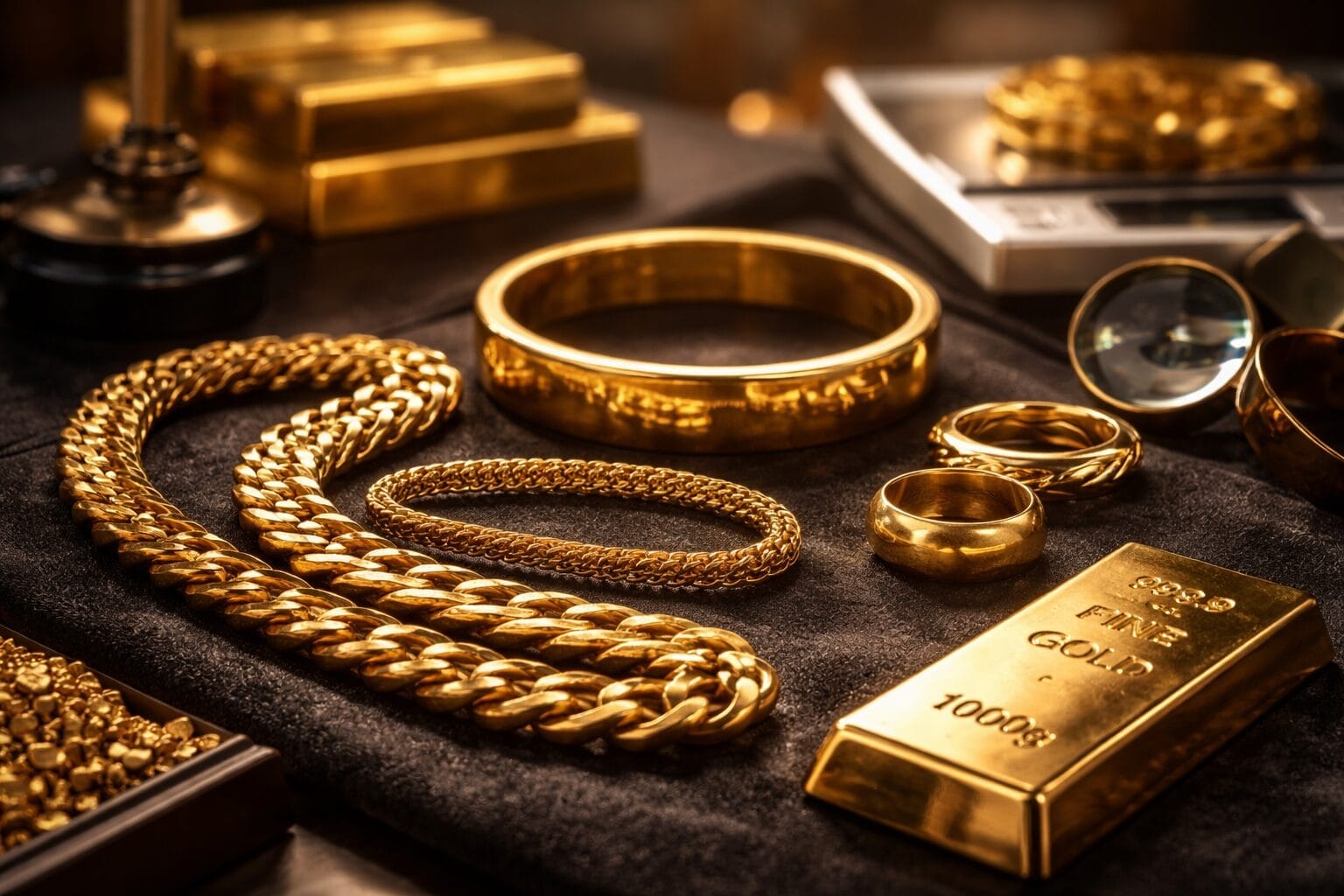
For many, especially women, buying jewellery as an investment is a very attractive and intuitive concept. It’s one of a few investment assets in the world that you can actually wear as an adornment to enhance your appearance, while its value has the potential to increase over time. “Wear your wealth, and watch it grow”—that’s the dream. This concept elevates a piece of jewellery from being just an expense to a form of savings that can be enjoyed.
However, the reality is that many people end up disappointed and feel like they’ve made a “loss” when they try to sell their jewellery back after a few years. The value they are offered is often far lower than what they expected, even if the spot price of gold has risen. This is because not all jewellery is created equal from an investment perspective. There are smart choices, and there are choices that will almost certainly lose you money. Don’t worry, with these 5 smart tips, you will be guided to choose a necklace, bracelet, or ring that is not only beautiful to the eye, but also “beautiful” financially.
Tip #1: DON’T Choose 9ct Gold, DO Choose 18ct Gold or Higher
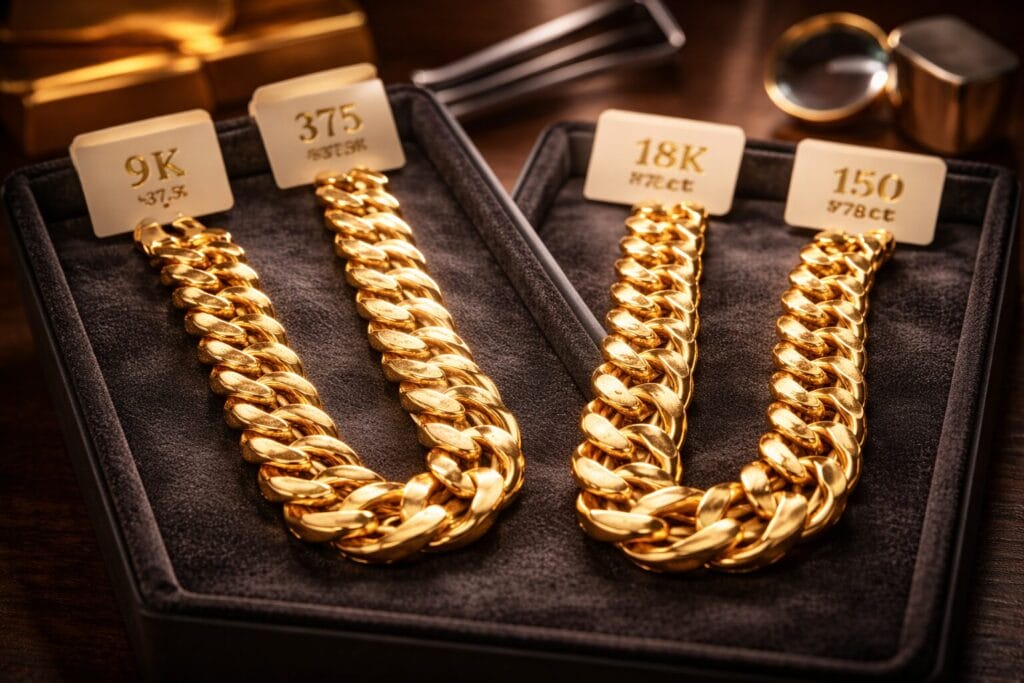
This is the most fundamental, most critical, and most important rule in choosing jewellery as an investment. It is the foundation for all your other decisions. The grade or purity of the gold will determine its intrinsic value and, more importantly, its resale value. Choosing the wrong grade is the biggest mistake that will guarantee you a loss before you have even begun. Ensure your jewellery has a high purity.
1. 18ct or 22ct Gold is the Investment Standard
In the UK, 18-carat (18ct) gold, which has a pure gold content of 75%, is often considered a good standard for high-quality jewellery that balances durability with high value. Even better for investment purposes is 22-carat (22ct) gold, which contains 91.6% pure gold. The remaining percentage is a mix of other metals (like silver or copper) intended to harden the gold to make it more durable for adornment. For investment-grade jewellery, the higher the carat, the better. The benefit is that it has a high resale value and is easily recognised anywhere, including by pawnbrokers.
2. Avoid Low-Grade Gold (Like 9ct or Gold-Plated)
In the market, you will often come across jewellery made from lower-grade gold, with 9-carat (9ct) being very common in the UK. This only has a 37.5% pure gold content. This type of jewellery has a higher content of other metals, which makes its manufacturing cost cheaper. However, from an investment perspective, it is a very poor choice. The same applies to gold-plated or gold-filled items, which have a negligible amount of actual gold.
The benefit of choosing 18ct gold or higher is clear: you get more “real gold” for every pound you spend. When you sell it back, the shop will only value the pure gold content within it. Therefore, lower-grade jewellery has a very high depreciation and is much harder to sell back at a good price. Don’t be tempted by a selling price that seems cheaper; focus on the actual gold content you are getting.
Tip #2: AVOID Gemstones, Choose 100% Gold Designs
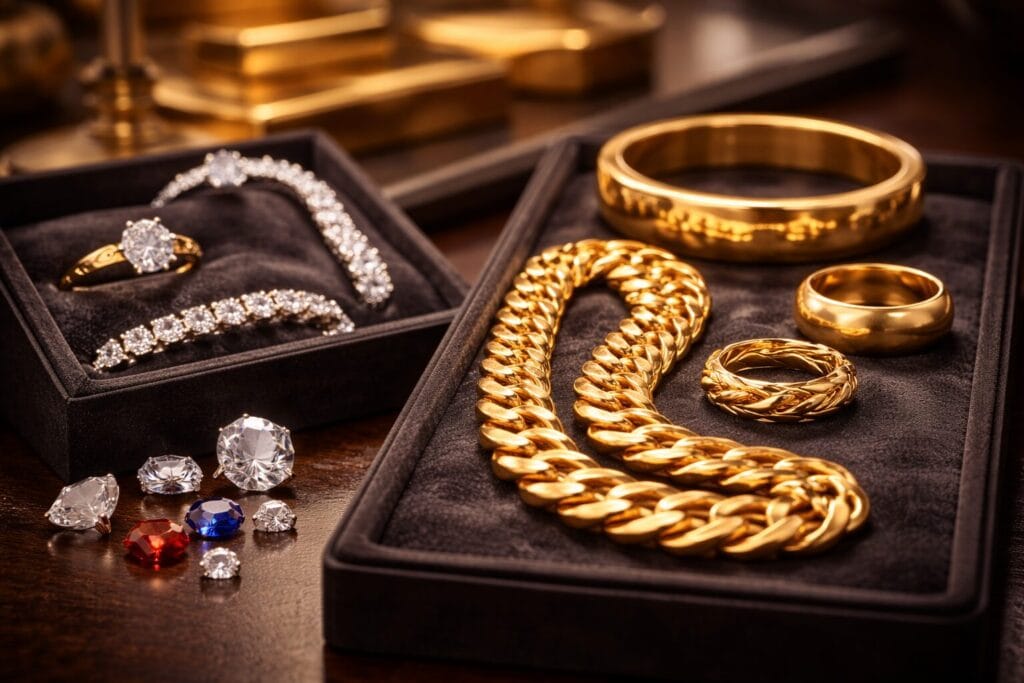
Jewellery that is adorned with gemstones like diamonds, rubies, or sapphires may look captivating, luxurious, and exclusive. It might catch your eye in the shop display. But from a smart investment perspective, it is a “value trap” that should be avoided. To make your jewellery a true investment, simplicity is key. Your focus should be on the gold itself, not on the additional decorations.
1. Jewellers Only Value the Gold Weight When Buying Back
This is a harsh but true reality. When you buy a diamond ring, a large portion of the price you pay is for the diamond itself and the retail markup. But when you want to sell it back to a jewellery shop a few years later, the shop will usually only value and pay for the weight of the gold. They will either remove the gemstone and return it to you, or value it separately at a very low second-hand market price, far lower than what you originally paid.
The benefit of choosing a 100% gold piece of jewellery is that you know every penny you paid is for the value of the gold. When the world gold price increases, the entire value of your asset will increase along with it. But the value of gemstones often does not appreciate and their liquidity is very low. So, for investment purposes, always choose “plain” jewellery without any stone embellishments.
2. Gemstones Can Hinder the Pawnbroking Process
Another major drawback of jewellery that contains gemstones is that its purity can be difficult to test using a densitometer, which is the preferred non-invasive method at many pawnbrokers. This machine works by measuring the density of the metal. The presence of gemstones will interfere with the density reading and give an inaccurate result. As a consequence, the pawnbroker might reject your jewellery outright, or they may have to resort to a scratch test (acid test), which will damage your piece.
The benefit of choosing 100% pure gold jewellery is that it maintains your flexibility to get instant cash through pawning without any issues. The ability to be liquidated via a secured loan is one of gold’s biggest advantages, so don’t sacrifice this benefit just for a design with stones.
Tip #3: Choose Solid and Thick Designs, Not Hollow Ones
The design plays a very important role in determining the durability and the long-term value of your jewellery as an investment. This is not just a matter of personal taste. Choose a design that is not only beautiful, but also practical and durable. Think about the lifespan of the jewellery. It needs to be able to withstand the test of time, just like its value.
1. Hollow or Delicate Designs are Easily Damaged and Dented
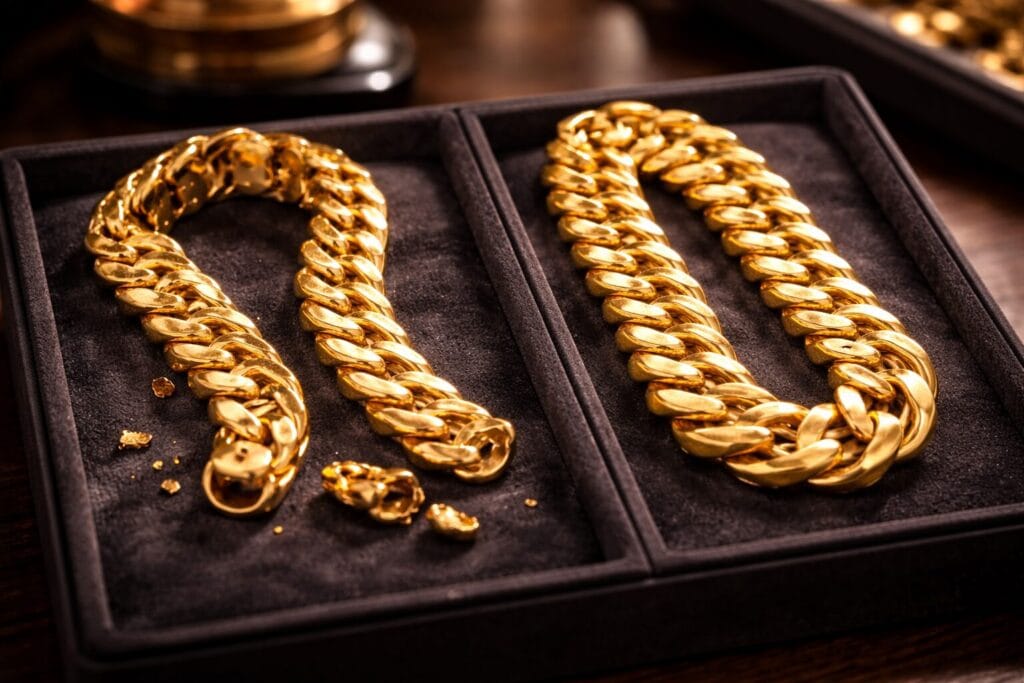
In a jewellery shop, you will see many necklaces or bracelets that look big and impressive, but when you hold them, they feel surprisingly light. This is because the jewellery is hollow inside. The purpose of this is to reduce the amount of gold used and make it cheaper. The problem is, this type of design is not very durable. It is very easily dented, bent, or broken, even with a little pressure. When a piece of jewellery is damaged, its value drops and it is no longer suitable to be worn.
2. Solid Designs Are More Durable and Better for Pawnbroking
Therefore, always choose a design that is solid and thick. Although it may look smaller or ‘simpler’ compared to a hollow design of the same weight, it is far stronger. The benefit is that it is not only more durable for daily wear, but it also provides a key technical advantage. A solid design will give a more accurate and consistent density reading on a pawnbroker’s densitometer machine. This will make the pawning process easier and ensure you get the maximum loan value for your jewellery.
Tips #4: Compare Workmanship Costs & Choose a Shop with a Good Buy-Back Policy
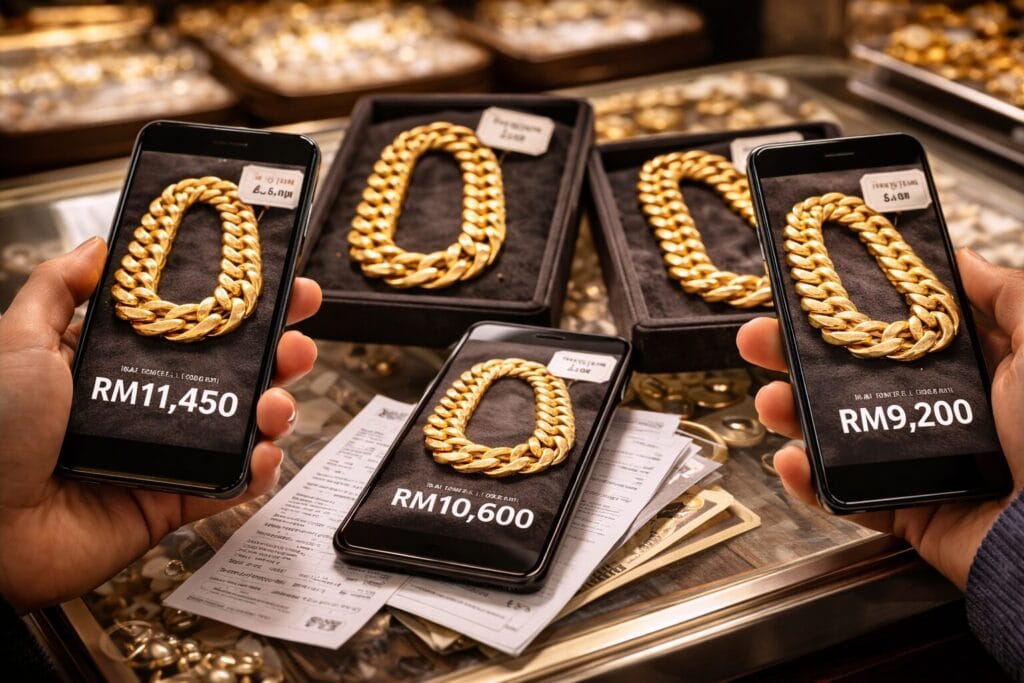
These final two tips are about being a smart consumer and investor. Don’t just buy from the first shop you walk into because the salesperson is friendly. A little research and comparison can save you hundreds of pounds. This is a critical step in ensuring your jewellery as an investment is truly profitable.
1. Don’t Be Shy to Compare and Haggle on Workmanship Costs
The workmanship cost is the charge that the jewellery shop applies for the labour and craftsmanship of the piece of jewellery. What many people don’t know is that the workmanship cost for a very similar design can differ by up to 100% or more from one shop to another. Don’t hesitate to visit 3-4 different jewellers, take pictures of the designs you like, and compare the net price after factoring in the workmanship cost.
The benefit is that by spending a little time doing your comparison, you can save a significant amount of money. This saving directly lowers your net price per gram, which means your break-even point will be reached much faster. Workmanship costs are also often negotiable, so don’t be afraid to ask for a discount.
2. Always Ask About the Buy-Back Depreciation Policy
This is the most important question to ask before you make any payment. Ask the salesperson clearly: “What is the percentage depreciation or spread if I sell this piece of jewellery back to this shop in the future?”. Some jewellery shops offer a lower depreciation rate (e.g., 15% to 20%) if you sell it back to them along with the original receipt. Other shops might impose a much higher rate (25% or more).
The benefit is that by knowing this policy from the start, you can choose a shop that offers the fairest buy-back terms. This will maximise your return in the future. Buying from a shop that has a transparent and reasonable buy-back policy is just as important as choosing the design of the jewellery itself.
Conclusion: Turn Your Jewellery into a True Asset
Jewellery as an investment can indeed be a very smart and enjoyable strategy, but only if you do it correctly and with knowledge. It requires you to shift from the mindset of a ‘jewellery buyer’ to that of an ‘asset investor’. You need to look beyond the beauty of the design and evaluate each item based on its potential future value.
- By practising these 5 tips—choosing a high carat, avoiding gemstones, picking a solid design, comparing workmanship costs, and checking the buy-back policy—you are no longer just buying an adornment. You are making a wise financial decision that will benefit you in the long run.
- Choose your jewellery wisely: 18ct or higher, 100% gold, solid design, and buy it from a shop that is transparent and fair. This way, your collection of personal adornments will truly become an asset whose value grows over time, protecting your wealth in style.
✨ WANT TO START SAVING IN GOLD?
With just RM100, you can begin your gold savings journey with Public Gold.
This is the perfect opportunity to build a stronger and more secure financial future.