

Table of Contents
- Introduction: Unravelling the Complex Questions of Gold Zakat
- Question 1: Is Zakat Obligatory on Gold That is Currently Pawned at an Ar-Rahnu?
- Question 2: What About Gold in a Safe Deposit Box?
- Question 3: Is Zakat Due on Inherited Gold?
- Question 4: My Mother Passed Away Before Paying Her Gold Zakat. What Should the Heirs Do?
- Conclusion: Every Situation Has Its Answer
Introduction: Unravelling the Complex Questions of Gold Zakat
When we start to delve deeper into the knowledge of Gold Zakat, we realise that it is not just a simple calculation on the gold bars we keep at home. Gold ownership comes in various unique forms and situations. This, in turn, gives rise to a variety of more specific and sometimes confusing questions. “How do I calculate Gold Zakat for pawned items?”, “Is gold in a bank’s safe deposit box subject to Zakat?”, “If I receive inherited gold, is Zakat immediately due?”. These questions are very important.
The answers will determine whether our obligation of Gold Zakat as a Muslim is fulfilled perfectly or not. A mistake in understanding the ruling for these situations can cause us to either underpay our Zakat (leaving us in debt to Allah SWT) or overpay it (a loss for ourselves). This article will answer some of the most frequently asked questions about Gold Zakat in Malaysia, providing you with a clear and easy-to-understand guide based on the views of the majority of scholars and the practices at local Zakat centres.
Question 1: Is Zakat Obligatory on Gold That is Currently Pawned at an Ar-Rahnu?
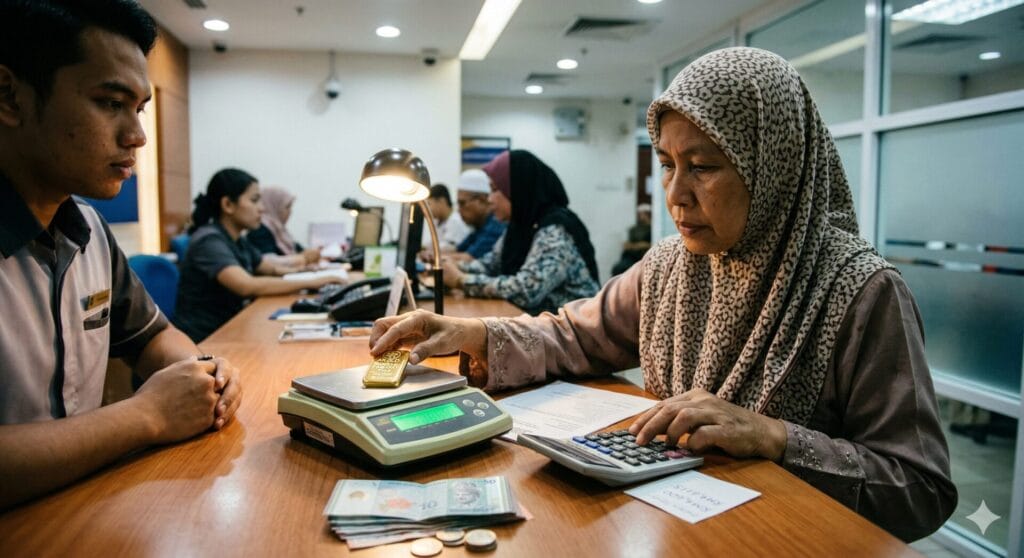
This is the question that most frequently confuses gold owners, as it involves a slightly complex concept of ownership. The gold still belongs to us, but it is in the possession of another party (the Ar-Rahnu) and is tied to a debt agreement. The answer is not a simple ‘yes’ or ‘no’. It depends on the original intention of owning the gold and the purpose for which it was pawned. There are two main situations that need to be differentiated to understand the ruling on Gold Zakat in this context.
1. Situation A: Worn Jewellery, Pawned for Business Capital or Necessities
If the gold you have pawned is jewellery that you normally wear (and its weight is below the ‘Uruf limit, making it not liable for Zakat originally), and you pawn it for the purpose of getting working capital for a business or to cover essential expenses, then the answer is **IT IS NOT OBLIGATORY** to pay Zakat on it as long as it is still under the pawn agreement. The Hawl (one-year ownership period) count will stop on the day you pawn it, and will only restart from zero on the day you redeem it.
2. Situation B: Savings Gold or Jewellery Exceeding the ‘Uruf is Pawned
If the gold that is pawned is savings gold (such as bars, dinars, or coins) or jewellery that exceeds the ‘Uruf limit (an asset that was already liable for Zakat before it was pawned), then the answer is **YES, IT IS OBLIGATORY** to pay Zakat on it, even while it is in the possession of the Ar-Rahnu. This is because the original intention of owning this asset was for savings and investment, and it is still considered your property.
However, the calculation method for Gold Zakat in this situation is different. You do not have to pay Zakat on the gross value of the gold. Instead, you are given a leniency to pay Zakat only on its net value. This is a principle of justice in Islam. Here is how to calculate it:
- Step 1: Calculate the Net Value of Your Gold
Formula: Net Value of Gold = (Current Value of the Gold) – (Loan Amount) – (Safe-keeping Fee)
Example: Let’s say the current value of your gold is RM10,000. You have an outstanding loan of RM5,000 and the safe-keeping fee is RM400.
Net Value = RM10,000 – RM5,000 – RM400 = **RM4,600**. - Step 2: Calculate the Total Zakat to be Paid
Formula: Total Zakat = 2.5% x Net Value of Gold (if positive)
Total Zakat = 2.5% x RM4,600 = **RM115**.
The benefit of this method for calculating Gold Zakat is that it is very fair. You are only obliged to pay Zakat on the net value of the gold that truly belongs to you after deducting the debt obligations related to the pawning.
Question 2: What About Gold in a Safe Deposit Box?
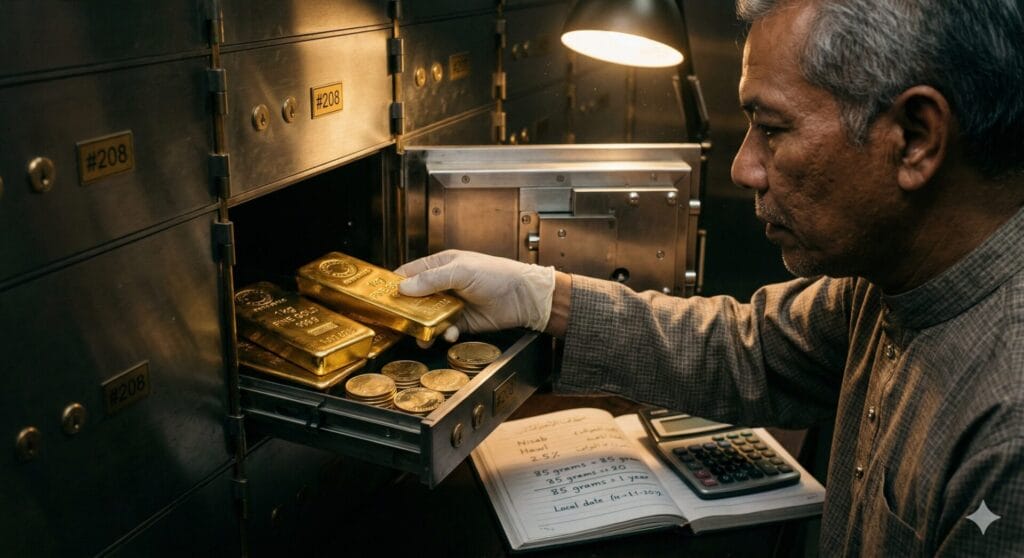
This is another common question, especially for those who store their gold in large quantities and want maximum security. The answer is very clear, simple, and has no complexity. It goes back to the basic principle of ownership in the calculation of Gold Zakat.
- Answer: YES, IT IS OBLIGATORY TO PAY ZAKAT ON IT. Gold that is stored in a safe deposit box at a bank or a private company is considered “savings gold” or unworn gold. It is exactly the same as the gold you keep in a safe at home. The location of the storage does not change your ownership status. Therefore, if the total weight of the gold in the safe deposit box exceeds the Nisab of 85 grams and has completed the one-year Hawl, you are obliged to pay Zakat of 2.5% on its entire value. There are no exemptions. This is the most basic calculation for Gold Zakat.
Question 3: Is Zakat Due on Inherited Gold?

This is another important frequently asked question about Gold Zakat, as it involves the transfer of wealth after a death. Many heirs are confused about when and how they should start calculating Zakat on the gold they have just received. Yes, Zakat on inherited gold is obligatory, but with specific conditions and a specific start to the Hawl calculation for the heir.
- Answer: YES, IT IS OBLIGATORY if it meets the conditions. The Hawl (one-year ownership period) count for you as the heir begins on the day you officially receive or take possession of the gold, which is after all matters of the estate distribution are settled. If you then keep that gold as savings and do not wear it, and its amount exceeds 85 grams, then after one year from that date of possession, you are obliged to pay Zakat on it. The Hawl count does not continue from the deceased’s ownership. It restarts for you.
Question 4: My Mother Passed Away Before Paying Her Gold Zakat. What Should the Heirs Do?

This is a very important question as it relates to the responsibility of the heirs towards the debts of the deceased, not just to other people but also to Allah (SWT). It shows how important the concept of accountability is in Islam. The matter of the deceased’s Gold Zakat must be prioritised.
- Answer: THE HEIRS ARE OBLIGATED TO SETTLE the Zakat payment. Unpaid Zakat is considered a debt of the deceased. Therefore, before the estate of the deceased is distributed to the heirs according to the laws of inheritance (*Faraid*), this Zakat debt (along with other debts) must be settled first, using the assets from the estate.
- Therefore, before the deceased’s assets, including the gold, are distributed, the heirs must first identify and calculate the amount of outstanding Gold Zakat and pay it using the deceased’s assets. The benefit of this is that this action will release the deceased from their responsibility in the hereafter and will ensure that the inheritance distribution process is smooth and blessed.
Conclusion: Every Situation Has Its Answer
The worship of Gold Zakat is a detailed and just process. Every situation, whether it involves pawned gold or inherited gold, has its own method of calculation and its own ruling to ensure fairness for the property owner. A proper understanding will ensure that our worship is more perfect.
- The basic rule is simple: as long as the gold is in your complete ownership, has reached the Nisab (85 grams), and has completed the Hawl (one year), then it has the potential to be liable for Gold Zakat.
- When you are in doubt, the best step is to always refer to the most authentic source. The official website or the hotline of the Zakat centre in your state is the best place to ask. They are the most qualified source to answer all your frequently asked questions about Gold Zakat and to ensure your worship is valid.
✨ WANT TO START SAVING IN GOLD?
With just RM100, you can begin your gold savings journey with Public Gold.
This is the perfect opportunity to build a stronger and more secure financial future.