

Gold moved lower on 1 June 2026 even though geopolitical tension was still active in the background. The story was not simply that gold became weak for no reason. Markets were reassessing the inflation risk linked to Iran-US tension, alongside higher US bond yields and a firmer US dollar. For Malaysian gold savers, the more useful response is not to panic over a one-day move, but to understand the reason behind it, separate global spot from local physical pricing, and decide based on budget and long-term discipline.
- Introduction
- What Happened To Gold Today?
- What Is The Gold Chart Showing?
- Why Did Gold Move Lower?
- What Does This Mean For Malaysian Gold Savers?
- What Is A More Practical Response?
- Conclusion
What Happened To Gold Today?
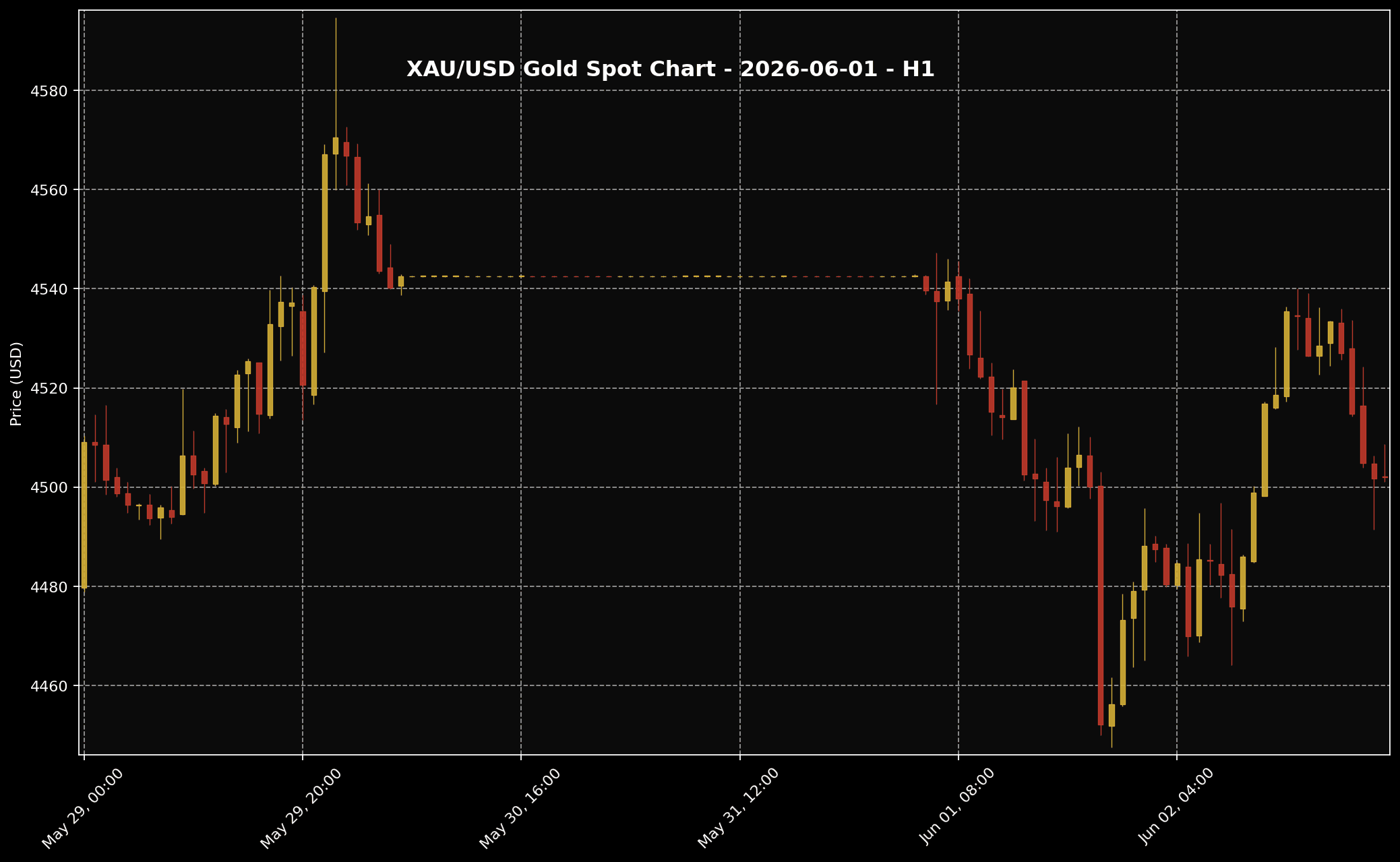 This chart shows the XAU/USD movement for the 1 June 2026 market session. Sifu Gold uses it as a visual reference, not a cue to buy emotionally.
1. At the review time of around 11:30 PM Malaysia time, XAUUSD stood at around USD 4,475.92 per troy ounce. Using a USD/MYR reference of around 3.96491, the estimated global spot value came to roughly RM 17,746.62 per troy ounce. That showed gold had indeed lost some of its earlier upward momentum.
2. Broken down into grams, the estimated global spot value was around USD 143.90 per gram or roughly RM 570.57 per gram. That gives Malaysian readers a clearer way to relate the world gold price to a more familiar unit of reference.
3. It is important to keep the distinction clear: this was the global spot gold reference, not the local physical gold price and not Public Gold pricing directly. Local physical prices in Malaysia can differ because of exchange rates, premiums, buy-sell spread, product type, operating costs and logistics. So the world spot price should be treated as market context rather than a direct retail purchase price.
What Is The Gold Chart Showing?
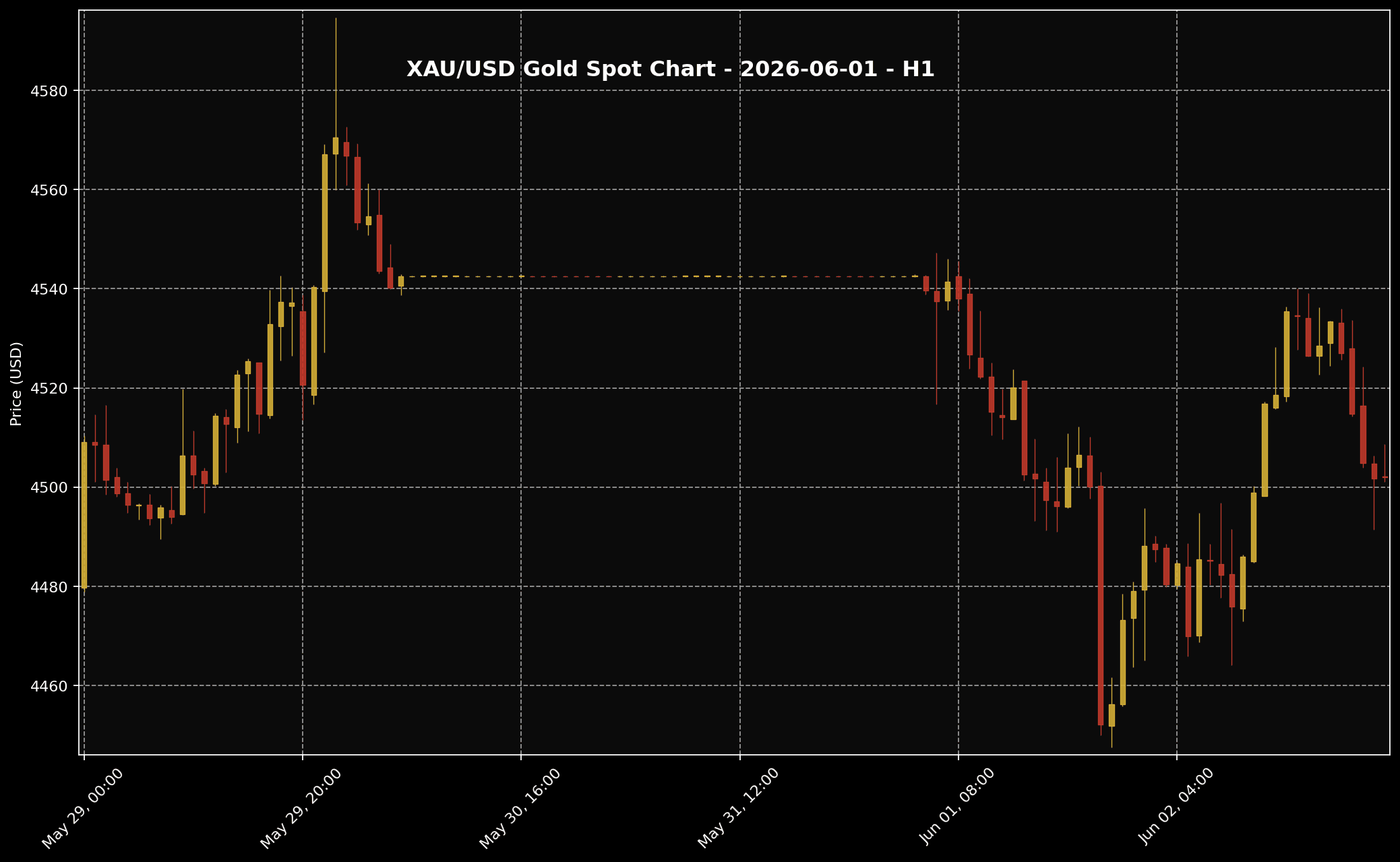 This chart helps readers see the gold price structure for the 1 June 2026 market session. It is used as market context, not as a trading signal.
1. If we look at the H1 chart, the 1 June 2026 session showed a fairly wide and active range. Gold opened around USD 4,523.02, pushed up towards a high near USD 4,545.72, then dropped to a low around USD 4,448.51 before settling back near USD 4,475.92. In plain terms, the market tried to push higher early on, but failed to keep that upward momentum.
2. From a structure point of view, the upper area around USD 4,523 to USD 4,546 looked difficult to break with confidence. Once price failed to hold near that higher zone, selling pressure became more visible. On the lower side, the USD 4,448 to USD 4,476 area looked like the main reaction zone, where price attempted to stabilise after the sharper drop.
3. This is not a buy or sell signal. It is simply a market-structure reading to help readers understand the rhythm of that session. For gold savers, this kind of context is more useful because it shows that gold was under short-term pressure rather than giving any rushed instruction.
Why Did Gold Move Lower?
 The US dollar is often one of the key factors influencing gold prices. When the dollar is firmer, gold can face more noticeable pressure.
1. The main trigger came from fresh Iran-US tension, which raised inflation concerns. Normally, geopolitical tension can support gold through safe-haven demand. But this time the market appeared more focused on the inflation consequences and the interest-rate implications rather than on the protective side of the story alone.
2. When inflation risk rises, markets are more likely to think interest rates may stay higher for longer. That matters because the US 10-year Treasury yield was around 4.506%, higher than the roughly 4.453% seen on 29 May. When yields rise, gold often struggles in the short term because it does not provide interest income the way bonds do.
3. At the same time, the US dollar tone was firmer, with the Dollar Index futures proxy around 99.15. The chain was fairly straightforward: geopolitical tension raised inflation concerns, inflation concerns supported higher-rate expectations, yields and the dollar firmed up, and gold came under pressure even though some safe-haven interest was still present in the background.
What Does This Mean For Malaysian Gold Savers?
 For Malaysian gold savers, the key point is not only whether prices rise or fall. What matters more is budget, discipline and a clear purpose.
1. For Malaysian gold savers, a day like this is a reminder that daily gold pricing can move because of a mix of global drivers. Sometimes it is US economic data. Sometimes it is the dollar and bond yields. Sometimes it is geopolitics. So when gold moves, it is usually more helpful to look at the bigger chain of reasons rather than assume one single headline explains everything.
2. On the local side, Public Gold GAP 24K on 1 June 2026 was around RM 619/g, compared with around RM 630/g on 31 May 2026. That means the local reference was lower by about RM 11/g. This does matter to readers watching local pricing, but it still has to be understood within the reality of Malaysian physical gold pricing rather than world spot alone.
3. In my view, Sifu Gold readers are better served by using a day like this to review their savings plan. If the purpose of saving gold is long term, then discipline, affordability and consistency matter more than reacting emotionally to a single day’s move.
What Is A More Practical Response?
 When gold prices move quickly, better decisions usually come from disciplined planning, not panic reactions.
1. The more practical approach is to return to the basics: review the budget and avoid rushed decisions. If this month’s budget allows it, small staged buying is usually easier to manage than trying to go in heavily all at once. That helps readers build savings without creating unnecessary pressure.
2. If the budget is tight this month, there is no need to force it. Gold should fit into a healthy financial plan, not become a reason for cash flow stress. In a market still sensitive to geopolitics, inflation, yields and the dollar, a decision based on affordability is usually the more mature one.
3. For Malaysian gold savers, the better question is not “price is down, should I rush in?” The better question is whether the budget is still comfortable, whether an emergency fund already exists, and whether the gold-saving plan has a clear purpose. When those three things are clear, decisions usually become calmer and more structured.
Conclusion
In summary, gold moved lower on 1 June 2026 because the market focused more on inflation risk after fresh Iran-US tension, alongside higher US bond yields and a firmer US dollar. Although geopolitics often supports gold, the macro pressure looked more dominant this time. For Malaysian gold savers, the more important step is not to chase a one-day move, but to understand the market driver, separate global spot from local physical pricing, and act according to budget. If you want to start in a more structured way, Public Gold GAP can be an option from RM100, provided the decision is made with discipline and within your means.