

If we look back at what happened on 11 June 2026, gold did make some people feel that the market was starting to recover. Price fell quite sharply first. After that, gold tried to rebound before the session closed. But if we look at the fuller picture, the story did not end there. For Malaysian gold savers, the more important point was not just that gold bounced. The real question was whether that rebound was truly strong enough, or whether the market was still not clear in direction.
- Introduction
- What Happened To Gold On 11 June 2026?
- What Is The Gold Chart Showing?
- Why Did Gold Move This Way?
- What Does This Mean For Malaysian Gold Savers?
- What Practical Action Makes More Sense?
- Conclusion
What Happened To Gold On 11 June 2026?
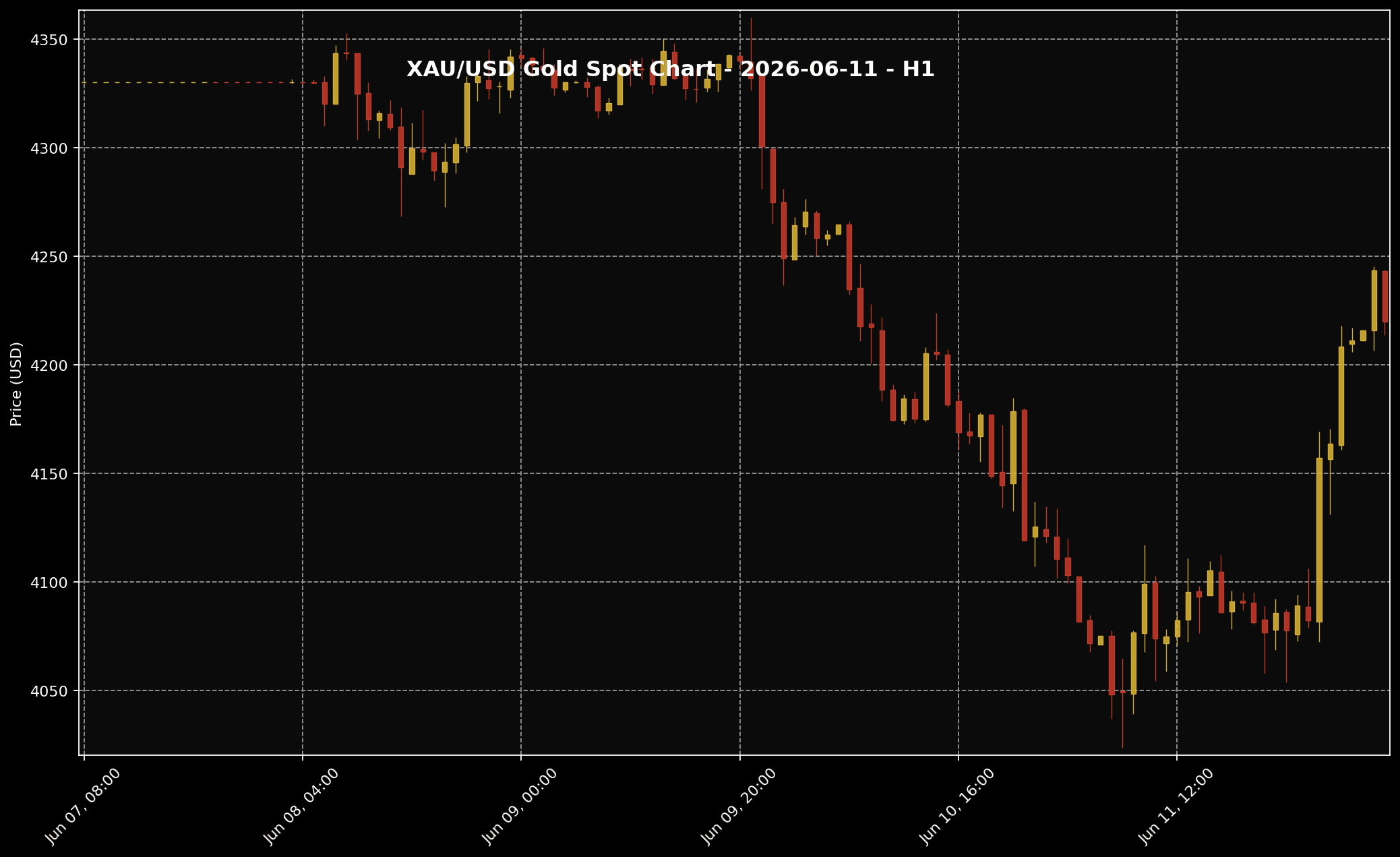 This chart shows the XAU/USD movement for the 11 June 2026 market session. Sifu Gold uses it as a visual reference, not a cue to buy emotionally.
1. On 11 June 2026, gold still closed below its opening level even though it did manage to rebound from its intraday low. Based on the main Twelve Data H1 snapshot, at the reference review time of around 11:00 PM Malaysia time, XAU/USD was around USD 4,089.00 per troy ounce. With USD/MYR around 4.06789 at the same time, that worked out to roughly RM 16,633.62 per troy ounce, or about USD 131.46 per gram and RM 534.78 per gram.
2. If we break the session down step by step, gold opened around USD 4,124.16, briefly moved up to around USD 4,134.79, then dropped to around USD 4,023.50 before closing near USD 4,089.00. So yes, there was a rebound of nearly USD 65 from the day’s low. But even with that rebound, the close still could not get back to the opening area. In my view, that was not enough to call it a clear recovery. A fairer way to put it is that gold did bounce from below, but the earlier pressure was still there.
3. One thing Sifu Gold readers should keep in mind is that these numbers refer to the global spot gold price, not the local physical gold price in Malaysia. Local pricing can still differ because of USD/MYR, spread, physical premium, operating costs, and the way local pricing is set.
What Is The Gold Chart Showing?
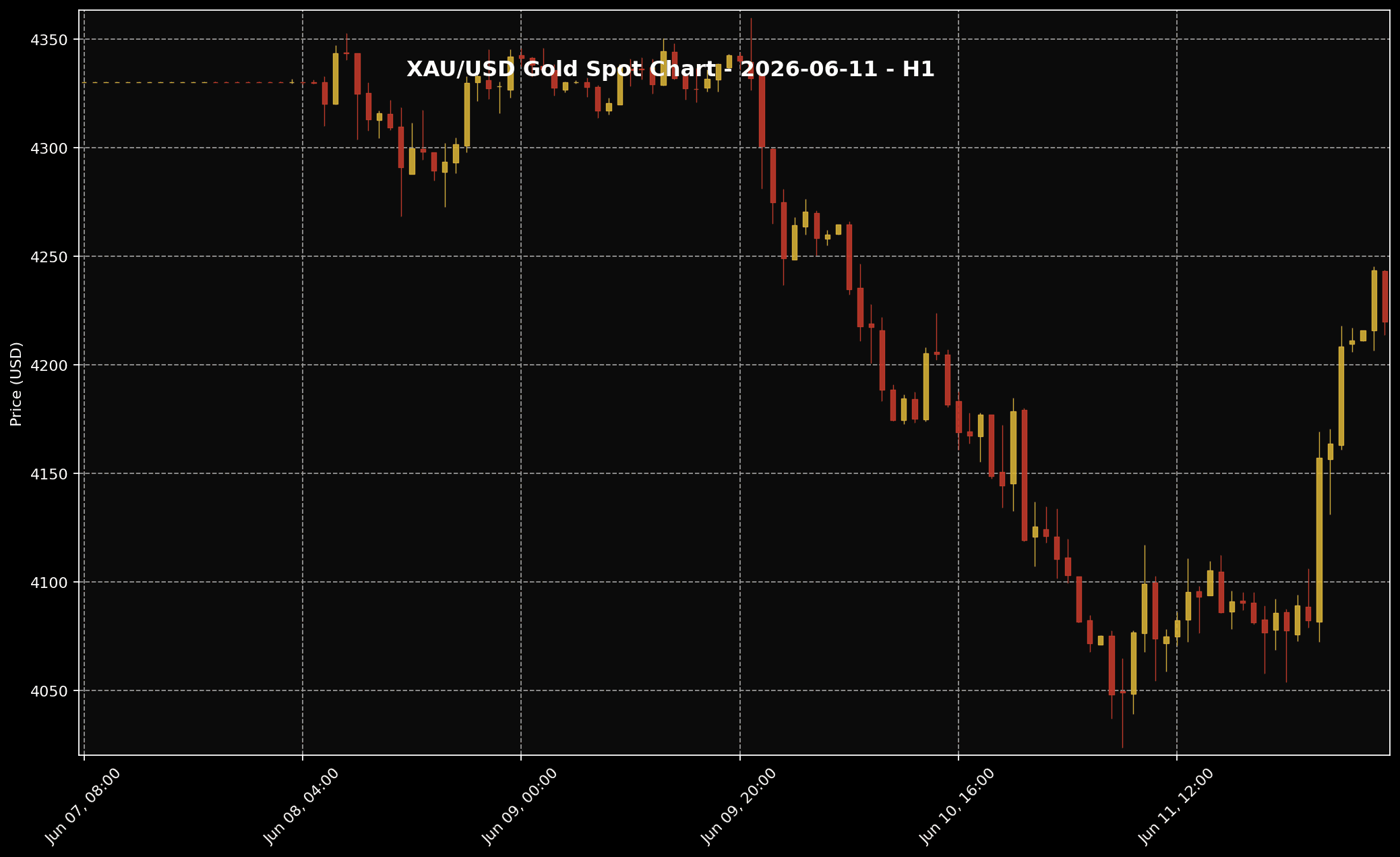 This chart helps readers see the gold price structure for the 11 June 2026 market session. It is used as market context, not as a trading signal.
1. If we look at the H1 chart, the story is fairly clear. Gold entered that session already looking pressured. Then another wave of selling pushed price down into the zone around USD 4,023 to USD 4,050. Once price reached that area, buyers started stepping back in and tried to lift it again.
2. But this is the key point. Even though gold did bounce from the lower zone, that rebound still was not strong enough to undo the earlier pressure. The area around USD 4,075 to USD 4,100 looked like the first recovery zone. Meanwhile, the area around USD 4,105 to USD 4,135 still looked like the nearest barrier. As long as price had not properly settled back into that upper zone, I would still describe the market as trying to stabilise, not as a market that had already recovered properly.
3. This is not a buy or sell signal. It is simply an easy way to read the structure of the price. Sometimes price can bounce from the lows, but that does not automatically mean the pressure is over.
Why Did Gold Move This Way?
 The US dollar is often one of the key factors influencing gold prices. When the dollar is firmer, gold can face more noticeable pressure.
1. The story is quite simple when we break it down. Gold’s move on 11 June 2026 seemed to come from a mix of two main factors. First, geopolitical tension appeared to ease slightly. Reuters at headline level showed that market sentiment shifted after reports came out that planned US strikes on Iran had been cancelled. When geopolitical fear cools a little, the market starts adjusting its wider risk expectations. That was one reason gold managed to rebound from the lower levels.
2. But that was only one side of the story. The other side was that the market still had not moved past worries about interest rates and inflation. Kitco pointed in the same direction. Gold did bounce from the lows, but the upside still looked limited because rate worries were still there. Put simply, gold got a bit of breathing room when the geopolitical story cooled down, but pressure from higher-rate expectations had not disappeared.
3. So if we connect the full story, the flow looked like this: geopolitical fear eased a little, gold rebounded from below, but at the same time the market still felt that interest rates could stay higher for longer. When that view remains in place, the US dollar and bond yields usually stay strong competitors to gold. That is why gold could rebound, but still did not look strong enough for us to say the recovery was fully in place.
What Does This Mean For Malaysian Gold Savers?
 For Malaysian gold savers, the key point is not only whether prices rise or fall. What matters more is budget, discipline and a clear purpose.
1. For Malaysian gold savers, the key point is this: do not treat an intraday rebound as proof that everything is already back to normal. Yes, gold did bounce from the day’s lower levels. But by the close, price was still below the opening level. That tells us the market was still not fully stable and could still change quickly.
2. Another thing worth noticing is the currency side. In the same data set, USD/MYR only moved slightly, from around 4.06993 to 4.06789. That means the ringgit move was not big enough to change the main story. So for Malaysians buying physical gold, local pricing is still shaped by the mix of world spot price, the dollar-ringgit exchange rate, physical premium, and buy-sell spread.
3. That is why I always think it is important to separate global spot gold from local physical gold properly. If global spot gold falls, local pricing may not fall by the same amount. If global spot gold rebounds slightly, local pricing may not move in exactly the same way either. For Sifu Gold readers, the healthier way to look at this is to watch the broader market direction, check your own budget, and understand the difference between a global reference price and the actual price you pay locally in Malaysia.
What Practical Action Makes More Sense?
 When gold prices move quickly, better decisions usually come from disciplined planning, not panic reactions.
1. In my view, the more sensible move in a situation like this is to stick to the saving plan you already have. There is no need to suddenly change your decision just because price dropped. And there is also no need to get too excited just because gold bounced for a while. If you are saving gold for the long term, a day like this is usually more useful for reviewing your strategy than trying to guess the nicest entry point.
2. If your monthly budget has already been set aside for gold saving, buying gradually in small amounts can still make sense. That approach helps because you do not have to place your whole decision on one price level. If this month’s budget feels tight, there is no need to force it. Waiting a little is not wrong. What matters is that the decision has a reason behind it, fits your own means, and is not driven by emotion when the market suddenly moves fast.
3. From a money-management point of view, 11 June 2026 gave a very clear reminder. Gold can rebound from the lows, but the structure of the day may still not be fully repaired. So the safer focus is still to build the saving habit, protect cash flow, keep emergency savings intact, and add to gold according to your own means.
Conclusion
If we step back and look at the full story of 11 June 2026, gold did rebound from heavy pressure. But by the close, it still was not strong enough for us to say the market had properly recovered. Geopolitical relief did help gold rise from the lows, but worries about inflation and interest rates were still the main limit on that recovery.
So should you worry? In my view, there is no need to panic, and there is also no need to chase the price. What matters more is understanding the market context, separating global spot gold from local physical gold pricing, and making decisions based on your own budget. If you want to start or add to your gold savings, doing it gradually and according to a plan still makes more sense. And if you want to begin in a more structured way, Public Gold GAP can be one possible option because you can start from RM100, as long as the decision fits your own financial comfort level and is not driven purely by market emotion.