

If we look back at the gold market on 12 June 2026, the session was not as straightforward as it first looked. Gold did recover from the deeper part of the drop and managed to hold above the USD4,200 area by the end of the session. But that does not automatically mean the market was strong again. The bigger story was that gold was still trying to steady itself after a heavy selloff, and the rebound still did not look complete. For Malaysian gold savers, that is the part worth paying attention to.
- Introduction
- What Happened To Gold On 12 June 2026?
- What Is The Gold Chart Showing?
- Why Did Gold Move This Way?
- What Does This Mean For Malaysian Gold Savers?
- What Practical Action Makes More Sense?
- Conclusion
What Happened To Gold On 12 June 2026?
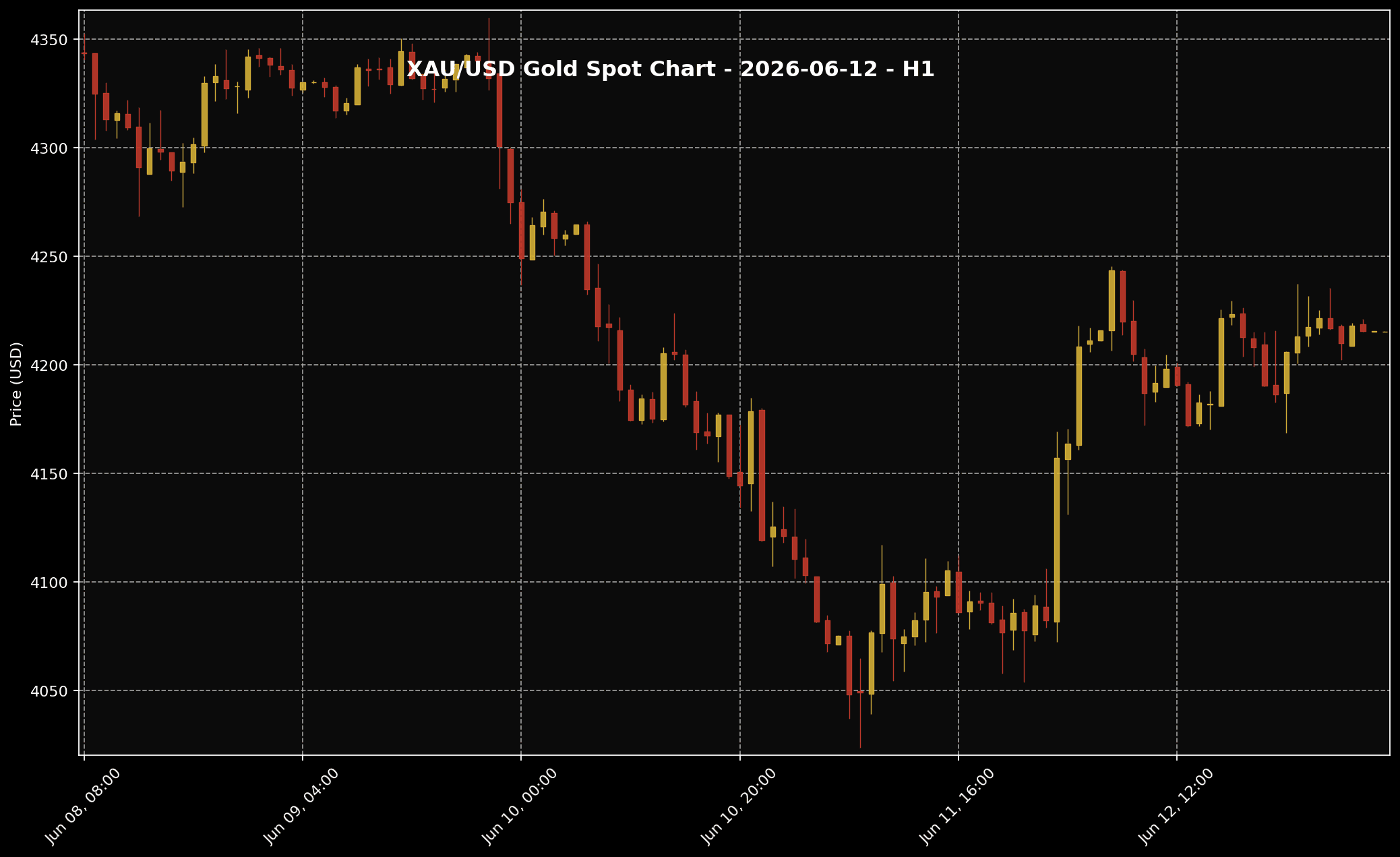 This chart shows the XAU/USD movement for the 12 June 2026 market session. Sifu Gold uses it as a visual reference, not a cue to buy emotionally.
1. On 12 June 2026, gold moved in a mixed way. It fell first, then tried to recover later in the session. At the review time of around 11:00 PM Malaysia time, XAU/USD was around USD4,213.07 per troy ounce.
2. In other simple references, that worked out to around RM17,096.39 per troy ounce based on USD/MYR at around 4.05794. On a per gram basis, global gold was around USD135.45 per gram, or around RM549.66 per gram.
3. But this is the important part. Those are global spot references, not local physical gold prices in Malaysia. So we should not assume that the number on the world chart will match the physical gold price here on the same day. In terms of session behaviour, gold looked weak earlier, then managed to climb back from the lower area. Still, that rebound looked more like an effort to stabilise than a clear sign that the market had fully turned strong again.
What Is The Gold Chart Showing?
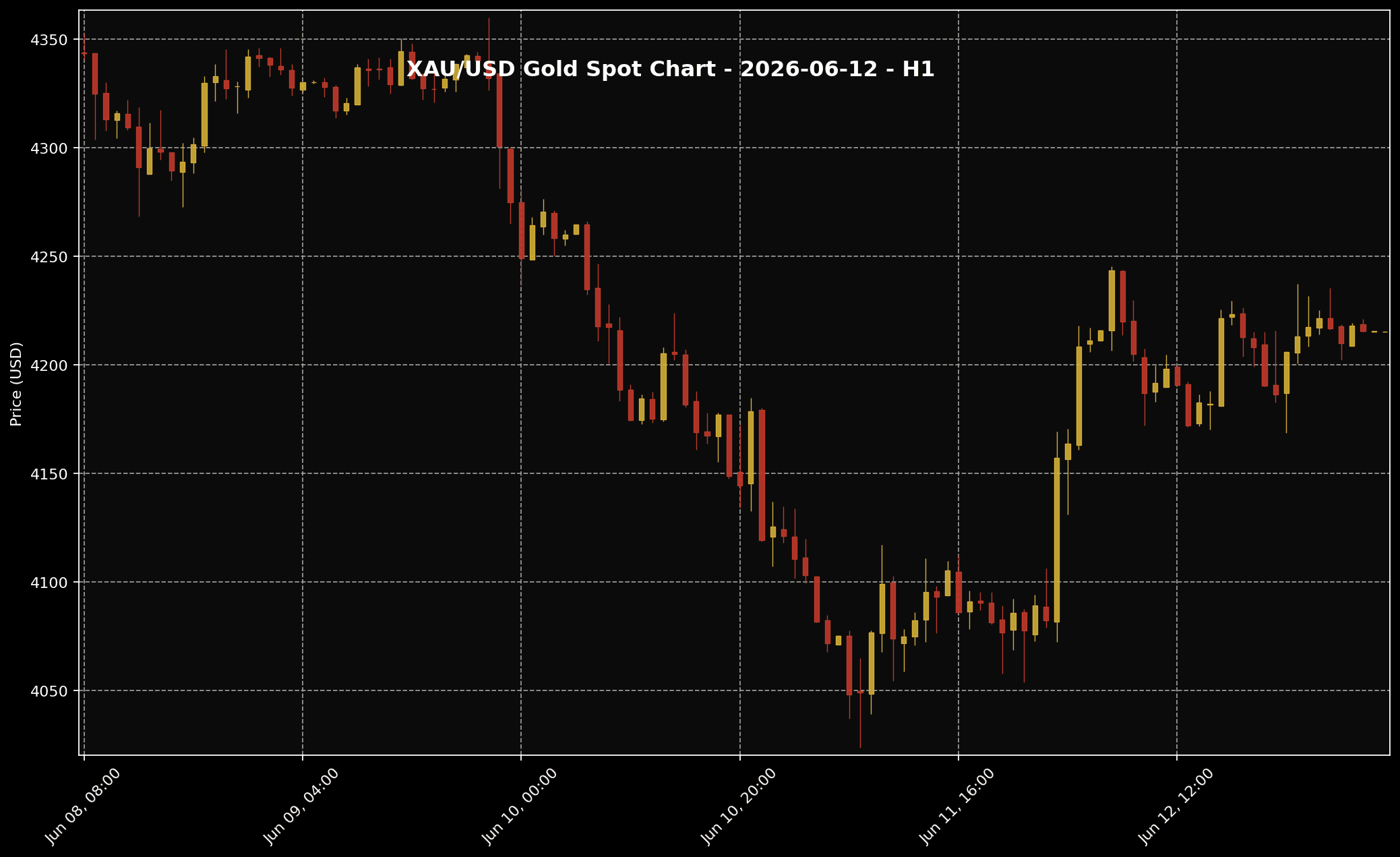 This chart helps readers see the gold price structure for the 12 June 2026 market session. It is used as market context, not as a trading signal.
1. If we read the H1 chart in simple terms, the structure shows one clear thing. Gold had already gone through a fairly heavy breakdown before trying to recover again.
2. On the left side of the chart, price was still much higher, around the USD4,330 to USD4,345 area. After that, the market sold off aggressively and dropped close to the USD4,050 zone. That tells us the earlier pressure was real and quite strong.
3. Once price reached that lower zone, gold started to bounce. It then moved back into the USD4,200 to USD4,245 area. That matters because it shows buyers did come back in, but the recovery still was not strong enough to fully undo the earlier damage. Towards the end of the session, price action looked more choppy and sideways. In simple words, gold was no longer in free-fall, but it also did not show a clean and strong continuation higher. For now, the chart looks more like a partial recovery followed by consolidation, not a full repair. Broadly speaking, the USD4,050 to USD4,090 area still looks like a rough lower support zone, while the USD4,200 to USD4,245 area looks like the current recovery zone. Above that, the USD4,250 to USD4,300 area still looks like a region the market has not easily pushed through yet. This is not a buy or sell signal. It is simply a price-structure reading to help readers understand the market condition.
Why Did Gold Move This Way?
 The US dollar is often one of the key factors influencing gold prices. When the dollar is firmer, gold can face more noticeable pressure.
1. The story here was not just one factor. It was a combination of pressures working together.
2. First, the broader macro backdrop was still not fully supportive for gold. Reuters, carried via Kitco off-the-wire, pointed to a firmer US dollar and still-restrictive Fed expectations as factors that had already taken strength out of gold earlier. When the US dollar stays firm, gold usually finds it harder to push higher because it becomes more expensive for buyers using other currencies.
3. Second, part of the geopolitical risk premium started to fade. Kitco reports showed that tension linked to the US-Iran situation appeared to ease, and that helped pull oil prices lower. When oil drops, the market also tends to see less near-term inflation pressure. When that inflation fear cools, gold loses some of its support as a defensive asset. Third, there was some later help from softer US bond yields, but that support was only enough to help gold recover part of the earlier fall. It was not enough to change the bigger market story. That is why gold could rebound from the lows, but still did not look fully strong again. So the chain is quite simple. Geopolitical tension eased, oil fell, inflation fear cooled a bit, and the urgency to rush into gold as a safe haven also eased. At the same time, the firmer US dollar backdrop still limited how far the rebound could go.
What Does This Mean For Malaysian Gold Savers?
 For Malaysian gold savers, the key point is not only whether prices rise or fall. What matters more is budget, discipline and a clear purpose.
1. For Malaysian gold savers, the main question is not just whether gold went up or down on the day. The more useful question is this: was the market recovering in a healthy way, or was it simply bouncing after a hard drop?
2. In my view, the 12 June session looked closer to the second situation. Gold did manage to rebound from the lower area, but the market structure still did not look fully repaired. So if someone saw the bounce and quickly assumed everything was strong again, that would be too fast a conclusion.
3. From a local price point of view, we also need to separate global spot from Malaysian physical pricing. The Public Gold GAP 24K reference on 12 June 2026 was RM594 per gram, compared with RM581 per gram on 11 June 2026. That means the local reference was up by RM13 per gram from the previous day. Compared with the global spot reference of around RM549.66 per gram, the gap is quite visible. That is normal. Local physical gold pricing does not follow world spot price one-for-one. It is also affected by USD/MYR, physical product premiums, buy-sell spread, operating costs and the local pricing method. So for Sifu Gold readers, the takeaway is simple. Even if the global chart looks weak or uneven, decisions about saving gold in Malaysia still need to be viewed through a local lens. These are related, but they are not the same thing.
What Practical Action Makes More Sense?
 When gold prices move quickly, better decisions usually come from disciplined planning, not panic reactions.
1. If you are saving gold for the long term, the more sensible approach here is still to stay disciplined and not react emotionally to daily market swings. A day like this is not the best time to make a rushed decision.
2. If your monthly budget for gold is already planned, buying in small stages still makes more sense than trying to guess the perfect bottom. That is especially true when the market still has not shown a really clean recovery.
3. If your budget is tight at the moment, there is no need to force it. Waiting while reviewing your own cash flow is also a mature decision. In a market that is still trying to stabilise, discipline matters more than the urge to jump in quickly. What I would not encourage is committing the full budget at once just because price has bounced a little. A short-term rebound does not always mean the pressure is fully over. It is still better to move according to a plan, stay within your means, and make sure each purchase has a clear reason behind it.
Conclusion
If we put the 12 June 2026 session together, gold fell first because some of its safe-haven support eased when geopolitical tension cooled and oil prices moved lower. After that, gold did try to rebound, but the market structure still did not look fully repaired because the firmer US dollar backdrop continued to limit the upside. For Malaysian gold savers, the message is not to panic and it is also not to chase price too quickly. The message is to understand the context, separate global spot from local physical pricing, and make decisions based on your own budget. In my view, if you are building long-term gold savings, the better approach still stays the same: save in stages, protect your cash flow, and do not go in heavily all at once. If you want to start in a more structured way, Public Gold GAP can be one option because you can begin from RM100, as long as it still fits your budget.