

What happened to gold on 2 July 2026? This time, the story was fairly clear. Gold jumped after weaker-than-expected US jobs data put pressure on the US dollar and made the market rethink the near-term Federal Reserve rate path. That gave gold much firmer support into the end of the session. For Malaysian gold savers, the bigger question is not just that gold went up, but why it went up and what that same global move really looks like once it is translated into Ringgit.
- Introduction
- What Happened To Gold On 2 July 2026?
- What Is The Gold Chart Showing?
- Why Did Gold Move This Way?
- What Does This Mean For Malaysian Gold Savers?
- What Practical Action Makes More Sense?
- Conclusion
What Happened To Gold On 2 July 2026?
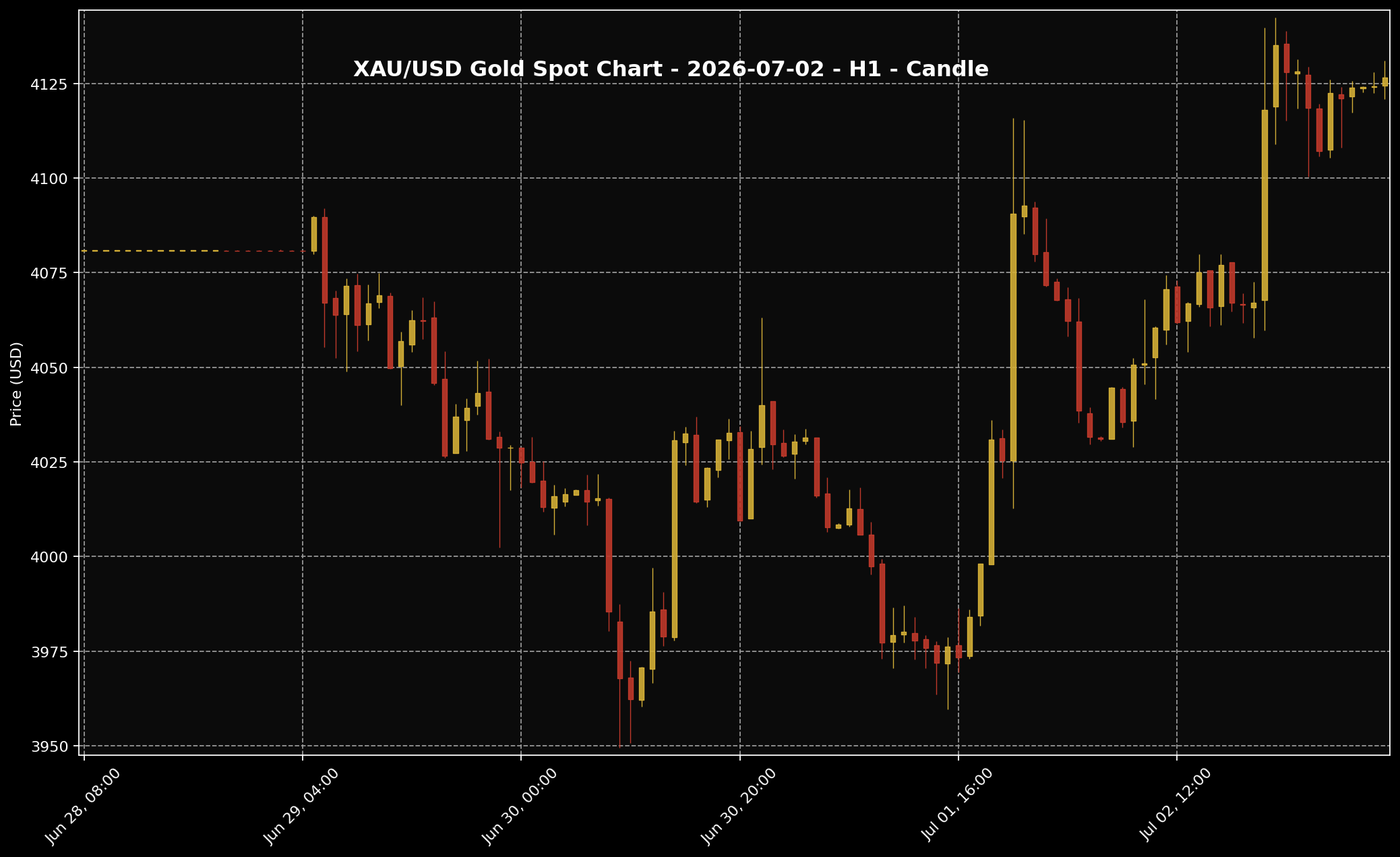 This chart shows the XAU/USD movement for the 2 July 2026 market session. Sifu Gold uses it as a visual reference, not a cue to buy emotionally.
1. Gold closed the session at around USD4,128.15 per troy ounce. Broken down further, that was about USD132.72 per gram. Using the approved USD/MYR snapshot near 4.08026, that worked out to roughly RM16,843.93 per troy ounce, or around RM541.54 per gram.
2. One thing needs to stay clear from the start: these Ringgit numbers are global spot gold conversions, not local physical retail gold prices in Malaysia. They help readers understand the direction of the world market in Ringgit terms, but they are not the same as the final price someone pays for physical gold locally.
3. As for the move itself, gold did not just edge higher. It jumped more convincingly after the market reacted to weaker US employment data. Kitco recorded gold moving back above USD4,100, and the Reuters-linked market direction captured via MarketScreener pointed the same way, with gold rising more than 2% after the weak US payrolls report.
What Is The Gold Chart Showing?
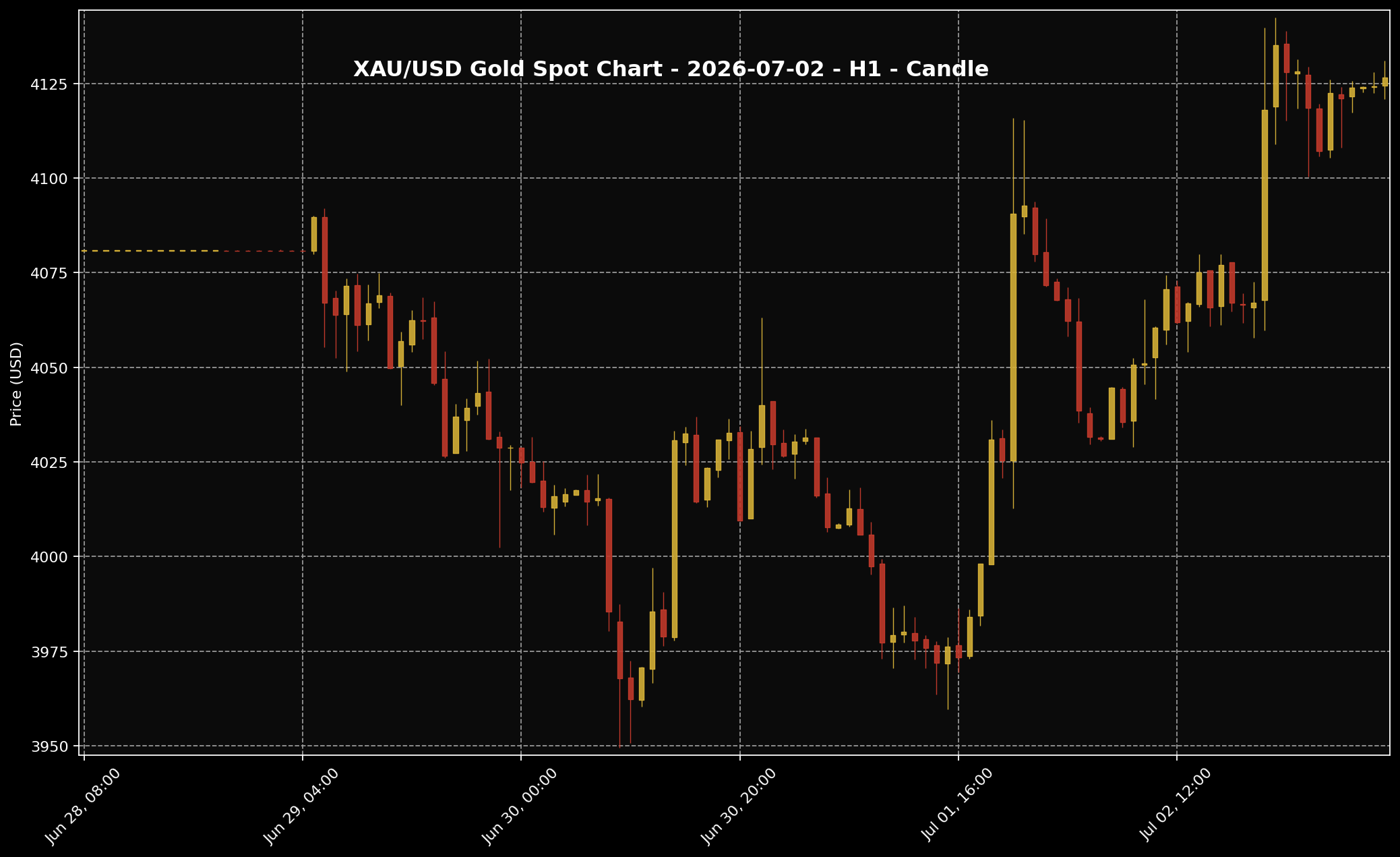 This chart helps readers see the gold price structure for the 2 July 2026 market session. It is used as market context, not as a trading signal.
1. If we look at the H1 chart structure, gold did not behave like a market that only made a quick spike and then gave everything back. It pushed higher, and it still managed to stay near the upper end of the session into the close. That usually tells us buyers were still present late in the day.
2. Still, this is where we need to keep the reading sensible. A strong rebound is not automatically the same thing as a fully confirmed new trend. The chart looked healthier by the end of the session, yes, but that does not mean every earlier pressure point has disappeared.
3. Put simply, the chart showed a solid rebound and a strong close after the macro trigger came in. That is useful as a market structure explanation. It is not a reason on its own to turn the session into a big breakout story.
Why Did Gold Move This Way?
 The US dollar is often one of the key factors influencing gold prices. When the dollar is firmer, gold can face more noticeable pressure.
1. The main trigger was the US jobs data. Kitco highlighted that the US economy added only around 57,000 jobs in June, which was weaker than the market had expected. When data comes in like that, traders quickly start asking whether the US economy is losing some momentum.
2. Once that thinking spreads, two things usually matter straight away. First, the US dollar can come under pressure. Second, the market starts adjusting its expectations for the Federal Reserve. If traders think the Fed may not need to stay as aggressive in the near term, gold often gets breathing space to move higher.
3. That is the simplest way to read this session. Gold did not rise for no reason. It rose because weaker jobs data changed the market mood around the dollar and the rate outlook. The Reuters-linked direction recorded for the day reinforced the same message, so the move looked like a real macro reaction rather than random intraday noise.
What Does This Mean For Malaysian Gold Savers?
 For Malaysian gold savers, the key point is not only whether prices rise or fall. What matters more is budget, discipline and a clear purpose.
1. For Malaysian readers, looking at XAU/USD alone is never enough. When gold rises in US dollar terms while the Ringgit is not especially strong, the move can still feel large once it is translated into local currency. That is why the rough global spot conversion near RM541.54 per gram matters as a reader-friendly reference.
2. But the story does not end there. Local physical gold pricing has extra layers on top of global spot. USD/MYR matters. Product premiums matter. Buy-sell spreads matter. The type of product matters too. So even when global gold rises sharply, local physical pricing in Malaysia does not move in a perfect one-to-one way.
3. That is why the more useful takeaway is understanding the cause first. If gold is moving because US macro data has changed how the market sees the dollar and the Fed, that gives savers better context. It is more useful than reacting to the headline move alone and assuming every strong session must be chased immediately.
What Practical Action Makes More Sense?
 When gold prices move quickly, better decisions usually come from disciplined planning, not panic reactions.
1. If you are saving gold for the medium or longer term, the more sensible approach still comes back to budget and discipline. Review your cash flow, stick to your plan, and avoid committing the full budget at once just because one session looked strong.
2. If you already have a regular saving schedule, a move like this is better used as market context than as a reason to keep changing your behaviour every time gold jumps. In most cases, consistency matters more than trying to catch the perfect day.
3. If this month’s budget is comfortable, continuing in stages can still make sense. If your budget is tight, there is no need to force a purchase just because the market is suddenly more active. In gold saving, a plan that you can actually sustain usually matters more than reacting quickly to one day’s excitement.
Conclusion
Gold on 2 July 2026 moved higher because weaker US jobs data pressured the US dollar and pushed the market to rethink the near-term Fed story. The chart then backed that up with a solid rebound and a firm close near the top of the session. For Malaysian gold savers, the real lesson is not only that gold rose, but why it rose, how that translates into Ringgit, and why global spot gold still needs to be separated from local physical pricing. A disciplined, step-by-step approach remains the more responsible way to respond.