

At first glance, gold on 21 June 2026 looked quiet. Price barely moved, so it would have been easy to assume nothing important happened. But the real story was not about a dramatic rise or a fresh collapse. It was about a market that still had not shaken off the old pressure from a hawkish Federal Reserve, a firmer US dollar, and high US bond yields. In other words, gold stopped falling hard, but it still did not look strong enough to suggest a clear new direction.
- Introduction
- What Happened To Gold On 21 June 2026?
- What Is The Gold Chart Showing?
- Why Did Gold Move This Way?
- What Does This Mean For Malaysian Gold Savers?
- What Practical Action Makes More Sense?
- Conclusion
What Happened To Gold On 21 June 2026?
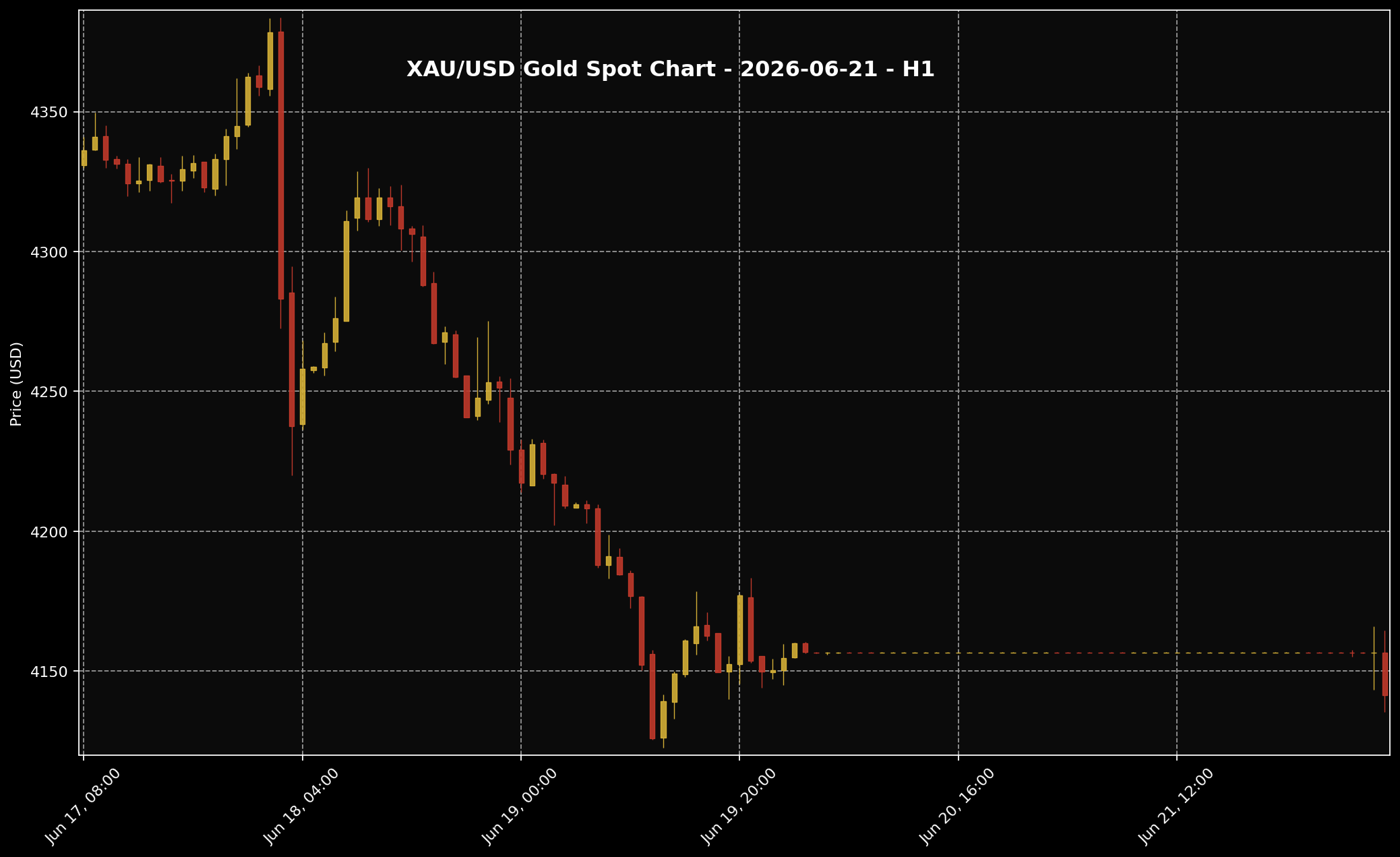 This chart shows the XAU/USD movement for the 21 June 2026 market session. Sifu Gold uses it as a visual reference, not a cue to buy emotionally.
1. For the 21 June 2026 market session, the main closing H1 reference put global spot gold at around USD 4,156.61 per troy ounce at about 11:00 PM Malaysia time. With USD/MYR around 4.13745 at the same review point, that worked out to roughly RM 17,197.79 per troy ounce, or about USD 133.64 per gram and RM 552.92 per gram.
2. If we compare that with the previous session, the change was extremely small. XAU/USD on 20 June 2026 was around USD 4,156.63 per troy ounce, so the move into 21 June was lower by only about USD 0.02. In ringgit terms, the change was also very small, from roughly RM 552.93 per gram to RM 552.92 per gram. Put simply, gold was almost flat.
3. So if someone asks whether gold was continuing a major drop or starting a convincing recovery on 21 June 2026, the more accurate answer is neither. The market looked as if it was still searching for direction. It did not break down in a fresh, obvious way, but it also did not show enough strength to suggest a clear rebound had begun.
What Is The Gold Chart Showing?
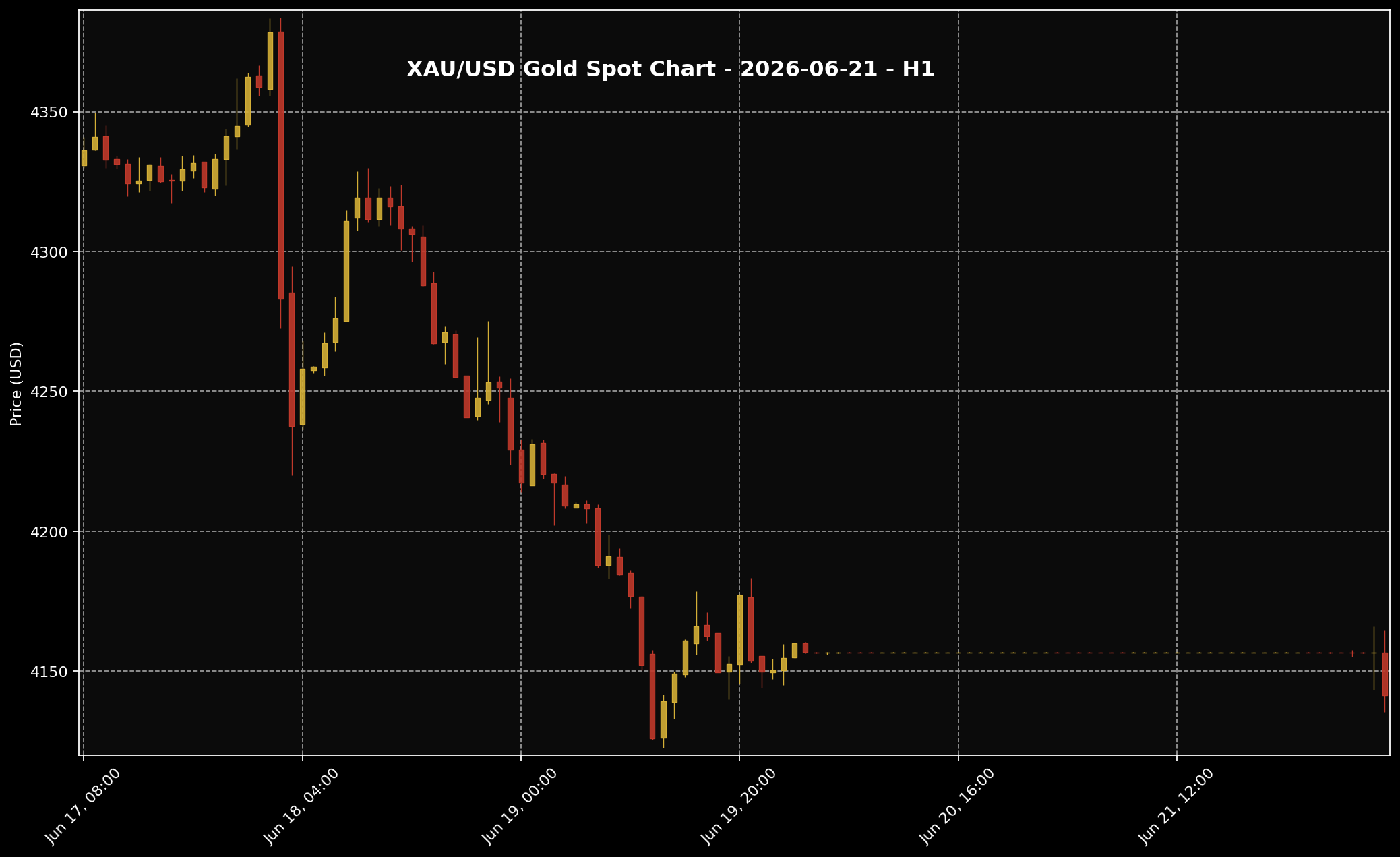 This chart helps readers see the gold price structure for the 21 June 2026 market session. It is used as market context, not as a trading signal.
1. If we read the H1 chart as simple market structure, the message is fairly straightforward. Before 21 June 2026, gold had already come off higher levels. Then, instead of building a strong new move, price began settling into a much tighter range.
2. Near the end of the session, gold was clustering around the USD 4,156 area. Based on the internal session range used for this market date, price moved in a very narrow band of about USD 4,156.48 to USD 4,156.73. That kind of range usually tells us the market is pausing, trying to steady itself, but still not showing fresh momentum.
3. In plain English, the chart did not show a clear new break lower, but it did not show a proper break higher either. So the safer reading is that gold was moving sideways in a narrow zone. This is not a buy or sell signal. It is simply a chart-reading explanation to help readers see that the market had gone quiet, not decisive.
Why Did Gold Move This Way?
 The US dollar is often one of the key factors influencing gold prices. When the dollar is firmer, gold can face more noticeable pressure.
1. The main reason gold looked so flat on 21 June 2026 was not because of one big new event on that day. The bigger story was that the market was still carrying the weight of earlier macro pressure, especially from a Federal Reserve tone that still looked hawkish.
2. When the market thinks interest rates may stay higher for longer, gold usually finds it harder to push up strongly. Gold does not pay income in the way bonds do. So when US Treasury yields remain high, some investors continue to see bonds as a stronger short-term alternative. At the same time, a firmer US dollar can also limit gold demand because gold becomes more expensive for buyers using other currencies.
3. That is why the combination still mattered here: a hawkish Fed backdrop, a stronger US dollar, and elevated US bond yields continued to hang over gold. The key point is that 21 June 2026 did not bring a fresh catalyst large enough to change the mood. So rather than a strong new fall or a strong new rebound, the market simply stayed stuck between old pressure and the absence of new momentum.
What Does This Mean For Malaysian Gold Savers?
 For Malaysian gold savers, the key point is not only whether prices rise or fall. What matters more is budget, discipline and a clear purpose.
1. For Malaysian gold savers, the most important point is not to read the global spot chart as if it were exactly the same as the local physical gold price. On 21 June 2026, global spot gold was almost unchanged, yet the GAP 24K Public Gold reference still moved slightly higher from RM601 per gram on 20 June to RM602 per gram on 21 June.
2. That small difference already tells us something useful. Local physical gold has its own pricing logic. Yes, the global spot price matters. But local pricing can also be influenced by USD/MYR, physical product premium, buy-sell spread, and other local pricing factors. So even when the world spot chart looks almost still, the local price per gram can still shift a little.
3. That is why I think Malaysian readers benefit from separating these two things properly. Global spot gold gives us market direction and context. Local physical gold tells us what buyers here may actually see when they check gram prices. They are connected, but they do not always move at exactly the same speed or in exactly the same way on the same day.
What Practical Action Makes More Sense?
 When gold prices move quickly, better decisions usually come from disciplined planning, not panic reactions.
1. When the market is moving almost sideways like this, the more sensible response is usually not to chase price and not to freeze for no reason either. A better approach is to go back to your own purpose, monthly budget, and the way you normally build your gold savings.
2. If you already save gold regularly, a session like this usually supports the idea of staying disciplined. Buy according to your schedule and according to what you can actually afford. There is no need to wait for the so-called perfect moment when, in reality, nobody can read every short-term move with certainty.
3. If you are still unsure, if your budget is tight, or if you are only just starting, there is also no need to go in heavily all at once. There is no need to commit the full budget at once just because price does not seem to be moving much. Breaking purchases into stages often makes more sense because it is easier on cash flow and easier to manage emotionally. And if your emergency fund still needs work, that deserves attention too. Gold saving should sit on top of healthy financial basics, not replace them.
Conclusion
In the end, 21 June 2026 was not a session that proved gold had turned strong again, and it was not a session that showed a fresh collapse either. It was more of a flat market still carrying the old pressure of a hawkish Fed, a firm US dollar, and high US bond yields, while lacking a strong new catalyst to change the tone. For Malaysian gold savers, the more useful takeaway is not to overreact to a quiet chart. The better takeaway is to understand what the market is actually saying, separate global spot gold from local physical pricing, and make decisions based on budget, discipline, and time horizon. If your plan already makes sense, stay consistent. If your cash flow is not ready, there is no need to force it.