

On 23 June 2026, gold did not simply fall and stay weak all day. The session had a bit more shape than that. Price started from a firmer area, then came under real pressure as the US dollar strengthened and the market leaned back towards the view that US rates may stay tighter for longer. Reuters recovered through MarketScreener also showed the dollar at a more-than-one-year high and reinforced the sense that markets were repricing the Fed outlook in a more hawkish direction. Gold did recover from the day’s low later on, but that rebound was not strong enough to change the bigger story. For Malaysian gold savers, this matters because the move was not only about spot gold. It was also about how that move translates into Ringgit.
- Introduction
- 1. What Happened To Gold On 23 June 2026?
- 2. What Is The Gold Chart Showing?
- 3. Why Did Gold Move This Way?
- 4. What Does This Mean For Malaysian Gold Savers?
- 5. What Practical Action Makes More Sense?
- 6. Conclusion
1. What Happened To Gold On 23 June 2026?
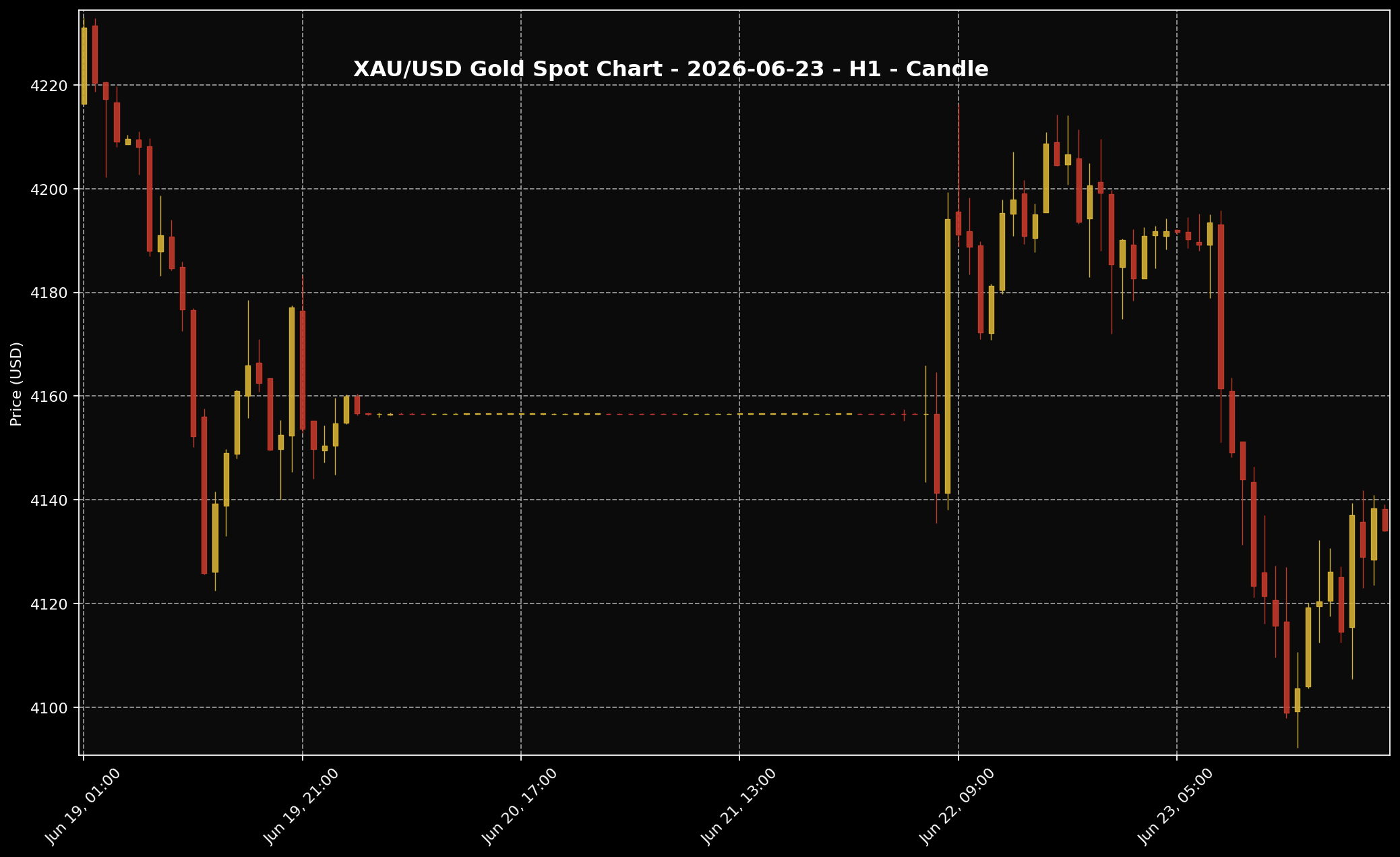 This chart shows the XAU/USD movement for the 23 June 2026 market session. Sifu Gold uses it as a visual reference, not a cue to buy emotionally.
1. By the final approved snapshot for the market date, gold was around USD4,138.35 per troy ounce. Broken down further, that was about USD133.05 per gram. Using USD/MYR around 4.14031, the global spot equivalent came to roughly RM17,134.06 per troy ounce, or around RM550.87 per gram.
2. But the main point was not the closing figure on its own. During the session, gold had earlier traded in a higher zone near USD4,195.86 before dropping towards about USD4,092.16. Later in the day, it managed to recover part of that fall.
3. So this was not a clean bullish session. It was not a full collapse either. The more accurate reading is that gold came under pressure first, then clawed back part of the loss into the close.
2. What Is The Gold Chart Showing?
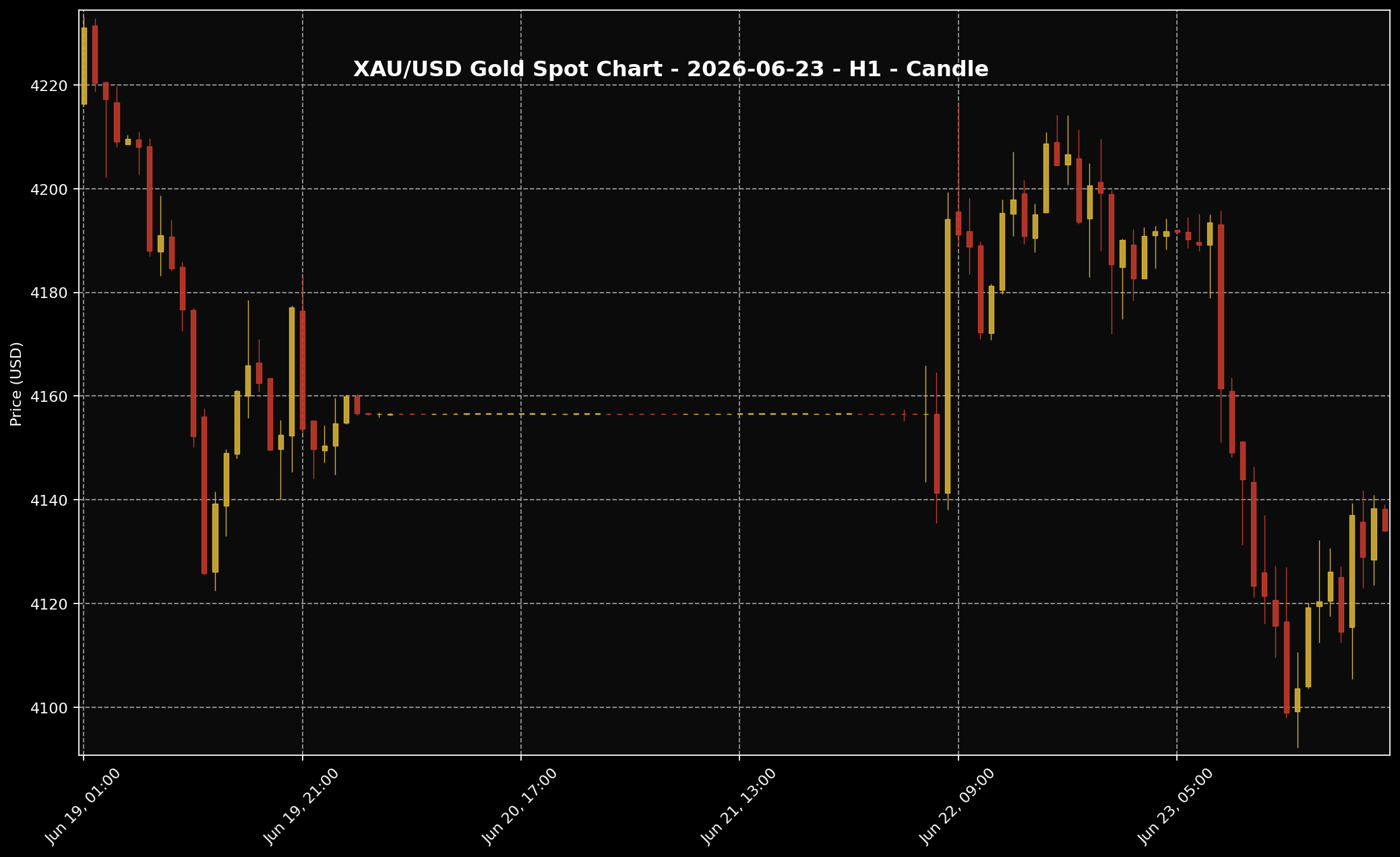 This chart helps readers see the gold price structure for the 23 June 2026 market session. It is used as market context, not as a trading signal.
1. If we keep the H1 chart reading simple, the structure was fairly clear. Gold looked firmer early in the session. It was holding in a higher area and, at that stage, the market did not yet look badly damaged.
2. Then selling pressure became much more obvious around the middle of the day. Price moved sharply away from the earlier high zone, which is why this session reads more like a day of real pressure rather than normal small intraday noise.
3. Later on, gold did bounce from the daily low. That rebound mattered because it showed buyers were still willing to step in after the sell-off. In other words, price did not stay pinned at the worst level into the close.
3. Why Did Gold Move This Way?
 The US dollar is often one of the key factors influencing gold prices. When the dollar is firmer, gold can face more noticeable pressure.
1. The main trigger on 23 June 2026 was a stronger US dollar together with firmer expectations that the Federal Reserve could keep policy tighter for longer. Reuters recovered through MarketScreener showed the US dollar at a more-than-one-year high during the session, so the pressure on gold clearly had a macro driver behind it.
2. The reason is straightforward. Gold does not pay yield. So when markets think higher rates may stick around for longer, interest-bearing assets can start to look more attractive in the short term. That does not mean gold loses its role completely, but it does mean momentum can weaken for a while.
3. There was also a macro data angle behind the move. US flash S&P Global Composite PMI for June was reported at 52.2, up from 51.5 in May and above the 50.8 forecast. Reuters added another layer by showing that December hike odds had risen to around 86%, up from 61% before the previous Fed meeting. That combination suggested the US economy still had resilience and that markets were becoming less relaxed about the rate outlook.
4. What Does This Mean For Malaysian Gold Savers?
 For Malaysian gold savers, the key point is not only whether prices rise or fall. What matters more is budget, discipline and a clear purpose.
1. For Malaysian readers, the key lesson is not to look at XAU/USD alone. What matters more is how that global move feels once it passes through the Ringgit. On the approved snapshot, the translated global spot reference was around RM550.87 per gram.
2. That gives a useful Malaysia-facing picture, but it should not be mistaken for the exact price of local physical gold. Local pricing is also influenced by the exchange rate, product premium, buy-sell spread, and local pricing structure. So even if spot gold drops or rebounds in one session, the local effect may not move in exactly the same way.
3. This is why some people feel confused when they see world gold soften but local prices still look high. The answer is that Malaysian buyers are dealing with two layers at the same time: the global gold move and the currency translation underneath it.
5. What Practical Action Makes More Sense?
 When gold prices move quickly, better decisions usually come from disciplined planning, not panic reactions.
1. If you are a medium- or long-term gold saver, a session like this is usually more useful as a reminder about discipline than as a cue to react to one candle or one headline.
2. If your monthly budget already includes room for gold saving, gradual accumulation still makes more sense than trying to guess the perfect bottom. You do not need to commit the full budget at once simply because price has already pulled back from the day’s higher levels.
3. If your budget is tight, there is no need to force anything. Check your cash flow first. Make sure emergency savings are not disturbed. When the market is still sensitive to the US dollar and rate expectations, the more sensible move is to follow your own plan rather than chase the emotion of one volatile session.
6. Conclusion
On 23 June 2026, gold was pressured by a firmer US dollar and tighter Fed expectations before recovering part of the move from the session low. Reuters recovered through MarketScreener also showed that this pressure happened while the dollar was at a more-than-one-year high and markets were repricing the rates outlook in a more hawkish direction. That rebound showed the market had not given up on gold completely, but it was still not strong enough to rewrite the main story of the day. For Malaysian gold savers, the more useful response is not to overreact to the late bounce. It is to understand the difference between global spot gold and local physical pricing, check the Ringgit angle properly, and keep any next step tied to budget, cash flow, and gradual saving discipline.