

Ok, today we can see that gold moved quite quickly. It fell during the session, then tried to recover towards the USD4,480 per troy ounce area. So today’s story is not simply “gold went up” or “gold went down”. The market was trying to digest several things at the same time: U.S.-Iran geopolitical headlines, oil-inflation risk and mixed US economic data.
For Malaysian gold savers, a day like this can easily feel confusing. When the price falls, some people become afraid to buy. When the price recovers, others become afraid of missing out. That is why, in my view, the most important thing today is not to decide based on emotion. Understand why the price is moving first, then follow your own budget.
- What Happened To Gold Prices Today?
- Why Did Gold Move Like This?
- What Does This Mean For Malaysian Gold Savers?
- What Is The More Practical Response?
- Conclusion
What Happened To Gold Prices Today?
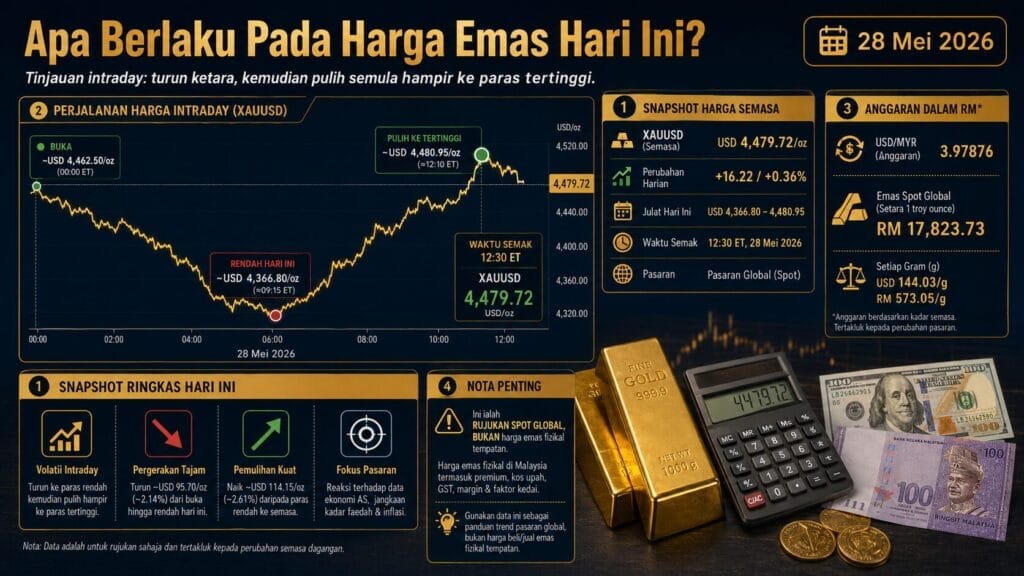
At around 11:30 PM Malaysia time on 28 May 2026, XAUUSD was around USD4,479.72 per troy ounce. Based on the Stooq snapshot, gold opened around USD4,462.50, fell as low as about USD4,366.80, then recovered close to the daily high area around USD4,480.95.
In simple terms, gold lost momentum earlier in the session, but buyers came back in after the market assessed geopolitical headlines and US economic data. This means the early drop did not continue as a straight move lower. The market was still looking for clearer direction.
Using USD/MYR around 3.97876, the global spot estimate works out to roughly RM17,823.73 per troy ounce. In gram terms, that is around USD144.03/g or RM573.05/g. This calculation uses the standard formula of 1 troy ounce = 31.1035 grams.
It is important to remember that this is the global spot price. It is not the same as Malaysian physical gold pricing or Public Gold pricing. Local physical gold can be different because of USD/MYR, premium, buy-sell spread, product cost, logistics and local pricing references.
Why Did Gold Move Like This?
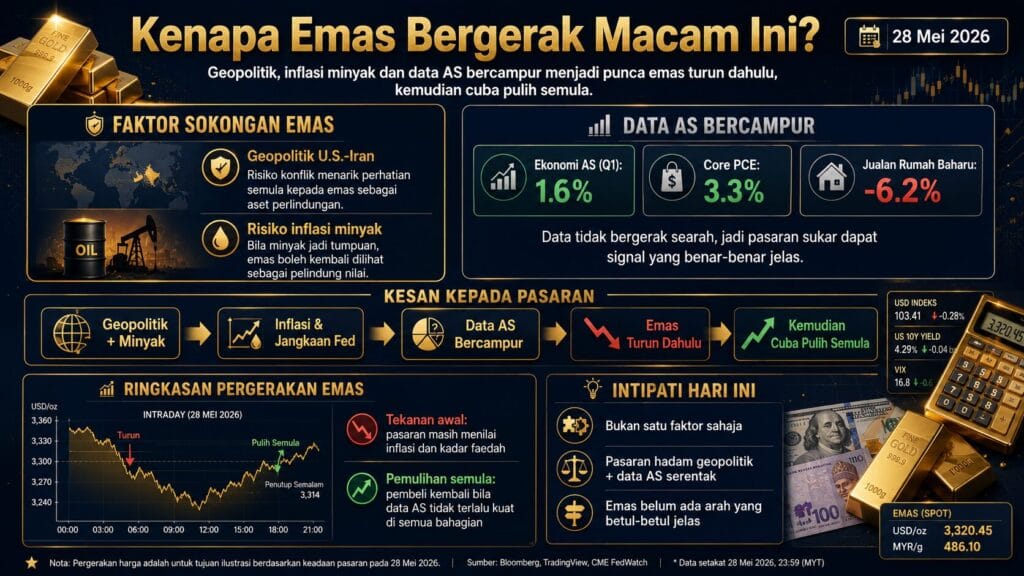
The easiest way to understand today’s move is this. When geopolitical headlines such as U.S.-Iran tension and oil-inflation risk appear, gold can get attention again. Some investors look at gold as a safer asset when markets start to worry about conflict, oil prices and inflation.
At the same time, US economic data was mixed. Kitco reported that the US economy grew 1.6% in the first quarter, while core PCE rose 3.3%. Core PCE matters because it is one of the inflation measures watched by the market when thinking about the Federal Reserve. If inflation still looks high, the market may believe the Fed cannot cut interest rates too quickly.
But not all US data looked strong. US new home sales fell 6.2% in April. Data like this can make the market feel that the US economy is not strong in every area. When confidence in the economy cools slightly, early pressure on gold can also ease.
That is why gold fell first, then pared its losses and tried to recover. Today’s story was not driven by only one factor. It was a mix of geopolitics, inflation, interest-rate expectations and economic data that did not all point in the same direction.
What Does This Mean For Malaysian Gold Savers?
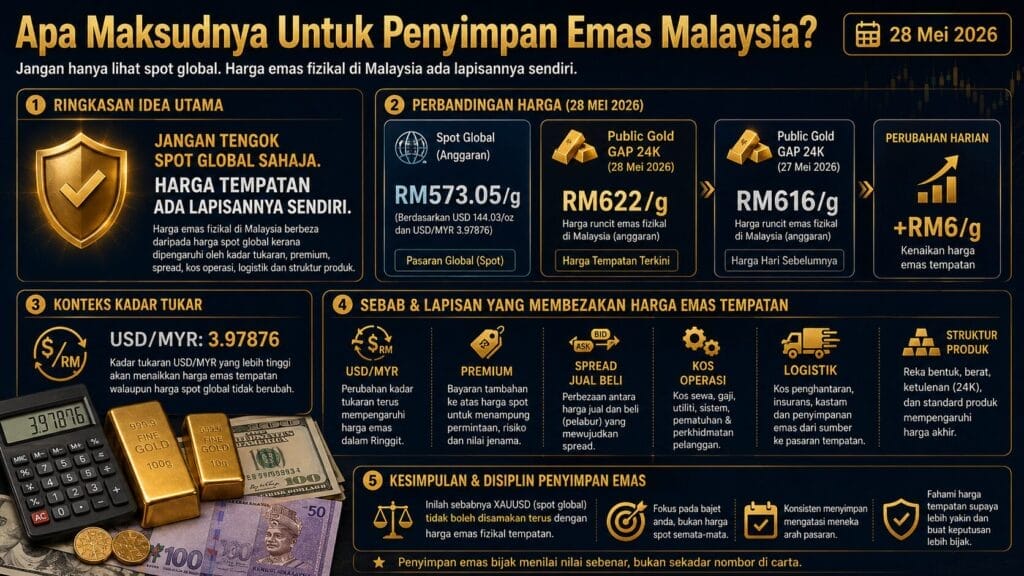
For Malaysian gold savers, do not look at the global spot price alone. The world gold price matters, but the price we see locally can move differently because of USD/MYR. When the Ringgit moves against the US dollar, Malaysian gold prices can be affected even when the global spot movement looks small.
For a local reference that is closer to the real experience of Malaysian buyers, the Public Gold GAP 24K reading on 28 May 2026 was around RM622 for 1 gram. On 27 May 2026, the GAP 24K reference was around RM616 for 1 gram. That means the latest local reference was higher by about RM6/g compared with 27 May 2026.
This is a simple reminder that XAUUSD and local physical gold prices are not the same thing. The estimated global spot reference of around RM573.05/g is not the same as the GAP 24K reference of around RM622/g because local pricing still includes USD/MYR, physical gold premiums, buy-sell spreads, operating costs, logistics and product structure.
In my view, a day like this is a good discipline test. When prices move quickly, many people feel afraid of missing out or afraid that the price may fall again. But if we are saving gold for the long term, the main focus is not guessing tomorrow’s price. The main focus is budget, consistency and saving little by little.
What Is The More Practical Response?

If you already have the budget and your intention is long-term gold saving, the calmer approach is to buy gradually. You do not need to wait for the perfect bottom. You also do not need to put everything in just because the price is moving.
If your budget is tight this month, do not force yourself. Keep your cash first, settle important commitments, then continue when your finances are more comfortable. Gold should help us build discipline, not create pressure on our monthly cash flow.
For me, the key message today is not to decide based on emotion. When the market moves quickly, we go back to the basics: buy according to ability, split purchases into smaller portions, and remember that physical gold is better viewed as long-term saving, not a place to chase quick profit.
Conclusion
So, for 28 May 2026, the main gold story is that the price fell earlier but managed to recover as the market assessed geopolitical risk, oil-inflation concerns and mixed US data. At the same time, inflation and Fed interest-rate expectations remain important factors to watch.
For us as gold savers in Malaysia, do not treat today’s movement as a buy or sell signal. Treat it as a reminder to organise your strategy. If you can afford it, save gradually according to your budget. If you cannot afford it yet, wait calmly. Small, consistent saving can build up over time.
If you want to start in a more structured way, Public Gold GAP can be one option because you can begin from RM100. But as always, follow your own budget and do not decide based on emotion.