

What happened to gold on 30 June 2026? It tried to hold near USD4,000, and that did bring in some buying interest. But the session still did not turn into a clean recovery. The bigger market mood remained cautious. A hawkish Fed backdrop was still weighing on sentiment, US labour data still looked resilient, and the US dollar plus Treasury yields were still limiting how far gold could climb. For Malaysian gold savers, this was a useful reminder that the story is not just about the dollar price, but also about what that move looks like once it is translated into Ringgit.
- Introduction
- What Happened To Gold On 30 June 2026?
- What Is The Gold Chart Showing?
- Why Did Gold Move This Way?
- What Does This Mean For Malaysian Gold Savers?
- What Practical Action Makes More Sense?
- Conclusion
What Happened To Gold On 30 June 2026?
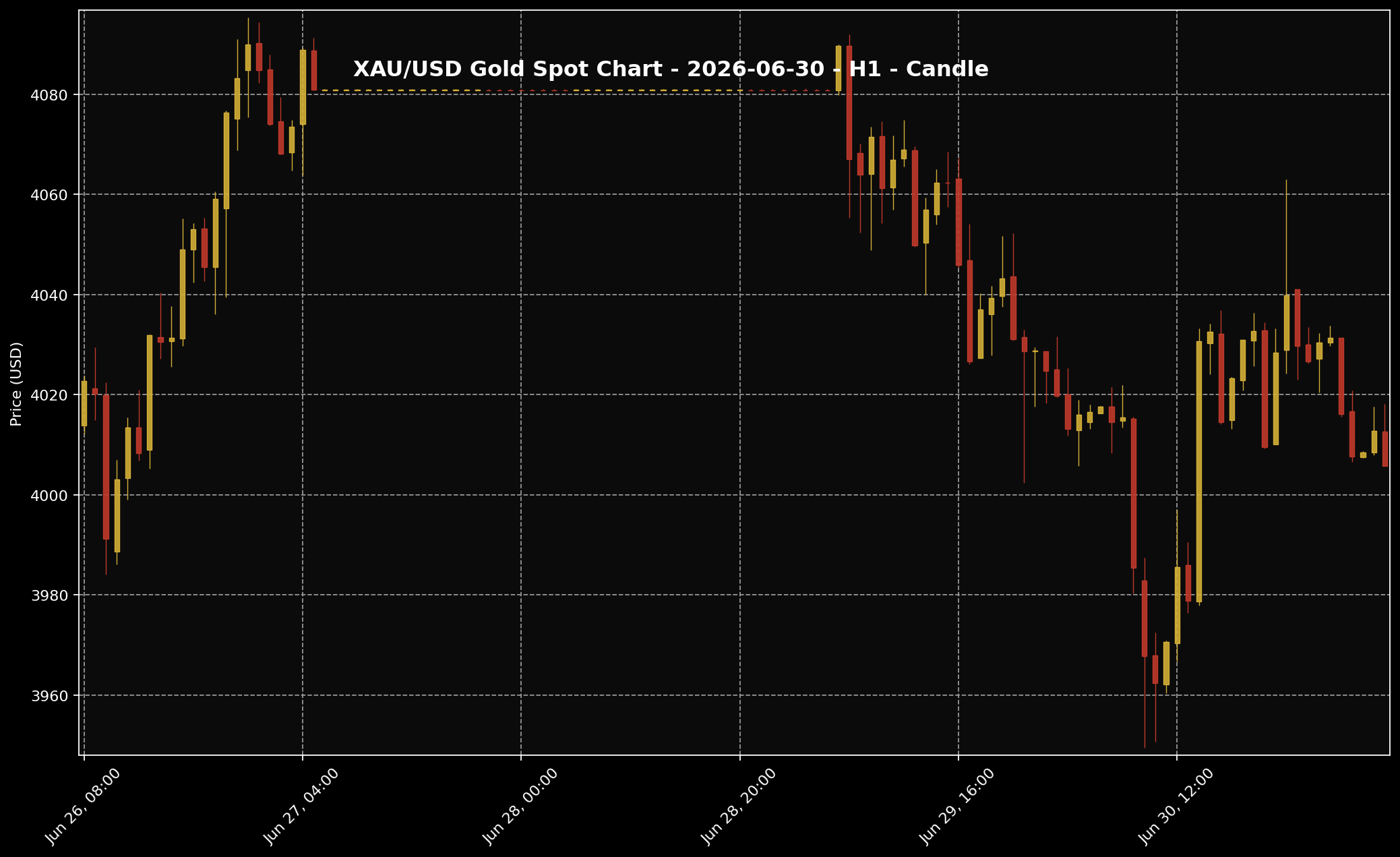 This chart shows the XAU/USD movement for the 30 June 2026 market session. Sifu Gold uses it as a visual reference, not a cue to buy emotionally.
1. Gold did not break down on 30 June 2026, but it did not produce a convincing recovery either. Kitco’s daily coverage showed that gold managed to attract a modest bid, especially as price stayed close to the important USD4,000 area. Even so, that support still looked fragile because the wider market had not really shifted in gold’s favour.
2. By the final approved snapshot for the session, gold was around USD4,029.70 per troy ounce. That works out to roughly USD129.56 per gram. With USD/MYR around 4.08336 at the same point, the global spot conversion came to about RM16,454.71 per troy ounce, or roughly RM529.03 per gram.
3. That Ringgit translation matters, but one thing must stay clear. These are global spot gold figures converted into Malaysian currency. They are not the same as local physical retail gold prices in Malaysia. So this was a useful market reference, not a direct one-to-one guide to the actual price local buyers would pay for physical gold.
What Is The Gold Chart Showing?
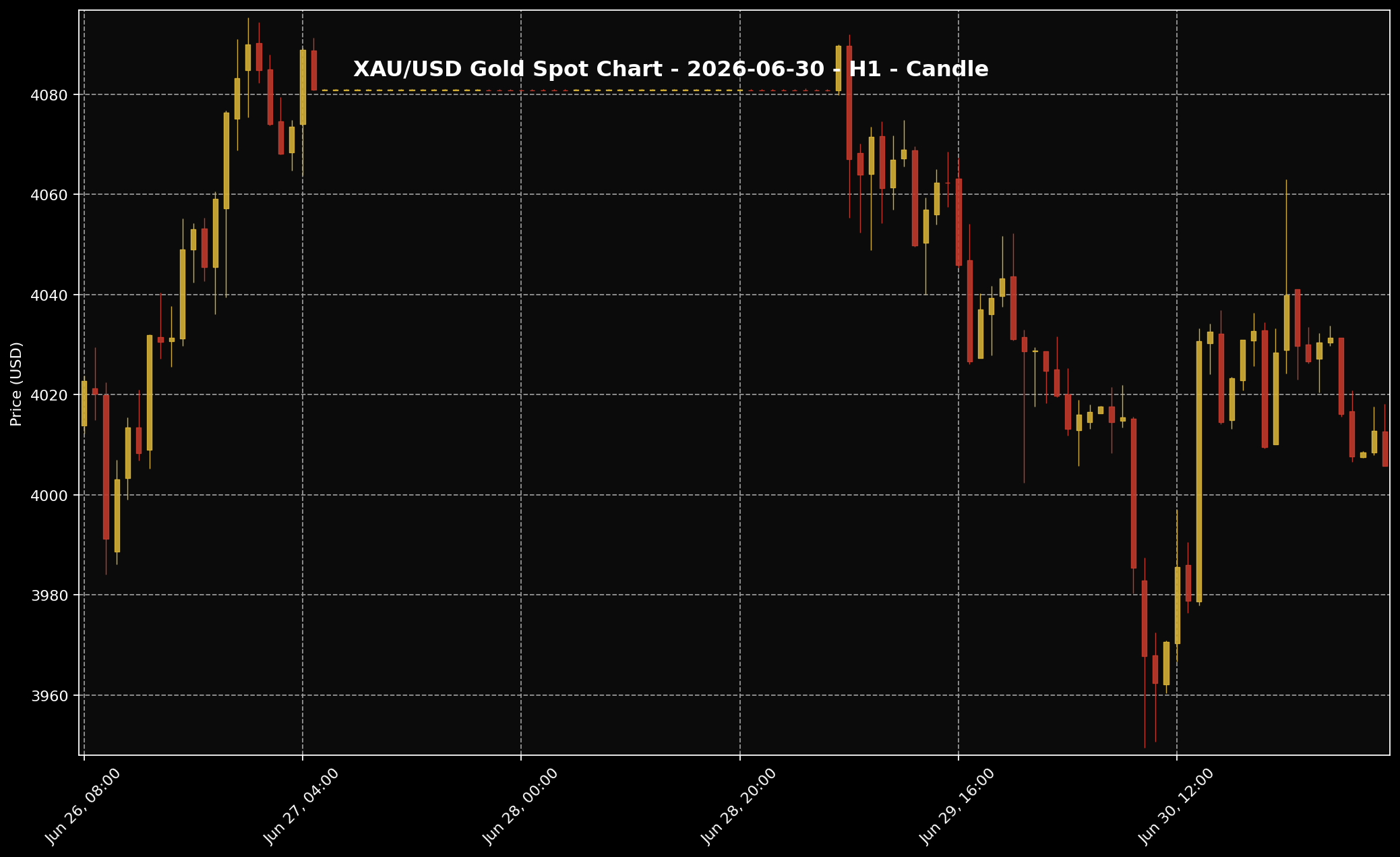 This chart helps readers see the gold price structure for the 30 June 2026 market session. It is used as market context, not as a trading signal.
1. If we keep the chart reading light, the session looked rough rather than smooth. Earlier in the day, gold came under pressure first, then bounced back quite quickly. That tells us buyers were still willing to step in when price moved closer to an important support area.
2. But once gold moved back into a higher zone, that strength did not hold for long. The late-session structure showed gold failing to stay above the USD4,040 area, and the final H1 candle closed below its open. In simple terms, there was an attempt to recover, but the market still met selling pressure fairly quickly once price pushed higher.
3. So the chart was not signalling panic, but it was not confirming a fresh upside phase either. The safer reading is that gold was still trying to stabilise, while the broader tone remained mixed with a slightly softer bias by the close.
Why Did Gold Move This Way?
 The US dollar is often one of the key factors influencing gold prices. When the dollar is firmer, gold can face more noticeable pressure.
1. The clearest reason still comes back to the Fed story. The Reuters-linked direction for the day remained consistent at headline level: gold was still being weighed down by a hawkish Fed backdrop, with end-of-month and end-of-quarter pressure still hanging over the market. Put simply, when traders still believe US interest rates may stay higher for longer, gold usually struggles to build stronger upside momentum.
2. Kitco added the next important layer. Gold did attract some buying interest, but the US dollar and Treasury yields were still firm enough to cap that move. That matters because a stronger dollar can make gold less appealing for many buyers, while higher yields raise the opportunity cost of holding an asset that does not pay income.
3. US labour data also helped shape the mood. The JOLTS reading suggested the labour market was still holding up reasonably well. That made it harder for the market to expect a quick policy shift from the Fed. So even though gold tried to hold and attract fresh buying, the bigger macro pressure had not really stepped aside.
What Does This Mean For Malaysian Gold Savers?
 For Malaysian gold savers, the key point is not only whether prices rise or fall. What matters more is budget, discipline and a clear purpose.
1. For Malaysian gold savers, the main lesson is not just whether gold finished a little higher or lower on the day. The more useful point is that global gold still looks expensive once translated into Ringgit. A global spot reading near RM529.03 per gram is still a high level in local currency terms, even if the session itself did not produce a dramatic breakout.
2. But this is where readers need to separate global spot pricing from local physical pricing. Physical gold in Malaysia can still look different because of product premiums, buy-sell spreads, product type, operating costs, and movements in USD/MYR itself. So when gold appears to be holding steady in US dollar terms, the local experience can still feel quite different.
3. That is why a session like this is better used to build market awareness. Gold still has a long-term role for many savers, but its short-term movement is still heavily influenced by the Fed, the US dollar, and bond yields. When readers understand that clearly, they are less likely to react emotionally to one trading session.
What Practical Action Makes More Sense?
 When gold prices move quickly, better decisions usually come from disciplined planning, not panic reactions.
1. If you already have a proper gold-saving plan, the more sensible approach is still to stay with that plan. Review your monthly budget, be realistic about what you can afford, and continue buying gradually if that has been your method from the start. There is nothing in this session that clearly says one day’s move has suddenly changed the bigger story.
2. If you are still new to gold saving, this is a better time to slow down and understand the pricing properly first. Compare the global spot picture with the actual physical price you would be paying in Malaysia. That usually gives a much better decision framework than trying to guess whether tomorrow’s price will be slightly higher or slightly lower.
3. If your budget is limited, do not go in heavily all at once. Smaller and more consistent purchases are often more realistic for everyday savers. It may feel less exciting, but for most people, discipline and repeatability matter more than trying to catch the perfect timing.
Conclusion
In short, 30 June 2026 showed gold trying to hold near USD4,000, but the wider pressure from a hawkish Fed backdrop, resilient US labour data, and still-firm US dollar and Treasury yields had not gone away. For Malaysian gold savers, the practical takeaway is simple: do not look at the US dollar price alone. Look at the Ringgit translation as well, understand why local physical pricing can differ, and make decisions based on budget, consistency, and a saving plan you can actually maintain.