

If we look at gold on 7 June 2026, the price barely moved. But that does not mean everything was fine again. Gold was still sitting near its lower area because the market was still trying to absorb the earlier stronger US jobs data. For Malaysian gold savers, that is the real point to watch. Sometimes the more useful lesson is not a dramatic move, but what gold still cannot do after a big round of pressure.
- Introduction
- What Happened To Gold On 7 June 2026?
- What Is The Gold Chart Showing?
- Why Did Gold Move This Way?
- What Does This Mean For Malaysian Gold Savers?
- What Practical Action Makes More Sense?
- Conclusion
What Happened To Gold On 7 June 2026?
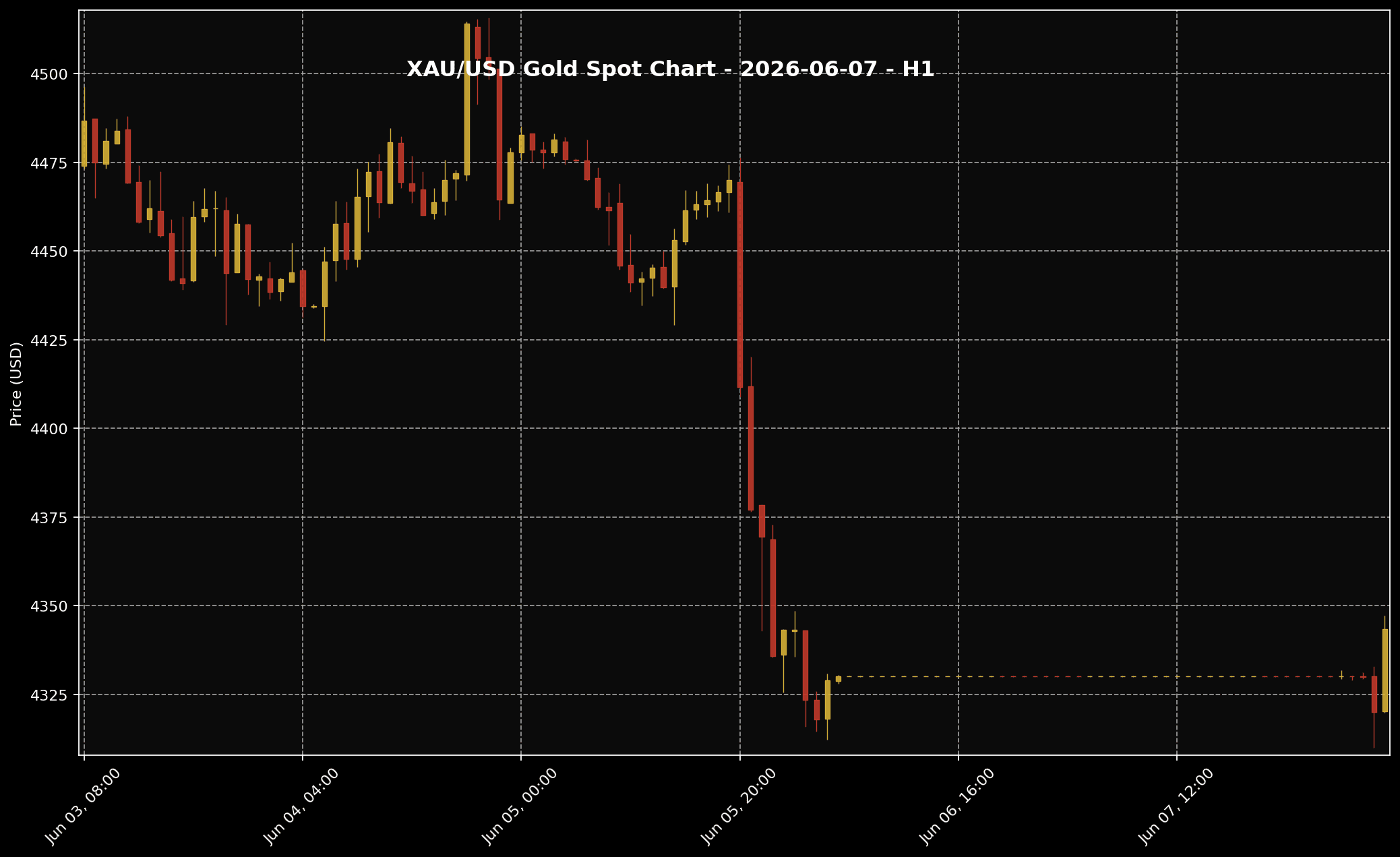 This chart shows the XAU/USD movement for the 7 June 2026 market session. Sifu Gold uses it as a visual reference, not a cue to buy emotionally.
1. At the final market-date snapshot for 7 June 2026, spot gold was around USD4330.07 per troy ounce. Using USD/MYR at about 4.02907 at the same snapshot point, that works out to roughly RM17446.16 per troy ounce. Broken down further, that is around USD139.22 per gram, or about RM560.91 per gram.
2. If we focus on the session itself, the range was very tight, only about USD4330.04 to USD4330.30. In simple terms, gold did not continue falling sharply, but it also did not look strong enough to stage a proper rebound. So the market was still stuck near its lower area.
3. That is why 7 June makes more sense as a sideways session near the lower zone, not a proper recovery session. It is also worth keeping one thing clear: this is the global spot price, not the same as local physical gold pricing in Malaysia. Local prices can look different because of USD/MYR, premiums, spreads, product type and other local cost factors.
What Is The Gold Chart Showing?
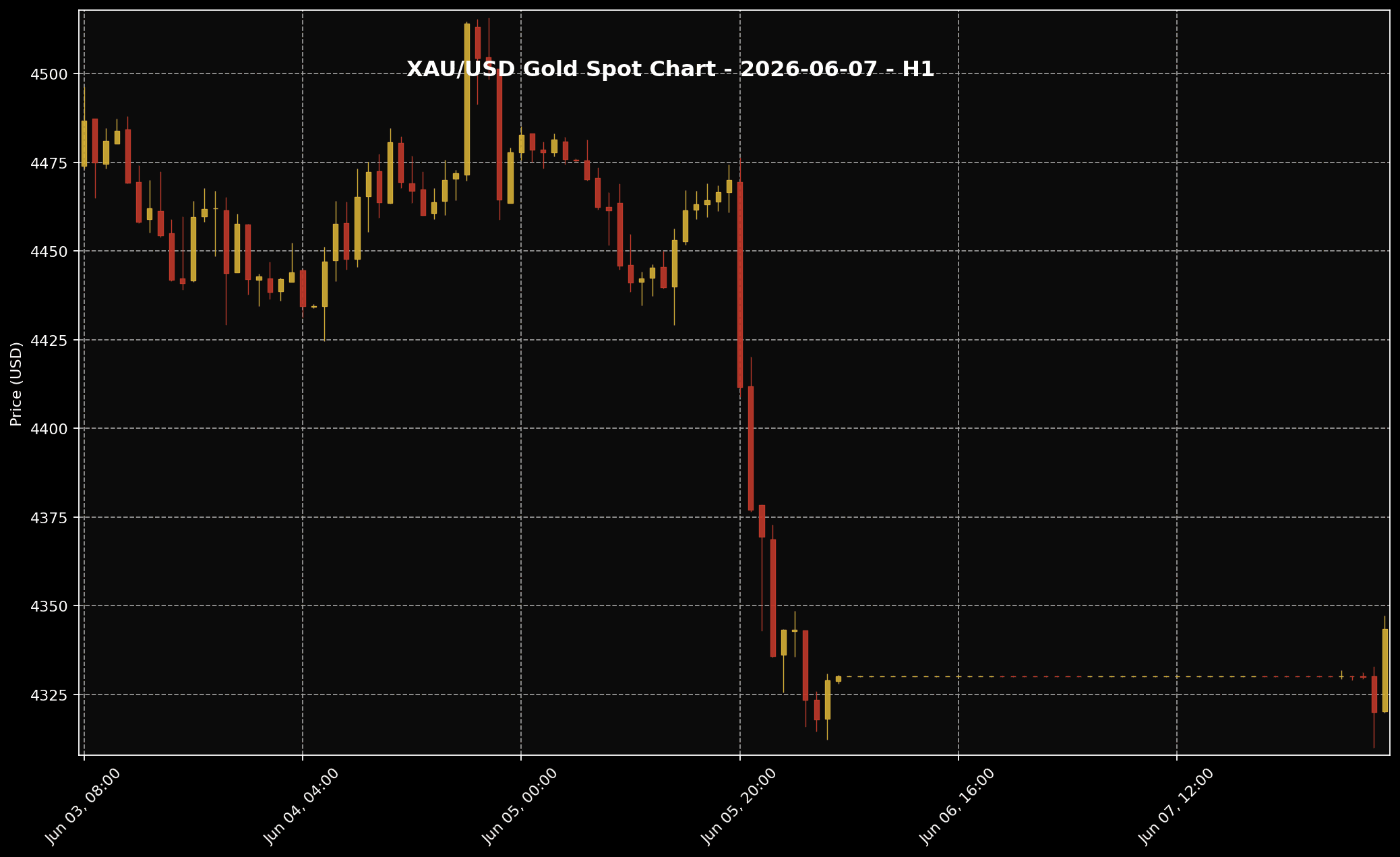 This chart helps readers see the gold price structure for the 7 June 2026 market session. It is used as market context, not as a trading signal.
1. If we look at the H1 chart, the clearest picture is that gold was still under pressure after the earlier sharper drop. By the later part of the chart, price was just hovering around the USD4330 area, so momentum looked limited rather than strong.
2. Put simply, the chart shows three things. First, gold had already sold off quite hard before flattening out. Second, the rebound afterwards was still shallow. Third, the USD4330 area still looked like a zone where price was trying to hold, but the small bounces towards USD4330.20 to USD4330.30 still looked weak.
3. So for now, the chart still does not show a proper recovery. It looks more like the market is resting near the lower zone while waiting for the next trigger. This is chart reading for context only, not a buy or sell call.
Why Did Gold Move This Way?
 The US dollar is often one of the key factors influencing gold prices. When the dollar is firmer, gold can face more noticeable pressure.
1. The main reason was not a fresh major catalyst on 7 June itself. The better way to read it is that the market was still digesting the stronger US jobs data from the earlier session. When US labour data comes in stronger than expected, the market often takes that as a sign that the US economy still has enough resilience for interest rates to stay higher for longer.
2. Once that higher-for-longer story stays in the market, two things usually happen. The US dollar tends to stay supported, and gold finds it harder to recover because it does not pay interest. So even though there was no big new surprise on 7 June itself, the earlier pressure still had not gone away.
3. That is why this session did not look like a real comeback. Gold was no longer falling hard, but it still did not have enough strength to climb properly. In plain English, the market still had no strong reason to push gold clearly higher again after the earlier macro pressure.
What Does This Mean For Malaysian Gold Savers?
 For Malaysian gold savers, the key point is not only whether prices rise or fall. What matters more is budget, discipline and a clear purpose.
1. For Malaysian gold savers, the key point is not simply whether gold moved a little or a lot that day. The bigger message is that the global market still had not shown a properly clear recovery. So this was not the kind of session to treat as proof that all the pressure had already disappeared.
2. At the same time, local buyers still need to separate global spot gold from local physical pricing. As a local reference, Public Gold GAP 24K was around RM610 per gram on 7 June 2026, compared with RM611 per gram on 6 June 2026. That means the day-to-day local change was only about RM1 per gram lower.
3. That matters because a big global narrative does not always turn into an equally dramatic local price move on the same day. If someone only looks at overseas headlines without understanding USD/MYR, local pricing structure and physical-gold spreads, it becomes very easy to overreact or read the situation wrongly.
What Practical Action Makes More Sense?
 When gold prices move quickly, better decisions usually come from disciplined planning, not panic reactions.
1. In my view, a session like this is better used as a reminder about discipline than as a reason to rush into a big decision. When gold is still sitting near the lower area but has not shown a proper recovery, the more sensible step is to review your savings goal, monthly budget and current cash-flow position first.
2. If you already have a regular gold-saving budget, a gradual approach can still make sense because you are not relying on one single price point. If this month feels tight, there is no need to force a move just because global gold still looks weak. Protecting your own cash flow still matters more than reacting to every market headline.
3. One more thing matters here: do not go in heavily all at once just because the price looks lower than before. In a market that still has not shown a clear recovery structure, steadier planning is usually safer than emotional decisions made from one day’s price action.
Conclusion
So yes, gold looked almost flat on 7 June 2026, but the more important message was that the market was still holding near its weaker zone after the earlier strong US jobs-data shock. For Malaysian gold savers, the practical lesson is not to jump to a dramatic conclusion from one quiet day. It is to understand the difference between global spot pricing and local physical pricing, stay aware of budget limits and keep decisions structured. If you want to start in a more organised way, Public Gold GAP can be an option because you can begin from RM100, but it still needs to fit your own budget first.