

If we look back at 9 June 2026, the main story in gold was not just that the price moved lower. The bigger issue was that the market still seemed uneasy about US interest rates staying higher for longer ahead of US inflation data, and that made gold’s rebound attempt look far less convincing. For Sifu Gold readers in Malaysia, this matters because it helps us separate short-term market emotion from the more important question: how should we respond with discipline when gold is still being pushed around by the US dollar, bond yields and macro expectations?
- Introduction
- What Happened To Gold On 9 June 2026?
- What Is The Gold Chart Showing?
- Why Did Gold Move This Way?
- What Does This Mean For Malaysian Gold Savers?
- What Practical Action Makes More Sense?
- Conclusion
What Happened To Gold On 9 June 2026?
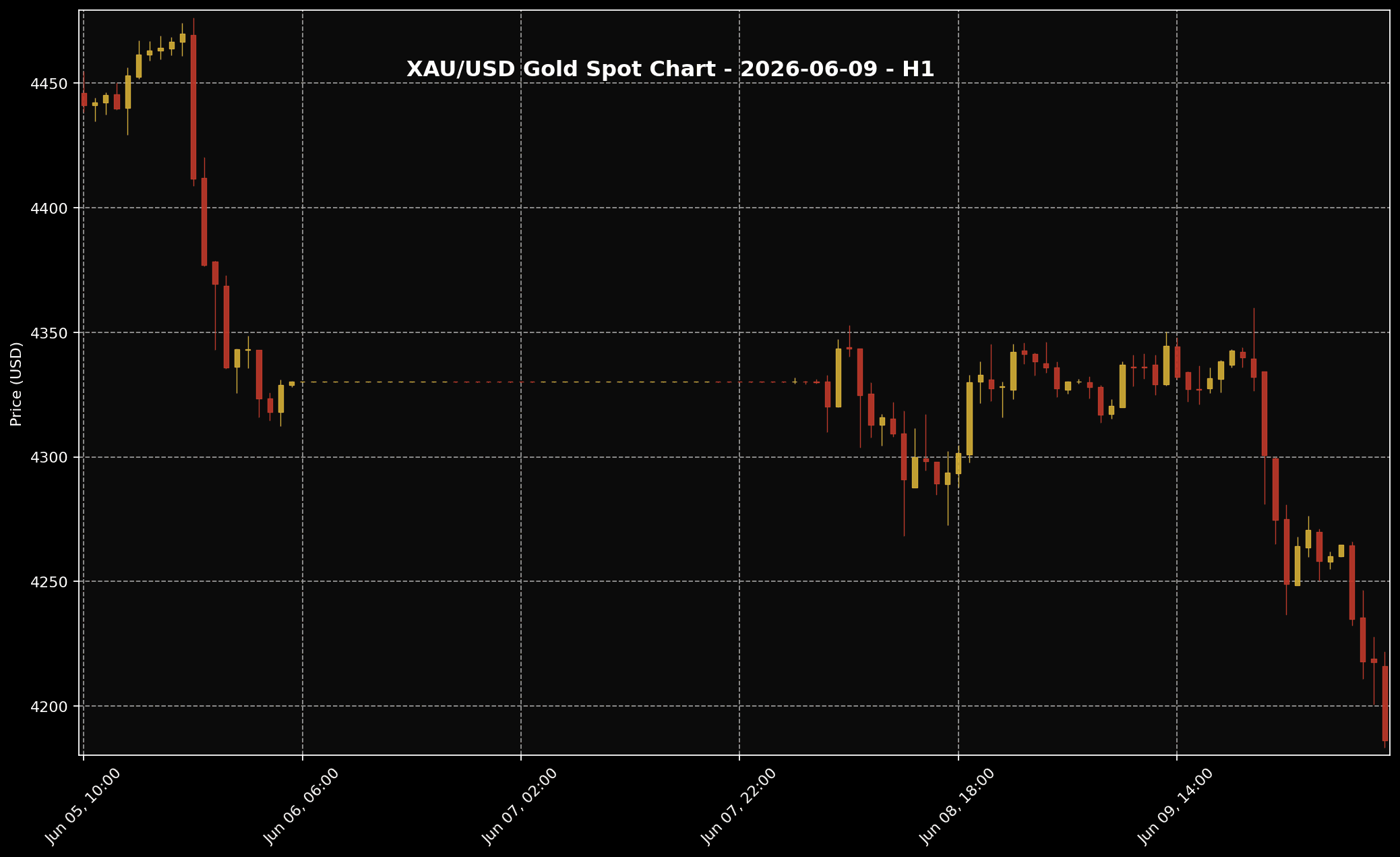 This chart shows the XAU/USD movement for the 9 June 2026 market session. Sifu Gold uses it as a visual reference, not a cue to buy emotionally.
1. On 9 June 2026, global gold still looked under pressure rather than comfortably recovered. Based on the approved market-date snapshot from the final H1 candle of the session, at the review time of around 11:00 PM Malaysia time, XAU/USD was around USD 4,274.74 per troy ounce.
2. Using USD/MYR at around 4.06202, that worked out to roughly RM 17,364.07 per troy ounce. Broken down into grams, global gold was around USD 137.44 per gram, or about RM 558.27 per gram.
3. It is important to say this clearly from the start: these are global spot figures, not local physical gold prices in Malaysia. They are useful for understanding the direction of the world market, but they are not the same thing as the price people see when buying physical gold locally. So even though the simple headline is that gold slipped, the more useful reading is this: the market tried to steady itself, but by the end of the session buyers still had not done enough to show that the earlier pressure had truly faded.
What Is The Gold Chart Showing?
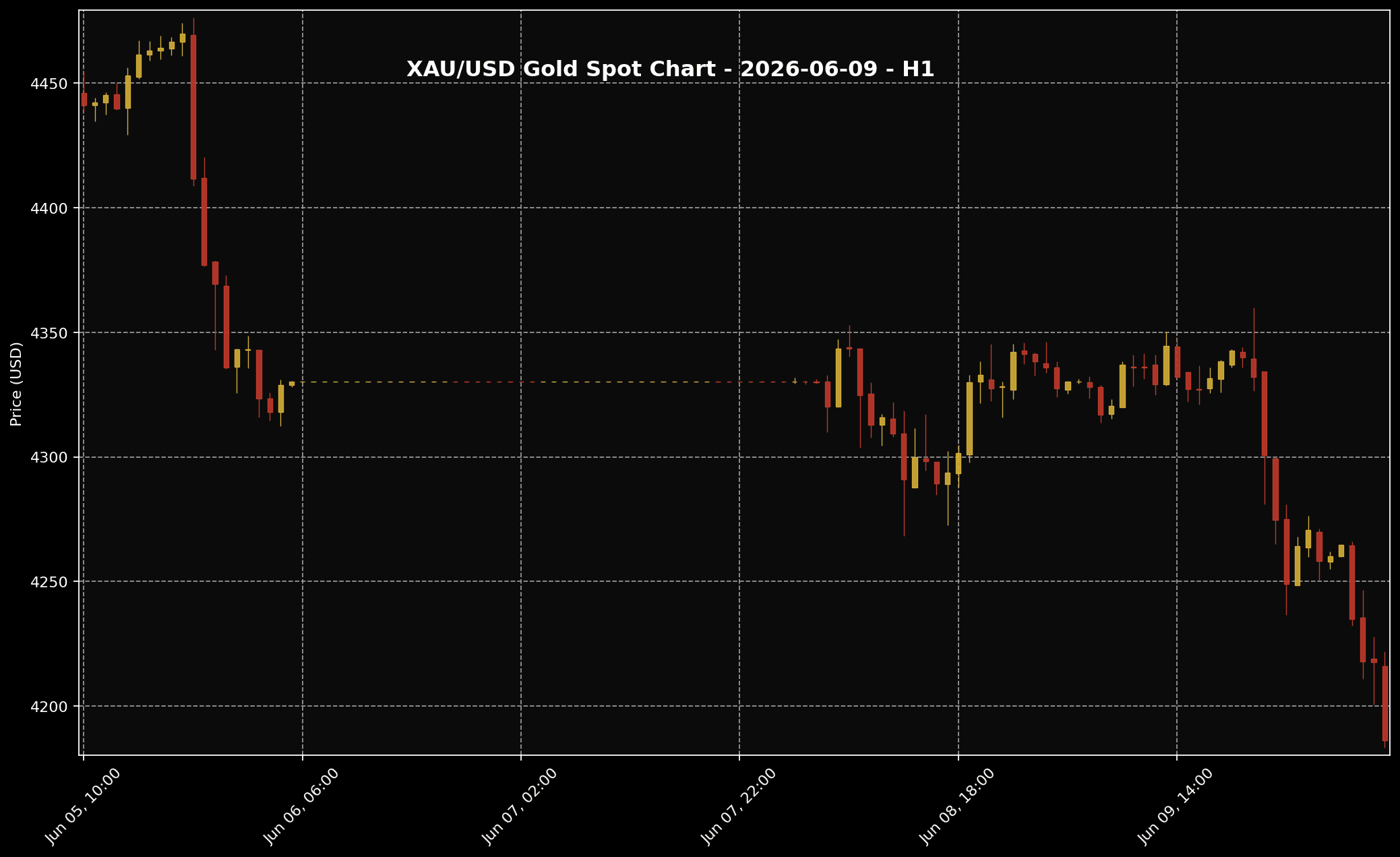 This chart helps readers see the gold price structure for the 9 June 2026 market session. It is used as market context, not as a trading signal.
1. If we read the H1 chart in a simple way, the short-term structure still looked weak. The wider chart already showed that gold had fallen sharply from much higher levels earlier, and the rebound phase that followed never really rebuilt strong momentum.
2. During the 9 June session itself, gold made several attempts to hold around the USD 4,330 to USD 4,345 area. That zone looked like an area where the market was trying to stabilise, but the support did not hold firmly enough. The rebound effort looked fragile rather than confident.
3. Later in the session, price pressure returned, gold slipped back below the psychological USD 4,300 area, and the market ended close to the weaker end of the daily range. That does not mean a trading instruction, and it should not be read that way. It simply shows that the market structure had still not turned convincingly stronger by the close. In plain English, the chart was showing a failed rebound rather than a healthy recovery. Gold was still trying to find its footing, but the pressure remained more obvious than the strength.
Why Did Gold Move This Way?
 The US dollar is often one of the key factors influencing gold prices. When the dollar is firmer, gold can face more noticeable pressure.
1. The story here is actually quite straightforward. The market was moving into US inflation data while still worried that US interest rates could stay high for longer. When that concern remains in place, the US dollar usually stays supported, and bond yields also tend to remain relevant. That combination often makes life harder for gold.
2. Why does that matter? Because gold does not generate an income stream in the way yield-bearing assets do. So when the market believes interest rates may stay elevated, some money continues to favour the dollar and US government debt instead of moving more confidently into gold.
3. That is why 9 June should not be framed as just a chart-only move. The chart weakness was more of a confirmation of the broader macro mood. The deeper issue was that the market had not yet become comfortable with the idea of easier US policy, especially with inflation data still ahead. In simple terms, gold was trying to recover, but the higher-rate narrative was still getting in the way. That is what kept the session defensive and stopped the rebound from looking convincing.
What Does This Mean For Malaysian Gold Savers?
 For Malaysian gold savers, the key point is not only whether prices rise or fall. What matters more is budget, discipline and a clear purpose.
1. For Malaysian gold savers, the key point is not only that global gold had a weak day. The more important lesson is understanding why it was weak, because that helps us judge whether this is ordinary short-term noise or part of a bigger macro story.
2. In this case, USD/MYR at around 4.06202 also matters. When the US dollar stays relatively firm, the impact on local gold pricing does not always match the move in global spot gold one-for-one. That is why some people feel confused when world gold prices fall, but local physical prices do not seem to drop by exactly the same amount.
3. That difference is normal. Local physical gold pricing in Malaysia also reflects exchange rates, product premiums, buy-sell spreads, operating costs and the local pricing structure used by sellers. So it is not practical to look at XAU/USD alone and assume that local physical prices will copy it directly. In my view, a session like this is more useful as an education moment than a panic moment. It reminds us that if the global market is still being driven by US inflation expectations and interest-rate concerns, local gold savers should pay attention to the bigger picture rather than react emotionally to a single day.
What Practical Action Makes More Sense?
 When gold prices move quickly, better decisions usually come from disciplined planning, not panic reactions.
1. If you are saving gold for the long term, the more sensible approach is usually not to chase every daily move. A better starting point is to review your savings purpose, your monthly budget and whether your buying plan is still realistic for your current cash flow.
2. If your monthly gold budget is already planned properly, buying gradually can still make sense because it is easier to sustain and easier to manage emotionally. It also reduces the pressure of trying to guess the perfect day to buy.
3. If this month feels tighter, there is no need to force anything. When the market is still sensitive to US inflation expectations and interest-rate narratives, sentiment can change quickly. In that kind of environment, it is usually healthier not to commit the full budget at once just because the market has pulled back a little. For me, the practical takeaway is simple: stay disciplined, understand the difference between global spot prices and local physical prices, and make your gold-saving decisions based on a clear plan rather than short-term emotion. Small, consistent action is usually easier to defend than one rushed big decision.
Conclusion
In summary, 9 June 2026 showed that gold was still in a cautious and pressured environment because the market remained worried that US interest rates could stay high ahead of inflation data. The chart supported that story as well, with rebound attempts failing to change the short-term structure in a convincing way. For Malaysian gold savers, the main message is not to overreact to one weak session. The more useful response is to understand what is driving the market, keep your expectations realistic, and organise your next step around budget and discipline rather than fear of missing out. If you still want to build your gold savings in a structured way, Public Gold GAP can be one option because you can start from RM100. But as always, the decision should follow your own budget, your own priorities and a plan you can maintain consistently.